What happened
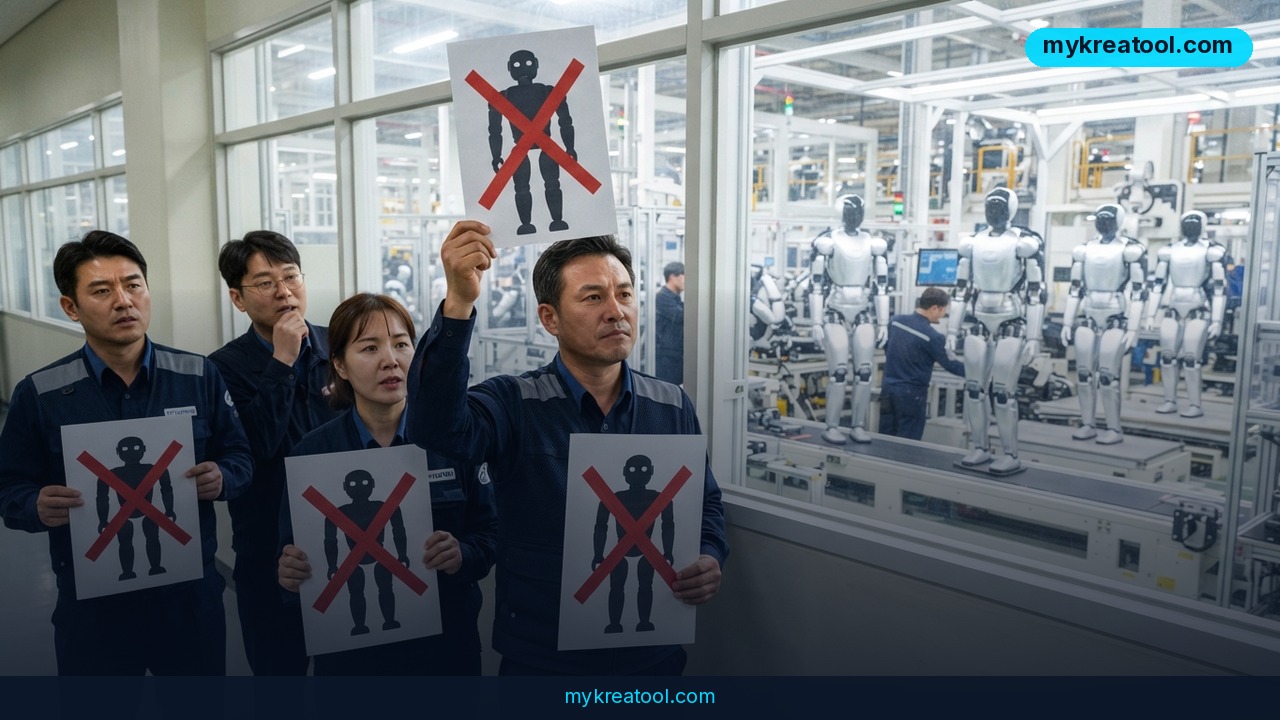
Humanoid robots in factories just triggered the auto industry's first labor strike over the technology. Thousands of unionized Hyundai workers at the automaker's massive Ulsan complex in South Korea walked off their shifts two hours early from July 13 through July 15, after 15 rounds of negotiations with management collapsed. The union representing more than 39,000 workers has announced follow-up four-hour strikes scheduled for July 20 through 22.
The dispute centers on Hyundai's plan to deploy more than 25,000 Atlas humanoid robots across its Hyundai and Kia manufacturing plants. Atlas is built by Boston Dynamics, the US robotics firm that is becoming a wholly owned Hyundai subsidiary. The robot stands over 6 feet tall, can lift more than 100 pounds, and made headlines earlier this year when Hyundai unveiled its latest version — the moment that set this standoff in motion.
The union's demands
Rather than blocking automation outright, the Hyundai Motor union is demanding structural protections: converting hourly production wages to a fixed salary so automation can't quietly cut paid hours, raising the retirement age from 60 to 65, and securing larger worker bonuses. It's a negotiating stance that treats robots as inevitable and focuses on softening the landing for human employees.
Why it matters
This isn't a one-off local dispute — it's a preview of how labor and automation will collide industry-wide. Hyundai plans to start deploying Atlas at its US factories in 2028, with no confirmed timeline yet for other regions, but the economics are already stark. Each Atlas robot costs an estimated $130,000, and according to Samsung Securities analyst Esther Yim, it could pay for itself within about two years of operation.
The numbers get more alarming from there. Macquarie Securities Korea analyst James Hong noted that if robot costs fall to around $100,000, the effective operational cost per robot could drop below the US federal minimum wage of $7.25 an hour — undercutting a typical auto worker's salary by a wide margin. That's the calculation driving Hyundai's union to negotiate now, before the robots arrive at scale.
Not just a Hyundai problem
Hyundai is far from alone. Tesla is building its own Optimus humanoid robot for EV production lines. BMW has been piloting humanoid robots from Figure AI at its Spartanburg, South Carolina plant. Chinese EV giant BYD and other automakers are testing or developing similar systems. The automotive industry has led industrial robot adoption for decades — more than 1 million robots were already working in car factories worldwide by 2021, a third of all industrial robots globally. The US alone had 38,000 industrial robots deployed by 2025, with 13,500 of them in automotive plants specifically. Humanoid robots are simply the next, more flexible generation of that trend.
How to use it today
Most entrepreneurs and small business owners won't be buying a $130,000 humanoid robot anytime soon, but the underlying shift matters to anyone running a business: AI-driven automation is getting cheaper and more capable every year, and the businesses that adapt early tend to capture the upside instead of just absorbing the disruption. Unlike traditional industrial robots, which are typically built for one repetitive task, humanoid robots are being marketed as general-purpose workers that can slot into environments designed for humans — a much bigger claim, and one still years from being proven at scale.
For marketers, creators, and small teams, the practical takeaway isn't buying hardware — it's testing automated workflows now, on a small scale, before competitors do. If you want to experiment with AI-powered automation for your own content, marketing, or operations without a six-figure commitment, the free AI tools at mykreatool.com are a low-risk way to see what task automation can realistically do for a business today, whether that's drafting content, generating creative assets, or streamlining repetitive workflows.
What to watch next
Keep an eye on Hyundai's 2028 US rollout and how other automakers respond to the strike outcome. If Hyundai's union wins fixed salaries and stronger retirement protections, expect similar demands from labor groups at Tesla, BMW, and other manufacturers piloting humanoid robots.
Who benefits
Manufacturers stand to gain the most in the near term — Hyundai, Boston Dynamics, and robotics suppliers benefit from lower long-term labor costs and 24/7 production capacity that doesn't require breaks, benefits, or overtime pay. Robotics investors and analysts like those at Samsung Securities and Macquarie are already modeling the payback period, which suggests the business case is solid enough to move forward regardless of labor pushback.
Workers in specialized, supervisory, or robot-maintenance roles could also benefit, since deploying thousands of humanoid robots creates new jobs in programming, monitoring, and repair — though these roles require different skills than traditional assembly-line work. Small businesses and creators benefit indirectly: as automation tools mature and costs fall, similar AI capabilities filter down into affordable software and services well before humanoid robots become common outside heavy industry.
Risks
The most immediate risk is job displacement at scale. With 25,000 Atlas robots planned and unit costs potentially undercutting minimum wage, production workers have legitimate grounds for concern, which is exactly why Hyundai's union escalated to strike action after 15 failed negotiation rounds.
There's also technical risk: humanoid robots capable of handling a wide variety of tasks in human-designed workspaces are still an unproven vision. Multiple challenges in AI training and hardware reliability remain unresolved before robots like Atlas can work fully autonomously. Hyundai's own test case — starting deployment at its Metaplant America facility — will be an early signal of whether the technology matches the hype. For businesses watching this trend, the risk isn't just automation itself, but moving too slowly and being caught off guard by how fast the economics can shift once robot costs fall below $100,000 per unit.
Conclusion
The Hyundai strike marks a turning point: humanoid robots have moved from science-fiction pilot projects to a direct threat labor unions are now organizing against. With 25,000 robots planned, a two-year payback period, and operational costs that could soon undercut minimum wage, the pressure on manufacturing jobs is no longer theoretical. Whether you run a factory floor or a five-person startup, the lesson is the same: automation economics are changing fast, and the businesses testing AI tools today will be far better positioned than those waiting for the technology to arrive at their doorstep.

Comments 0