What Happened
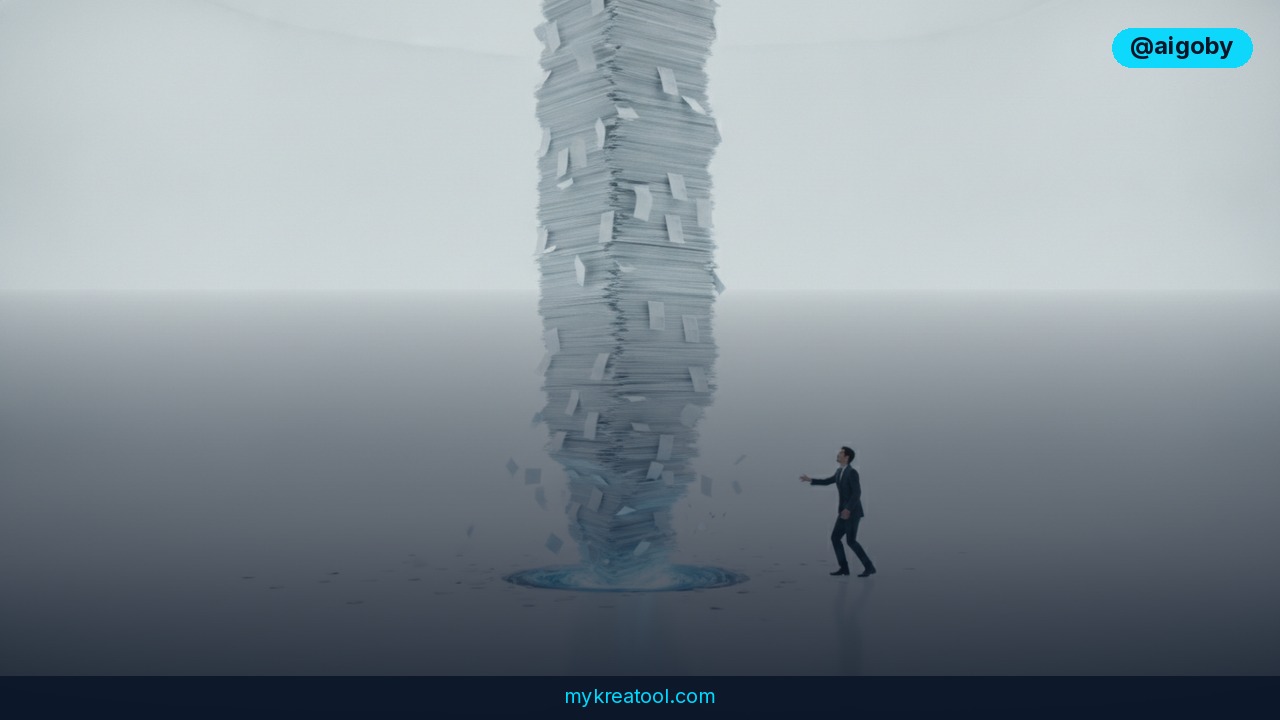
AI compressed a 2-month data-shuffling task into just one week — and that single example may tell us more about the future of work than any corporate white paper ever could. Anthropic co-founder Jack Clark recently went on record with a remarkably candid story: Anthropic helped the makers of Ozempic, the blockbuster weight-loss drug, sort through mountains of clinical trial data. A process that would normally consume two full months of human labor was completed in roughly seven days.
Clark didn't dress it up in buzzwords. He said plainly that nobody is mourning the loss of that work. His exact words: "I don't think anyone misses that… no one is crying at their desk because they can't be the best back-office paper shuffler."
That's a striking admission from someone at the top of one of the world's leading AI companies. It's also a concrete, real-world data point — not a hypothetical — about what AI is doing to workflows right now, in 2025.
Why It Matters
The Ozempic data example isn't just a fun anecdote. It's a signal about where AI is delivering its first and most measurable ROI: the elimination of high-volume, low-creativity, repetitive tasks.
Clinical trial data management is notoriously tedious. It involves sorting, cross-referencing, and validating thousands of data points across regulatory formats. Historically, that work requires teams of specialists working for weeks or months. Compressing it to one week doesn't just save time — it potentially accelerates drug development timelines, reduces costs, and frees skilled researchers to focus on interpretation and decision-making rather than data wrangling.
The Burnout Connection
There's a well-documented link between repetitive, low-autonomy tasks and workplace burnout. When Clark says "no one misses" the paper shuffling, he's pointing at something real: a large portion of knowledge work is genuinely soul-crushing. Administrative overhead, manual data entry, report formatting, and compliance paperwork are consistently ranked among the most draining parts of professional life. AI isn't replacing human judgment here — it's absorbing the friction that wears people down.
How to Use It Today
You don't need to be Novo Nordisk (the maker of Ozempic) to apply this principle. The same logic scales down to solo entrepreneurs, small marketing teams, and individual creators.
Start by auditing your own week. Write down every task you completed in the last five working days. Then mark anything that felt robotic — tasks where you were essentially moving information from one place to another, reformatting data, writing templated responses, or manually compiling reports. That list is your AI opportunity map.
Practical Starting Points
For marketers, AI tools can now handle first-draft content creation, keyword clustering, campaign reporting summaries, and social media scheduling — tasks that used to eat 30–40% of a marketing coordinator's week.
For entrepreneurs, AI can compress research cycles dramatically. Competitor analysis, market sizing, customer feedback synthesis — work that once took days can now take hours.
For creators, AI handles transcription, repurposing content across formats, generating thumbnail concepts, and drafting email newsletters from raw notes.
If you're looking for a practical place to start experimenting, mykreatool.com offers a suite of free AI tools built specifically for entrepreneurs and creators — a low-barrier way to test what automation can actually do for your workflow before committing to paid platforms.
Who Benefits
The clearest immediate winners are knowledge workers whose jobs contain a high ratio of process-heavy tasks to creative or strategic ones. That includes:
• Healthcare and pharma teams dealing with regulatory data, as the Ozempic example shows
• Legal and compliance professionals who spend hours reviewing documents for standard clauses
• Financial analysts who build the same Excel models week after week
• Marketing operations teams running repetitive campaign setups
• Customer support departments handling high volumes of templated inquiries
The Leverage Effect for Small Teams
For small businesses and solo operators, the benefit is even more pronounced. A one-person marketing operation that previously couldn't afford to produce daily content, run weekly reports, AND manage client communication simultaneously can now — because AI absorbs the mechanical portions of each task. This is a genuine competitive leveling. A team of three using AI intelligently can now produce output that previously required a team of ten.
Risks
Clark's candor is refreshing, but the harder question is the one he didn't fully answer: will companies use AI-driven efficiency gains to improve working conditions, or will they use them as justification for layoffs?
History offers mixed signals. Automation has repeatedly created net new jobs over long time horizons — but the transition periods are painful, and they don't distribute pain evenly. Workers in data entry, administrative support, and back-office processing roles face the most immediate displacement risk. These are often not the highest-paid positions, and the workers filling them may have the least access to retraining resources.
The Accountability Gap
There's also a quality and oversight risk that gets less attention. When AI compresses a 2-month task into one week, someone still needs to verify the output. In clinical trials, an error in data sorting isn't just inefficient — it can be dangerous. The speed gains AI provides only hold up if organizations invest equally in human review processes. Cutting headcount while also cutting review time is a recipe for costly mistakes.
For entrepreneurs and marketers, the parallel risk is over-reliance: publishing AI-generated content without editing, sending AI-drafted emails without review, or making business decisions based on AI-synthesized research without sanity-checking the sources. Speed is only an advantage when accuracy is maintained.
Conclusion
The story of AI compressing a 2-month clinical data task into one week is more than a tech headline — it's a practical preview of how work is being restructured right now. The most immediate impact isn't robots replacing creative professionals; it's AI absorbing the repetitive, low-value tasks that drain time and energy across every industry.
For entrepreneurs, marketers, and creators, the opportunity is clear: audit your workflow, identify the mechanical tasks, and start delegating them to AI tools today. The competitive gap between those who do this and those who don't will widen quickly.
The risk is equally real — for workers in task-heavy roles, for organizations that skip human oversight, and for anyone who assumes that because a task is automated it no longer needs to be managed. AI is a powerful lever. Like any lever, the outcome depends entirely on who's operating it and what they're trying to build.



Comments 0