What happened
Since August 2, every piece of text generated by Claude has reportedly carried an invisible watermark, according to Anthropic's own announcement — and a growing number of users believe this Claude watermark is the reason the model has become noticeably harder to work with. Unlike older watermarking tricks, this one isn't a hidden Unicode character you can strip in a text editor, and it isn't metadata sitting next to the file. It's described as a statistical signal woven into the actual word choices and phrasing of the output — something that survives copy-paste and even light editing. Anthropic hasn't published the mechanism, any detector, or technical documentation. The company's statement reportedly acknowledges, at least partially, that the technique affects meaning, quality, and style.
The timing lines up with something else users have flagged loudly: Opus 5, Anthropic's flagship model and the top performer on published benchmarks, has become frustrating to use in practice. Long-time users say the two events — the watermark rollout and the perceived quality drop — appeared close enough together that a connection seems plausible, even though it remains unconfirmed.
The complaints, specifically
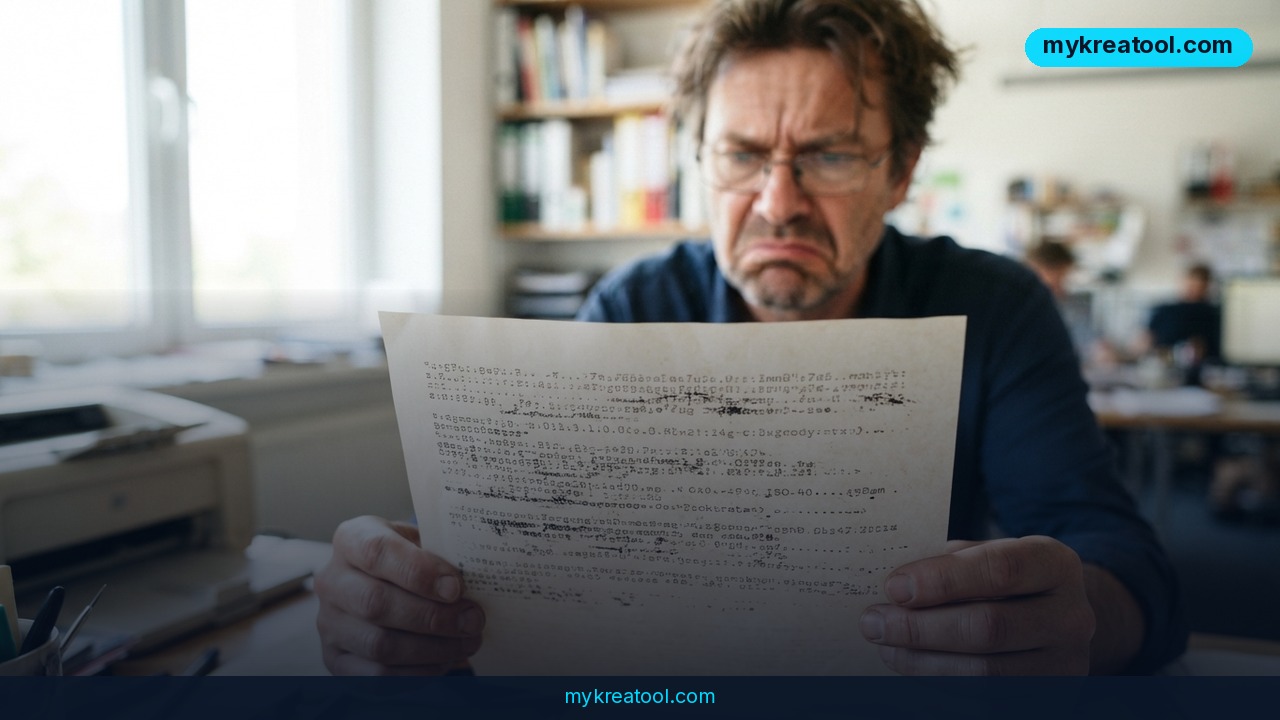
People aren't just complaining about longer responses. The core issue is that outputs stopped cohering into clear meaning. A task summary reads as a wall of technically correct sentences, yet it's unclear afterward what was actually done and what wasn't. Vocabulary skews toward rare words and inflated phrasing that signal effort without adding information. Ask the model to simplify an explanation, and the result often comes back denser and more tangled — not shorter or clearer. Instructions, custom prompts, and even project-level configuration files reportedly don't fix it reliably; tasks that used to take one pass now take five or more iterations to untangle.
Why it matters
If a watermarking layer is quietly reshaping word choice at scale, that's a meaningful shift for anyone relying on Claude for writing, technical documentation, or code explanations — not just a stylistic quirk. Watermarking AI text is a legitimate goal: it helps platforms, publishers, and educators flag AI-generated content and address concerns around plagiarism and misinformation. But if the tradeoff is measurably worse coherence, users need to know that a quality drop they're experiencing may not be a personal workflow problem or a prompting mistake — it may be a side effect of a system-level change they can't opt out of or inspect.
The degradation also isn't evenly distributed. Reports suggest it's worst inside Claude Code, noticeably milder in the desktop and mobile chat apps — despite all three running the same underlying model weights. That points to context composition, not just the model itself, as a driver of the problem.
A plausible explanation: context ratio
One working theory is about proportion. In a chat app, the AI-generated prose is nearly the entire context window. In Claude Code, a couple of paragraphs of user input and a short summary get surrounded by tens of thousands of tokens of diffs, stack traces, function names, and logs — real natural-language text becomes a rounding error against the code. If a watermarking pattern is layered onto word selection, and the context is 99% code, that statistical signature has far less room to blend in naturally, so the surrounding prose comes out denser, more jargon-heavy, and less conversational. Anecdotally, users report that responses get drier and more clipped the longer a Claude Code session runs, until reading the output costs more effort than doing the task manually.
How to use it today
Until Anthropic clarifies the mechanism, a few practical adjustments help right now. First, push back explicitly when a response is dense but unclear — ask Claude to restate the summary as a short bulleted list of concrete facts (what changed, what didn't, what's next) rather than asking for a vaguer "simpler explanation," which seems to trigger the same bloated pattern. Second, keep Claude Code sessions shorter and more focused; starting a fresh session for a new task appears to reset the drift some users describe. Third, for pure writing and explanation tasks — blog drafts, documentation, marketing copy — the desktop or mobile chat interface currently seems to produce cleaner prose than the CLI, so route writing-heavy work there instead of through a code-heavy agent session.
If you're testing outputs across tools or need a lightweight way to compare AI-generated drafts before publishing, a free resource like mykreatool.com can help you run quick checks and iterate without committing to a single workflow while the situation with Claude's output quality stabilizes.
Practical checklist
• Ask for structured, itemized summaries instead of prose recaps.
• Split long Claude Code sessions into smaller, single-purpose ones.
• Use chat apps for pure writing; reserve Claude Code for code-heavy tasks.
• Re-verify agent actions manually — several users note Opus 5 sometimes does more than asked in Claude Code.
Who benefits
Editors, content teams, and educators who need to detect AI-generated text stand to benefit most directly if the watermarking claim holds up, since it would make AI-authored content harder to disguise even after copy-editing. Compliance and academic-integrity teams have an obvious interest too. On the flip side, developers and technical writers who rely on Claude for fast, clear explanations are the ones absorbing the cost in the short term, at least until Anthropic tunes the tradeoff or ships a way to check whether a given output carries the mark.
Risks
The biggest risk is that this is still unconfirmed causation, not a documented fact — Anthropic has not published a technical breakdown linking the watermark to the writing-quality complaints, and the theory connecting the two comes from user observation, not from the company. Treat it as a working hypothesis. A second risk is opacity itself: with no detector or parameters released, users have no way to verify whether a given piece of text is watermarked, which makes it hard to separate a genuine model regression from watermarking side effects or from ordinary prompt and context issues. Teams that depend heavily on Claude Code for long, code-dense sessions should budget extra review time until the behavior stabilizes or Anthropic comments directly.
Conclusion
Whether or not Claude's invisible watermark is the actual cause, the practical reality for users right now is the same: Opus 5 output inside Claude Code reads worse than it did before August 2, and no prompt tweak has reliably fixed it. Until Anthropic publishes more detail, the safest move is to adapt your workflow — shorter sessions, structured summaries, and routing pure writing tasks to the chat interface — rather than waiting for an official explanation.


Comments 0