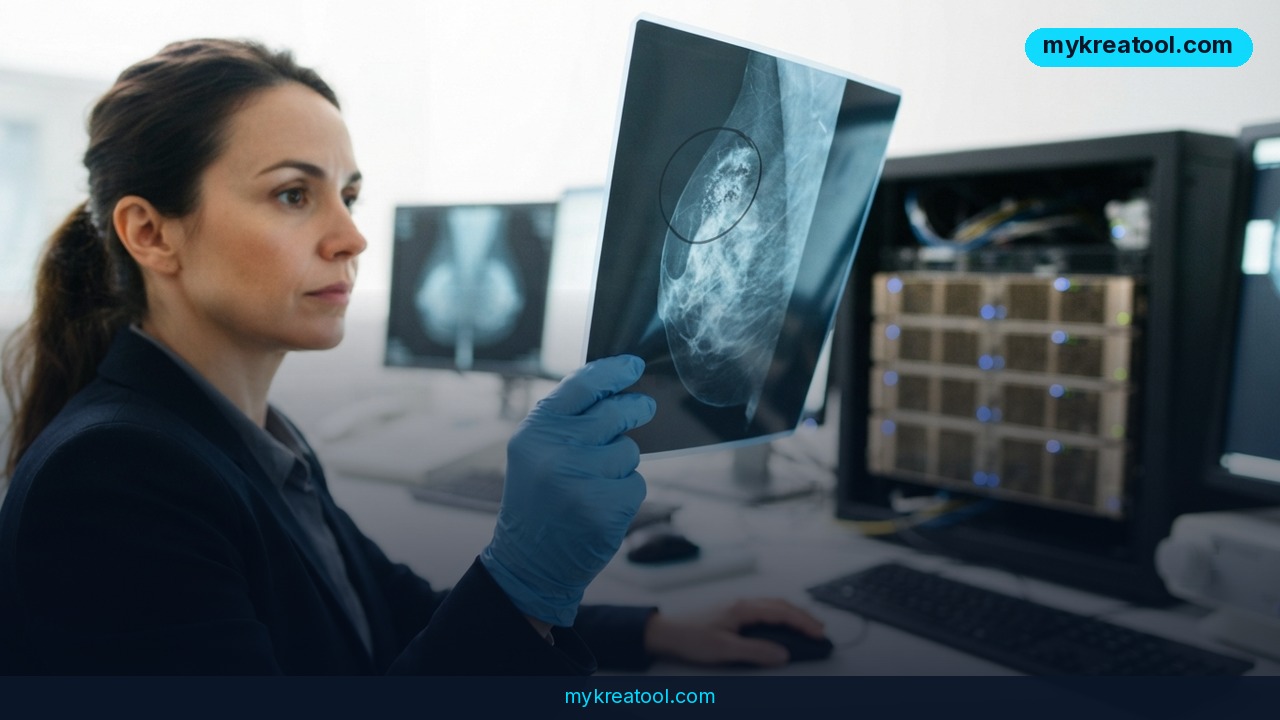
Roughly 40 million mammograms are performed in the U.S. every year, and there aren't enough radiologists to read them. AI breast cancer screening is the industry's answer to that squeeze — and the newest tools aren't just smarter software bolted onto the same old machines. They're changing how long a woman waits for an answer, and how far she has to travel to get one.
NVIDIA recently laid out the field in a blog post about its Inception program — an accelerator that gives startups access to NVIDIA's AI infrastructure. The companies inside it are attacking breast cancer care at three points where things jam up in real life: imaging, risk assessment and treatment planning. Here's what's actually shipping, minus the jargon.
What Happened: Wearable Scans, AI Readers and Weeks of Waiting
iSono Health's ATUSA scans a whole breast in about two minutes
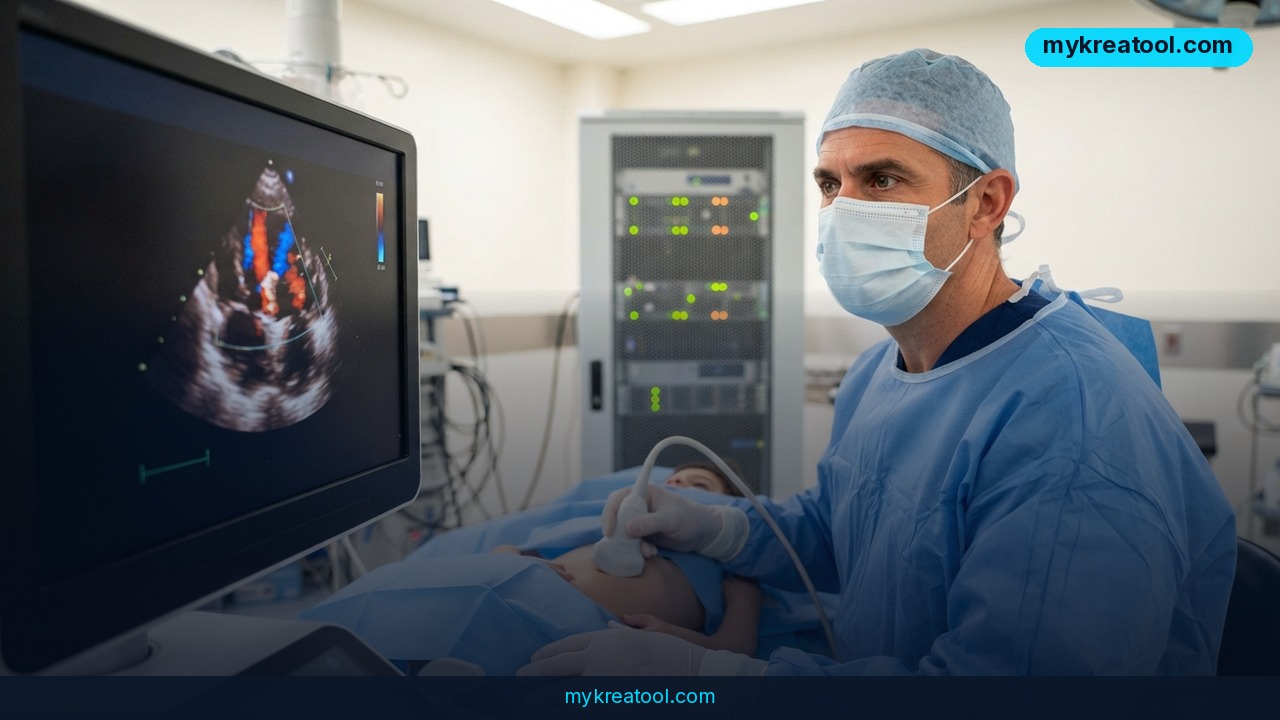
A mammogram is an X-ray of the breast. An ultrasound is a different kind of picture — it uses sound waves instead of radiation and shows tissue in a different light. Traditional breast ultrasound is a handheld job: a technician presses a probe against the breast and sweeps it around, hunting for anything suspicious. It works, but it's slow — up to 45 minutes — and it hinges entirely on who's holding the probe. Two technicians can produce two very different-looking scans, so a woman's images often can't be compared cleanly from one year to the next.
iSono Health's answer is ATUSA, an FDA-cleared platform the company calls a wearable, automated 3D quantitative ultrasound system. You wear it, and it captures a standardized view of the whole breast in roughly two minutes per breast, versus up to 45 minutes for the handheld version. The AI behind it learned from thousands of full-breast scans made up of more than 1.5 million ultrasound frames, and it runs on NVIDIA GPU acceleration plus open source medical imaging technology. According to iSono, the resulting 3D scan is 28% more sensitive than a handheld 2D ultrasound — a company figure, not an independently verified one.
Whiterabbit.ai goes after breast density and long-term risk
Whiterabbit.ai, another Inception startup, works the mammogram side of the problem. Its FDA-cleared WRDensity software scores breast density automatically from a mammogram, and the company says it has been used in the care of hundreds of thousands of patients. Density matters for a simple reason: dense tissue shows up white on an X-ray, and so do tumors. More white on the image means a cancer is easier to miss, and dense tissue also raises a woman's underlying risk. Whiterabbit also built WRRisk, clinical decision support software that estimates a patient's long-term chance of developing breast cancer, and it's researching a new generation of mammography AI aimed at helping radiologists catch more cancers while automatically clearing the scans that come back negative.
The bottleneck nobody talks about: the weeks after a diagnosis
There's a second jam further down the timeline. Once a diagnosis lands, treatment decisions often hinge on genomic assays — lab tests that read a tumor's genetic signals to work out which therapy is likely to help. Those tests get shipped off to outside labs, and results can take weeks to come back. Weeks is a long time to sit with a diagnosis and no plan.
The numbers driving all of this
About 40 million mammograms are done in the U.S. each year. Over the next decade, the projected shortfall of radiologists runs into the tens of thousands. On top of that, a majority of women over 40 skip the recommended annual screening — sometimes because of cost or scheduling, sometimes because there's simply no convenient place to go. Against that backdrop, iSono Health has a multicenter clinical study with 3,200 patients underway, with lead research sites at UC Davis and Vanderbilt University Medical Center. ATUSA is already commercially available through partner clinics in California, Texas, Georgia, Tennessee and Washington D.C., with new sites coming online regularly.
"Getting the scan closer to the patient is the first breakthrough," said Neda Razavi, CEO of iSono Health. "Our vision is to make that scan increasingly informative: helping clinicians see what is there, understand what has changed and make more informed decisions."
What It Means for You
You probably don't run a radiology department. That's fine — this still lands in ordinary life, just in different places.
At home: screening stops swallowing an afternoon
The gap between two minutes per breast and up to 45 minutes for a handheld scan isn't a rounding error. It's the difference between an appointment that fits into a lunch break and one that eats the whole day. And because ATUSA captures the entire breast the same way every time, your images become comparable year over year — closer to a photo booth that always snaps from the same angle than a portrait taken by a different person each visit.
At work: fewer radiologists, same pile of scans
Radiologists are reading more mammograms with fewer colleagues. Tools that auto-score density or clear out negative scans take the repetitive part off their plate and leave the judgment calls. That's the difference between a doctor skimming every page and a doctor reading the pages that actually matter.
If you run a clinic or a business
Automated capture cuts the variability that comes from operator technique, and variability is what generates repeat scans and wasted appointment slots. If your business touches imaging in any way, the pitch here is throughput: more patients per room, per tech, per day.
If you're studying medicine, engineering or design
The underlying skills — image segmentation (teaching software to outline a shape), lesion classification (sorting a spot into harmless or suspicious) and multimodal AI (combining ultrasound, mammography, MRI and clinical notes) — are exactly what iSono says it's building next. If you're learning this material, free AI tools like the ones at MyKreatool are a low-stakes way to get hands-on: summarizing dense papers, cleaning up study notes, or mocking up a concept long before you build it.
If you're a creator or a teacher
This is a story people genuinely want explained, and most of the coverage drowns in acronyms. A two-minute wearable scan and a 3,200-patient study are concrete hooks. If you make videos, newsletters or lesson plans, the explainer angle is wide open.
Where the income lands
The money follows whoever removes the wait. Screening is a volume business, and anything that shortens a scan, flags risk earlier or clears a negative result frees up capacity that clinics can bill for. Be skeptical of anyone quoting a specific paycheck from AI in medicine, though — the source here names no prices, and the earnings talk in this space is mostly speculation.
How to Try It Right Now
Step 1 — Free: ask for your density number
There's no cost to this one. Next time you're at your clinic, or on the phone with them, ask whether your mammograms are being scored for breast density and where you can see that number. It's the exact piece of information software like WRDensity produces automatically.
Step 2 — Check whether ATUSA is near you
The platform is commercially available through partner clinics in California, Texas, Georgia, Tennessee and Washington D.C., with new sites coming online regularly. If you live in one of those places and handheld ultrasound has always been a hassle, it's worth asking whether a partner clinic is within reach.
Step 3 — Ask about WRRisk
WRRisk estimates long-term risk of developing breast cancer. If you have a family history, that's a reasonable question to raise with your doctor: is risk-assessment software part of my file?
Step 4 — If you're a founder or clinician, look at NVIDIA Inception
Both iSono Health and Whiterabbit.ai are Inception companies, and the program is open to startups building AI applications. Access to AI infrastructure is the practical benefit.
Step 5 — Follow the clinical study
iSono Health's 3,200-patient multicenter study, with lead sites at UC Davis and Vanderbilt University Medical Center, is the number to watch. When those results land, you'll know whether the 28% sensitivity claim holds up outside the company's own testing.
Upsides and What Changes
Faster imaging is the obvious win. A scan that takes two minutes per breast instead of up to 45 minutes means more women can be seen with the same staff, and standardized capture means the pictures are actually comparable over time. Automated density scoring and risk estimation push information to the front of the process, where it can shape a screening plan instead of trailing behind it. And AI that clears negative mammograms could hand radiologists back the hours they currently spend on scans that turn out fine — time that goes straight into the harder reads.
Limitations
Be clear-eyed here. ATUSA, WRDensity and WRRisk are FDA-cleared, but clearance means a tool does what it claims to do safely — not that it has been proven to save lives. The 28% sensitivity figure comes from iSono Health itself, not from an independent lab, and the 3,200-patient study validating the platform is still running. Ultrasound and mammograms are different tools, so a faster ultrasound doesn't replace screening X-rays for everyone. Access is limited to partner clinics in five states plus Washington D.C., the genomic-assay wait at the treatment end of the timeline is untouched by any of this, and AI can't fix the biggest problem of all: a majority of women over 40 don't get screened in the first place.
Conclusion and One Action for Today
AI isn't about to replace your radiologist, and nothing here means you should skip a screening. What's changing is the math around speed and access: 40 million mammograms a year, a radiologist shortage measured in the tens of thousands, and tools that cut a 45-minute handheld scan down to about two minutes per breast. Today's action is small and it's free. Open your phone, find the number for your clinic, and ask one question: "Was my breast density recorded on my last mammogram?" That single call puts you on the front foot, whether or not AI is in the room.


Comments 0