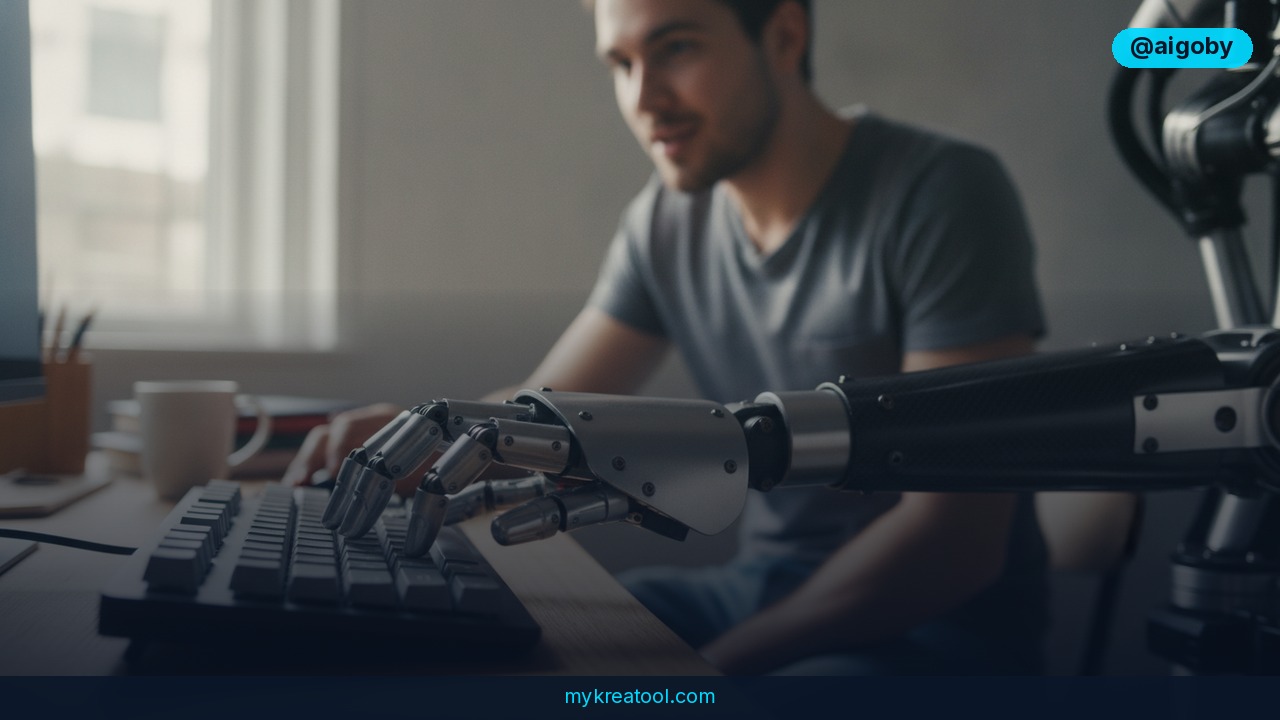
AI Is Torching the Junior Developer Job Market: Is Your Career at Risk?
Artificial intelligence is rapidly reshaping the labor market, and a recent discussion on Hacker News sounds the alarm: AI has already torched the market for junior programmers. Demand for junior developers has dropped by a shocking 70% in just six months, while the number of open positions has fallen threefold year over year. This isn't just a statistic — it's an early signal of deep changes that will touch every knowledge-based profession.
What Happened: AI Is Pushing Newcomers Out of IT
A post titled 'AI has torched the market for junior programmers' sparked heated discussion on Hacker News, gathering 57 points and 73 comments. The core idea is simple: tasks that used to be handled by junior developers — writing boilerplate code, routine bug fixes, basic testing, generating documentation — are now being effectively automated by AI-powered tools.
AI assistants like GitHub Copilot, ChatGPT, and similar tools can generate code, find bugs, and propose fixes far faster than a human newcomer. As a result, companies are cutting junior hiring, preferring to pay a premium to experienced specialists who know how to work with AI, or relying on algorithms for basic tasks altogether. The barrier to entering the IT industry for beginners is rising sharply, and competition for the remaining positions is becoming fierce.
Why It Matters for EVERYONE: A Paradigm Shift in Labor
The situation with junior programmers isn't an isolated incident — it's a warning sign for every industry. If AI can automate tasks so effectively in a field as complex as programming, what about other knowledge-based professions? Marketers, copywriters, analysts, designers, customer support specialists — all of them perform a share of routine work that AI can already take over.
This doesn't mean the end of these professions, but it does demand a radical skills overhaul. If junior developers used to be the bricks that buildings were made of, AI has become the 3D printer that makes and lays those bricks itself. The focus is shifting from executing mechanical tasks to managing AI, strategic thinking, creativity, critical analysis, and solving complex, unstructured problems where the human factor remains irreplaceable.
How to Apply This Right Now in Your Business or Career
Adapting is the key to surviving and thriving in the new reality. Here's what you can do today:
- For marketers: Use AI to draft copy, analyze target audiences, generate creative variations, and optimize content for SEO. Focus on strategy, and on emotional, viral content that requires a deep understanding of human psychology and cultural context.
- For bloggers and content creators: AI can help with idea generation, structuring posts, rephrasing, fact-checking, and SEO optimization. Your job is to bring a unique voice, deep expertise, personal experience, and insight that AI can't yet replicate.
- For entrepreneurs: Automate routine business processes — first-line customer support, report generation, basic data analysis, inventory management. This cuts operating costs, boosts efficiency, and frees your team for strategically important work that requires human intelligence and creativity.
- For any professional: Learn the basics of prompt engineering — the art of crafting effective AI requests. Learn to work with AI, not instead of it. Become an 'AI supervisor' in your field, turning AI into a powerful tool for scaling your own capabilities. If you want to not just survive but thrive in the new reality, it helps to have the right tools on hand. At mykreatool.com you'll find a curated selection of the best AI solutions to automate routine work and free up time for what matters most.
Who Benefits: From Students to CEOs
This information is critically important for a wide range of people:
- Students and graduates: Reconsider your career path. Focus on niches where AI is still weak, or that require deep interdisciplinary knowledge and human interaction.
- Managers and team leads: Assess which routine tasks on your team can be automated by AI. Rethink team structure and redirect people toward more complex, creative, and strategic work.
- Entrepreneurs: AI is an opportunity to cut costs, speed up time-to-market, and optimize internal processes. Use it to gain a competitive edge.
- Anyone who works with information: Understand the trend, assess the risk to your own profession, and start actively learning new tools and skills to stay relevant.
Risks and Limitations of AI: It's Not All Smooth Sailing
It's important to understand that, despite impressive progress, AI is not a silver bullet and still has real limitations. It cannot fully replace humans in tasks that require high levels of creativity, empathy, deep unstructured thinking, emotional intelligence, and ethical judgment. Problems with 'hallucinations' (making up facts), data bias, information security, and a lack of true contextual understanding remain unresolved.
However, these limitations are being overcome quickly, and AI's capabilities keep expanding. Relying on AI's current shortcomings as a guarantee of your own job security is short-sighted. The best strategy is to actively study and integrate AI into your work, while developing the skills where humans still outperform machines.
Conclusion: Time to Act
The labor market is changing, and it's irreversible. Passivity and ignoring these shifts is the biggest risk to your career and business. Actively adopting AI tools, developing soft skills, critical thinking, creativity, and strategic vision — that's the key to success in the new era. AI isn't waiting, and those who adapt first will gain the biggest advantage. Adapt, or become part of the statistic.
Find all the AI tools you need to automate routine work and get ahead of the curve at mykreatool.com.


Comments 0