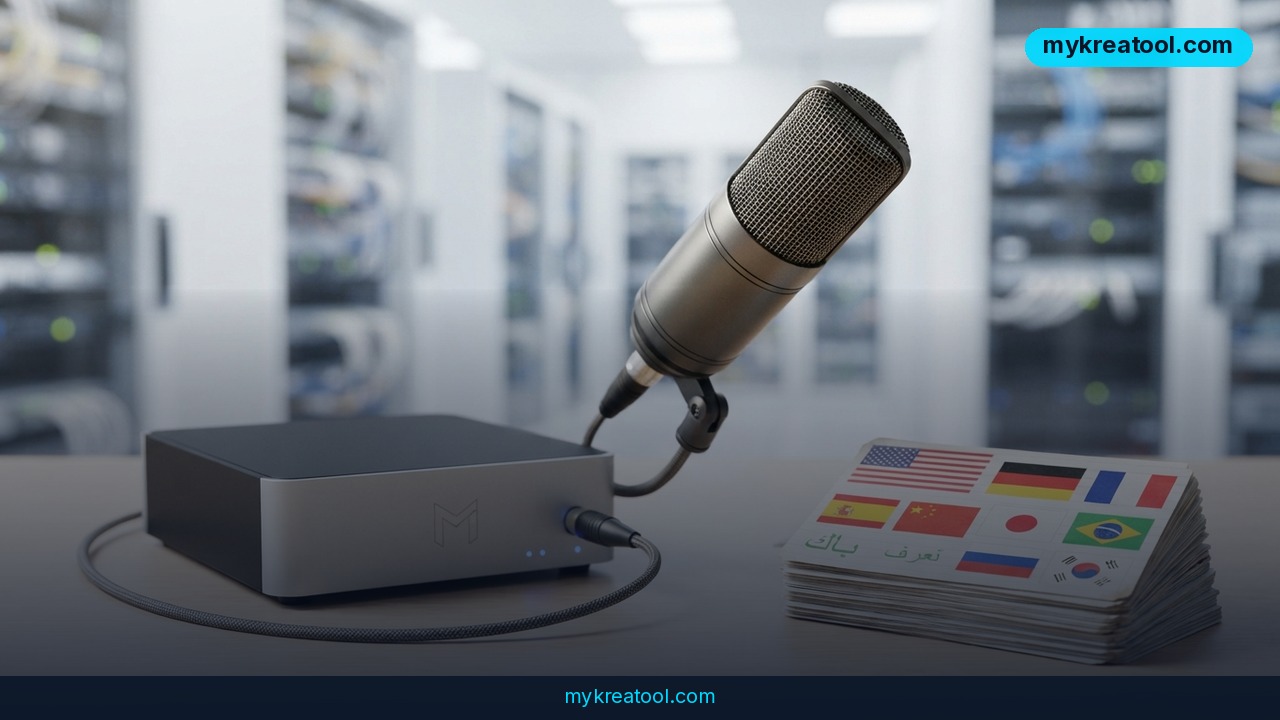
Talking to software still feels like filling in a form with your voice. You speak, you wait, you get a flat answer that ignores half of what you said — and the moment you ask it to actually do something, the whole thing falls apart. Mistral AI's Voxtral 3 is built to close exactly that gap: a complete stack for a real-time voice AI assistant that listens while you talk, thinks in the background, reaches into your other software, and answers out loud without the awkward pause. Mistral announced it on October 20, 2026.
What happened
On that date, Mistral AI released Voxtral 3, and the framing matters: this isn't one model, it's a full voice agent stack. The company is pitching it as everything you need to build a voice assistant that listens, thinks, uses tools, and speaks — inside one streaming pipeline, rather than four separate services glued together with hope and duct tape.
Three parts, one pipeline
The lineup is short and easy to follow. Voxtral Small Transcribe 3 handles speech-to-text — the dictation half, turning what you say into words on a screen. Voxtral Mini TTS 3 handles text-to-speech — the voice you actually hear coming back. The third piece is a voice agent SDK built on LiveKit. An SDK is just a box of pre-built parts that saves you from writing the plumbing yourself, and LiveKit is the plumbing: it keeps audio flowing in both directions at once so a conversation never has to stall.
Because all three sit in a single streaming pipeline, nothing waits for you to finish and hang up. While you're still wrapping up a sentence, the system is already turning it into text, working out what you meant, and getting its reply ready.
The numbers that matter
Mistral's specs are refreshingly concrete. Transcription covers more than 50 languages. Voice output covers over 35 languages and 50 dialects, with emotional adaptation — meaning the voice can shift its tone to match the moment instead of reading everything like a train station announcement. Agents can reach into outside systems mid-conversation, for example to book an appointment or check an invoice. Transcription pricing starts at $0.0035 per minute. And if data residency keeps you up at night, Mistral says the whole stack runs on your own infrastructure or through EU-hosted APIs.
Why 'real time' is the real story
Old voice bots worked like a walkie-talkie: press, talk, wait, listen. A real-time pipeline works more like a phone call with a sharp receptionist — you talk, they keep up, and by the time you're done they're already reaching for the calendar. That's the shift that turns a demo into something you'd actually let answer your business line.
What it means for you
You don't have to build anything to feel the change. You just have to imagine what gets cheaper and faster once software can hold a spoken conversation and quietly press a few buttons behind the scenes.
At home: a phone line that actually understands
Think about the calls you dodge — the pharmacy, the delivery company, the appointment you keep forgetting to reschedule. A voice assistant built on this stack could pick up, understand what the caller wants, and book or confirm something in your calendar, all in the caller's own language.
At work: meetings that tidy up after themselves
Record a call, and transcription in 50+ languages means nobody's scribbling notes and missing the point. Because the agent can hook into other systems, it can also pull a number from your CRM or confirm a delivery date while the client is still talking — no 'let me get back to you on that.'
In business: bookings and invoices without hold music
This is where it gets practical. Mistral names two examples: booking appointments and checking invoices. Both are the small, repetitive phone jobs that eat hours every week. And you can keep the audio in-house — your own servers or EU-hosted APIs — which matters if you deal with health, legal or financial data. Before you spend a cent, it's worth seeing how far free tooling already gets you; MyKreaTool rounds up free AI tools you can test in an afternoon.
For study: a tutor that talks back
Language learning is the obvious winner. With transcription in over 50 languages and speech output in 35+ languages and 50 dialects with emotional adaptation, you can practice a real conversation instead of tapping flashcards. The voice can sound encouraging when you nail it and gentler when you don't.
For creators and side income
Voiceover work, dubbing, audio versions of blog posts — all of it gets cheaper when you can produce natural-sounding speech in dozens of languages without hiring a studio. Freelancers can also sell the finished thing: a booking agent for a local salon, a call screener for a clinic, a multilingual helpline for a small shop. Small builds, real invoices.
How to try it right now
There's no advertised free tier in the announcement, so the honest cheapest route is to test one piece at a time. A ten-minute transcription job at $0.0035 per minute costs about $0.035 — less than a piece of gum. Start there before you build anything live.
1. Read the docs first (free). Open Mistral's Voxtral 3 documentation and check what's available in your region before you plan anything. Ten minutes of reading saves a week of guessing.
2. Get API access. Set up an account with Mistral and grab your key, or plan to run the models on your own infrastructure if that's your requirement.
3. Test the ears. Send a short recording to Voxtral Small Transcribe 3 and see how it handles accents, background noise and the way people actually mumble.
4. Test the mouth. Run the same text through Voxtral Mini TTS 3 and listen for the emotional adaptation — does it sound like a person or a satnav?
5. Add one button. Wire up a single tool call, like checking a calendar slot. One action proves more than a hundred clever replies.
6. Decide where it lives. Own infrastructure or EU-hosted APIs — pick now, not after your first customer.
7. Only then go live. Bring in the Voxtral voice agent SDK on LiveKit and let it stream. Keep a human fallback for the first few weeks.
Upsides and what changes
The big win is assembly. Most voice projects stall because you're stitching together three vendors and a telephony provider, and the seams show up as that dead half-second of silence. One stack from one vendor removes most of that.
Second, the language coverage is genuinely wide — 50+ for listening, 35+ for speaking plus 50 dialects — which means a small business can serve customers it couldn't afford to staff for. Third, tool use is the difference between a chatbot and a colleague: booking, checking, updating. And fourth, the self-hosting and EU-hosted options give cautious buyers a real answer to the data question instead of a shrug.
Limitations
Be clear-eyed about a few things. 'Real time' still means milliseconds of delay, and in conversation people notice; a stack that streams well can still feel slightly off if your network is poor. Emotional adaptation is impressive and occasionally wrong — a cheerful tone at the wrong moment is worse than a flat one. Transcription in 50+ languages doesn't mean equal quality in all 50, and noisy rooms punish everyone. Tool calls are where money and trust get lost: an agent that books the wrong slot or reads out the wrong invoice is a real risk, so guardrails and human fallbacks aren't optional. On cost, $0.0035 per minute sounds tiny until you multiply it by thousands of calls, and there's no published free tier to soften the testing phase. Mistral's announcement also doesn't hand you accuracy benchmarks, latency figures or a side-by-side with rivals — you'll have to measure that on your own audio.
Conclusion and one action for today
Voxtral 3 is less about a smarter model and more about a shorter path from idea to a phone line that works. Listening, thinking, doing and speaking in one streaming pipeline, in 50+ languages, at a fraction of a cent per minute, hosted where you want it — that's a meaningfully lower wall for anyone who's ever wanted a voice assistant but couldn't justify the engineering.
Your one action today: pick the single most repetitive phone task in your week — the appointment confirmations, the 'where's my invoice' calls — record five minutes of it on your phone, and price out transcribing that audio with Voxtral Small Transcribe 3. Five minutes at $0.0035 per minute is under two cents. If the transcript is good, you've got a business case; if it isn't, you've lost less than a coffee.


Comments 0