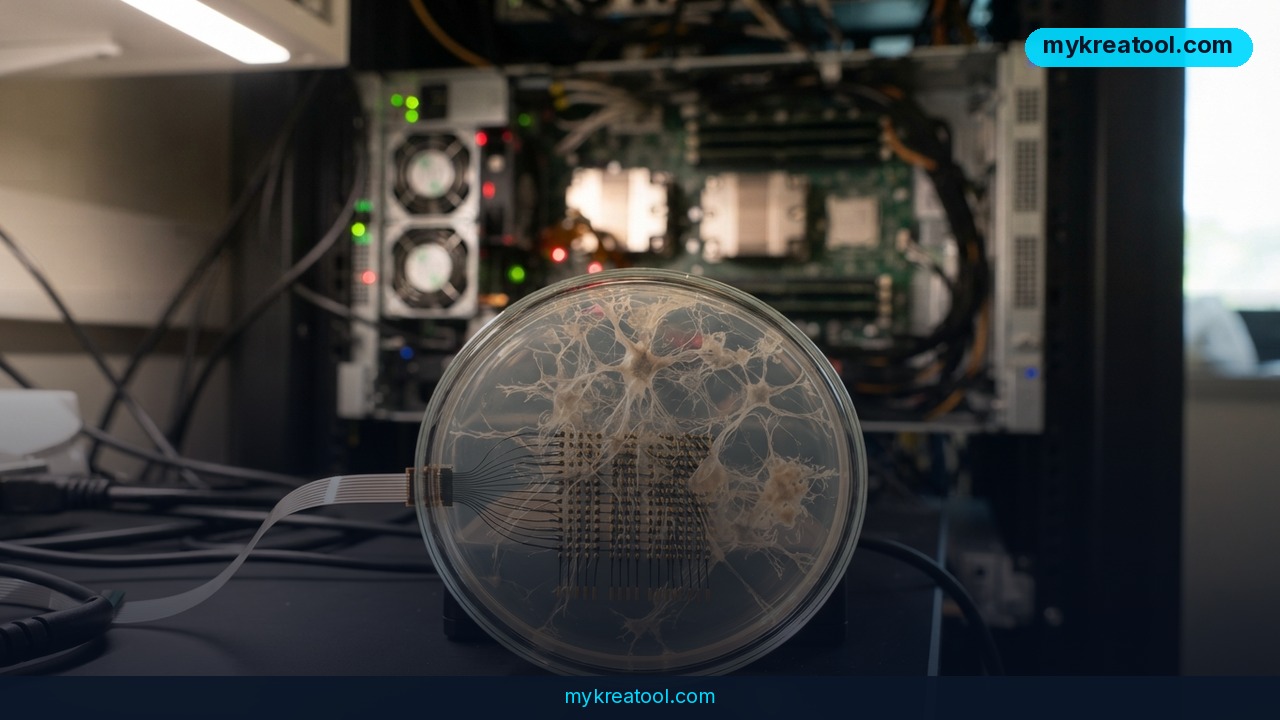
It sounds like the setup for a sci-fi movie: a startup in San Francisco spent four years growing living brain cells on electrodes, then used what it learned to build a faster AI video model. That's exactly what The Biological Computing Co. (TBC) says it did, and the result — a tool called mischief 1 — is now live on fal and OpenRouter. Feed it one image and it hands back a 3- or 5-second clip at 480p or 720p, starting at half a cent per second.
The claim that got everyone's attention: TBC says mischief 1 is at least 5x faster than Wan 2.2 — the open video model it's built on top of — while holding the same quality. No independent benchmark exists yet, so file that number under "promising, unverified."
What happened
First, the brain cells don't render anything
Let's clear up the wildest misunderstanding out there. No neuron is drawing frames. TBC grew real brain cells on electrodes and spent four years measuring how they process information. Then it translated those measurements into a small piece of software. The videos are still made the boring way — by ordinary computer chips, the same silicon that powers every other AI model on the market.
So "neuron-derived" means the design was shaped by living tissue. It doesn't mean your clip was imagined by a petri dish.
What mischief 1 actually is
mischief 1 isn't a model built from scratch. It's Wan 2.2 — an open video model anyone can download — with a thin software layer added on top. That layer makes the model less than 0.1% bigger. Picture a running coach who watched one athlete for four years and then handed over a single page of notes about their stride: tiny piece of paper, completely different race.
The numbers: image-to-video only, 3 or 5 seconds, 480p or 720p, from half a cent per second. A five-second clip costs 2.5 cents — the kind of number you simply stop budgeting for. The official launch announcement confirms the details, and The Next Web, Superpower Daily and Unite.AI have all covered it. None of them ran their own speed tests, so the 5x figure still rests on TBC's word.
TBC says language models and "physical AI" — robots and machines that move — are next on the list.
What it means for you
Everyday life: home and work
Short, cheap clips change what's worth automating. At home, you can turn a phone photo of your half-finished kitchen remodel into a 5-second push-in that's plenty good for the family group chat. At work, the same trick handles the chores nobody wants: a product photo that needs a little motion, a slide that needs a visual, a mockup that needs to look alive in a client email. At 2.5 cents a pop, you can generate ten versions and keep the one that doesn't look weird. You'll spend more on the coffee you drink while you wait.
Business and study
For small businesses, the math gets interesting fast. A bakery with 40 product photos can spin up 40 short videos for about a dollar and test which ones actually stop the scroll — no videographer, no studio, no shoot day. Students get a cheap way to make visual aids too: turn a diagram into a clip for a presentation, or bring a historical photo to life for a class project. If you want free tools for everything around the video — transcripts, images, editing helpers — MyKreatool keeps a running list worth trying before you pay for anything.
Creativity and side income
For creators, speed is the whole game. The bottleneck on a video idea has never been the idea — it's the twenty minutes you burn testing it. If clips really do come out five times faster and cost pennies, you can iterate on a hook the way writers iterate on headlines. Expect a small cottage industry to pop up around 5-second loops, animated logos and "living photo" posts for local businesses. The margin per clip is thin, but the volume is basically unlimited.
How to try it right now
Start free. Wan 2.2 is open, so you can see what the base model does without paying TBC a cent. Run it yourself if you have the hardware, or find a free demo — the point is to feel what a 5-second image-to-video clip is like before you spend money on a faster version of it.
Then, when you're ready to compare:
1. Open fal or OpenRouter — mischief 1 launched on both.
2. Search "mischief 1" in the model list and open its page. Check the price per second against the other models listed on the same screen.
3. Upload one image. A clean photo or a simple illustration beats a busy collage every time.
4. Pick length and resolution: 3 or 5 seconds, 480p or 720p. Pricing is per second, so shorter and cheaper go together.
5. Generate two or three versions of the same image. At 2.5 cents each, testing is cheaper than deciding.
6. Run that same image through Wan 2.2 and time both. You'll have your own version of the benchmark nobody has published yet.
Budget check: 40 five-second clips costs about $1. You can learn a lot for a dollar.
Upsides and what changes
The real story here isn't the brain cells — it's how small the fix is. A software layer under 0.1% of the model's size delivered a claimed 5x speed gain. That kind of jump used to require retraining a model from scratch, with a GPU bill to match. If the approach holds up, every open model becomes a candidate for the same treatment, and "good enough video, almost free" stops being a nice-to-have.
There's a second upside: proof that weird research pays. TBC spent four years on biology with nothing to sell, then shipped a commercial product the moment it had something useful. Plenty of labs will copy that playbook.
Limitations
Be honest about the gaps. There's no independent benchmark for the 5x claim — only TBC's own numbers. The tool makes very short clips (3 or 5 seconds) at modest resolution, image-to-video only, so you can't hand it a script and walk away. "Neuron-derived" doesn't mean smarter output either: quality should track Wan 2.2, because that's the model actually doing the rendering, so don't expect miracles in motion or physics. The "from" in "from half a cent per second" leaves room for pricier tiers, and a launch-day listing on a marketplace isn't the same thing as a battle-tested product. Spend a few cents before you build a workflow around it.
Conclusion
A startup grew brain cells, measured them for four years, and squeezed a claimed 5x speed boost into a patch that's under 0.1% of an open video model. Whether the neurons deserve the credit or not, the pricing does the talking: 2.5 cents for a five-second clip puts short AI video in impulse-purchase territory.
One action for today: pick the image you'd most like to see move, spend about 5 cents generating it two ways on fal or OpenRouter — once with mischief 1, once with Wan 2.2 — and judge the speed claim with your own eyes.

Comments 0