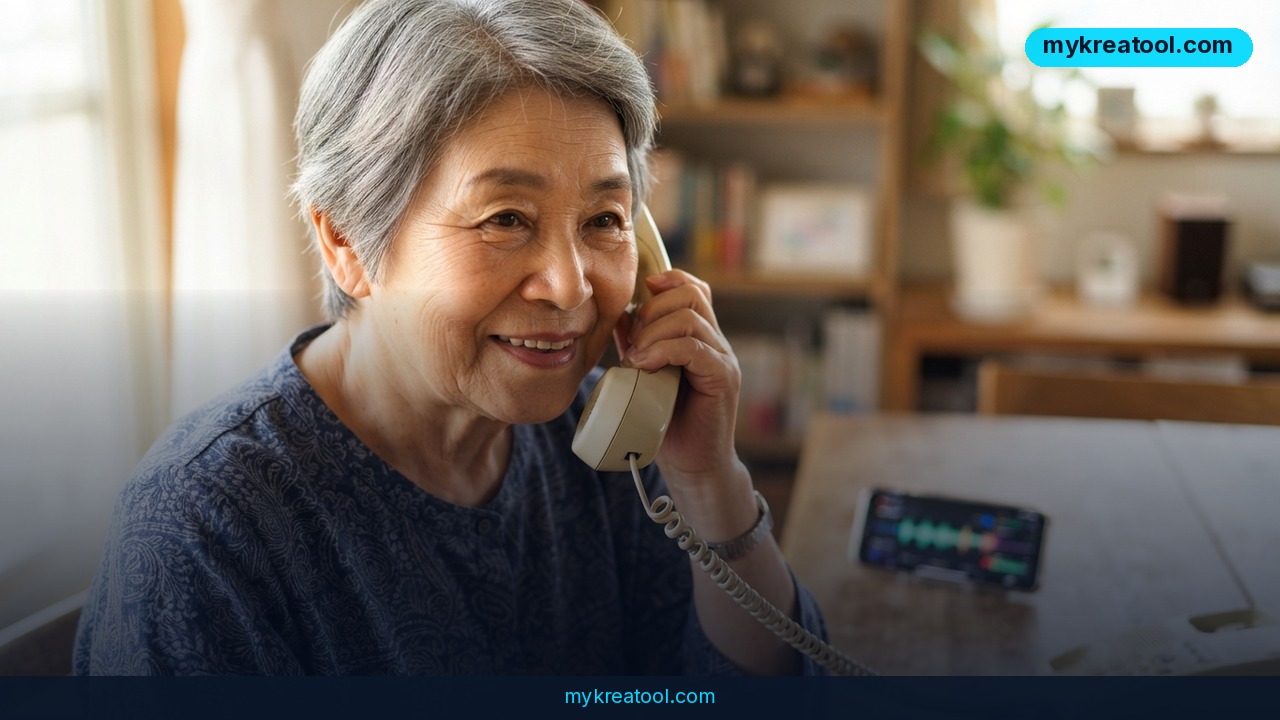
Most dementia detection by phone still starts with a gut feeling: a grandfather who suddenly answers in three-word sentences, a grandmother who keeps drawing a blank on your name. An 18-year-old student in China has turned that hunch into software — AI voice analysis built to catch the earliest signs of cognitive decline during an ordinary chat about the weather.
What happened
A grandfather's phone calls got shorter
Liu Sizhe, 18, studies at the University of Science and Technology of China. About a year before the project existed, he noticed a shift in his family's calls. His grandfather was answering in shorter and shorter bursts, going quiet more often. His grandmother had started mixing up his name.
Most families write that off as "just getting older." Liu didn't. He set out to build an AI assistant that could flag early dementia from a normal phone conversation — no clinic visit, no brain scan, no questionnaire. Just a call, a chat, and a model listening for patterns a human ear tends to miss.
How the AI actually listens
The model was trained on a library of recorded conversations with older people, collected at his university lab. Liu also brought in students who rode around the city recording chats with seniors to grow the dataset. Out of that came a service reported as Forget-Me-Not, which in testing dials a pensioner and makes small talk about the weather, breakfast, and the neighbors.
Behind the small talk, the algorithm tracks four things: how fast someone speaks, how long the pauses run, whether one thought connects logically to the next, and how quickly they respond. Picture a mechanic listening to an engine idle. Nothing sounds broken — the rhythm is just slightly off.
The numbers — and what's still unverified
In spring, over two and a half weeks, the assistant placed 150 calls and flagged 19 people as high risk. Follow-up exams confirmed cognitive impairment in two of them.
One honest caveat: the Forget-Me-Not and Xiao Chen names, and the 150-call figure, haven't been independently confirmed for Liu's specific project. The core claim — an AI system that screens for Alzheimer's risk by analyzing speech patterns over the phone — does check out, as Xinhua reported. Treat the specifics as reported, not audited.
The timeline is the part that matters most: changes in speech can show up 5–10 years before a diagnosis.
A company, a grant, and a hospital pilot
Liu has already founded a company and landed a 1 million yuan grant — serious backing for a project that started with a kid noticing something on family phone calls. The service is being tested at a medical center in Nanjing, with clinical data being gathered alongside several hospitals.
But here's the line that sticks. Liu himself thinks that for seniors living alone, the most valuable part might be something simpler than detection: someone is willing to call, listen, and ask about their life.
What it means for you
At home: turn "is Mom okay?" into a signal
If you've got a parent or grandparent you check in on by phone, you already own a screening tool — you just aren't using it deliberately. Listen to the mechanics, not the mood: are answers getting shorter? Are there more "what's the word…" moments? Do stories loop back to the same point? A five-to-ten-year head start is worth paying attention to, and it costs you nothing but noticing.
At work: eldercare is becoming a data problem
Care homes, home-health agencies, and elder-insurance providers already run on phone contact. A short weekly call that doubles as a speech check turns a routine touchpoint into a screening layer — cheap, non-invasive, and easy to explain to families. If you work in HR, it's also a benefits question: eldercare support that actually catches something is worth more than a glossy brochure nobody reads.
In business: steal the pattern, not the claims
The trick here isn't dementia. It's squeezing a signal out of an interaction you already have — a support call, a check-in, a follow-up. Support teams could score clarity and coherence on calls; sales teams could coach people out of rambling. Just don't borrow the medical claim without the clinical evidence behind it. Different rules, real liability.
For students: the dataset is the moat
An 18-year-old didn't win by having a fancier model. He won because he had recordings nobody else had: a lab archive plus students walking the city with recorders. If you're building something, ask what data you can collect that everyone else can't be bothered to.
For creators: the story is the product
Notice the narrative shape — a kid, a grandfather, a hunch, then 150 phone calls. That's why this travels. If you make content, the durable lesson is that a precision score on a slide is forgettable, and "my grandpa stopped finishing his sentences" isn't.
As income: a small service with a clear audience
A screening-adjacent service has an obvious market — but in most countries, anything claiming to detect disease is a regulated medical device. The safer near-term play sits around the core: transcription, family reporting, care coordination, and reminder calls that also happen to log speech. Boring infrastructure, real demand, far fewer lawyers.
How to try it right now
Forget-Me-Not isn't a consumer app you can download today — it's in clinical testing in Nanjing. But you can build a rough version of the workflow this week, starting free.
Step 1 — Record a two-minute baseline (free). Ask the same three questions every week: What did you have for breakfast? What's the weather like? What did you do yesterday? Record the answers on your phone. Same questions means a real comparison later.
Step 2 — Transcribe it (free). Run the recording through a free speech-to-text tool — MyKreaTool lists free AI tools that turn audio into text in seconds, no account gymnastics.
Step 3 — Count four numbers. Average words per sentence. Longest pause. How many times a word gets hunted for and then dropped. How long the first answer takes to land. Nothing fancy — a note on your phone is enough.
Step 4 — Keep the log. Date, four numbers, one sentence on how the conversation felt. Four weeks of that beats one panicked observation.
Step 5 — Loop in a professional, not a diagnosis. If the trend line is drifting, bring the log to a doctor. Screening is a reason to get tested, never a substitute for it.
Upsides and what changes
The obvious upside is timing. Five to ten years of warning is a different world from a diagnosis delivered in the middle of a crisis. And the delivery channel — a phone call — is the one thing almost every older adult can use without help.
Second, it's passive. No wearable to charge, no app to remember, no clinic trip. Reports land with family members in real time, which shifts the burden from "someone has to notice" to "the system noticed."
Third, the side effect might be the headline. A service that calls lonely people, listens, and asks about their day is worth something even when the algorithm says nothing at all. Liu thinks that himself.
Limitations
Be clear-eyed about all of this. The product names and the 150-call result haven't been independently verified, the confirmed sample is tiny — two people — and there's no peer-reviewed validation published yet. Speech is a noisy signal: accents, hearing loss, dentures, a bad night's sleep, a cold, anxiety, or simply not being a talker can all move the needle, and a false alarm in dementia screening causes real fear. Language matters too — a model trained on Mandarin conversations with Chinese seniors won't transfer neatly to other languages, dialects, or cultures. Then there's privacy: recorded calls with elderly people are about as sensitive as data gets, and consent has to come from the person being analyzed, not just from their adult children. And screening is not diagnosis — it flags risk, and a neurologist does the rest.
Conclusion
An 18-year-old heard something in his grandfather's voice and built a tool around it. Whether or not this particular service becomes a product, the direction is settled: your voice carries health information, and ordinary phone calls are about to become a place where that information gets read.
Today's action: call the oldest person in your family, ask permission to record two minutes of it, and write down three numbers — words per sentence, longest pause, and how long the first answer took. That's your baseline. Everything else is comparison.

Comments 0