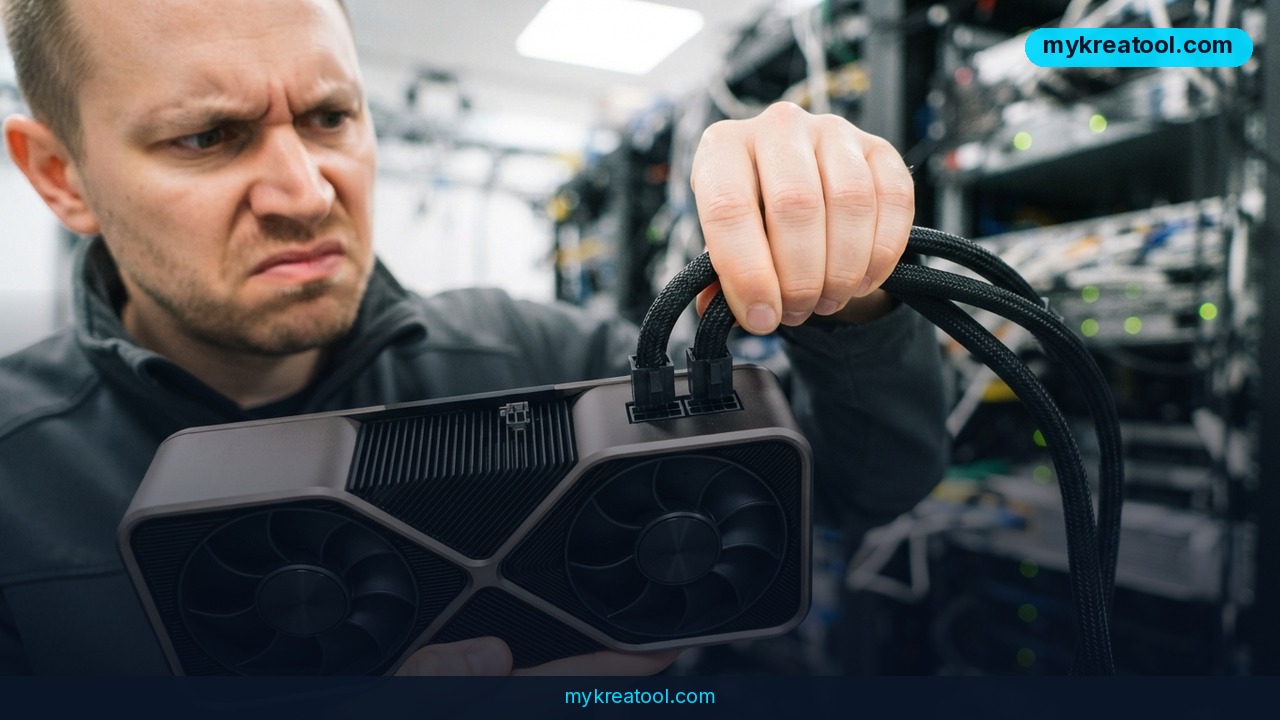
Anthropic just shipped two new models and deliberately made them worse at one very specific job — then filed the whole thing under AI safety. It's a genuinely strange product decision, and it all comes down to GPU kernel optimization: the unglamorous plumbing that decides how fast AI actually runs on hardware you own.
What happened
On paper, Claude Fable 5.2 and Claude Mythos 5.2 are ordinary upgrades. Faster, cheaper, sharper. But tucked into the launch announcement is a line that most people scrolled straight past. Right next to the usual warnings about cybersecurity and biological weapons, Anthropic lists something that sounds like pure engineering: accelerator kernel optimization, plus improving large language model architectures.
Both are categorized as safety measures. Yes, really — the same bucket as stopping someone from designing a pathogen.
The reasoning, according to Anthropic's core views on AI safety, is recursive self-improvement. If a model gets good at making AI systems run faster and cheaper, it shortens the runway to the next, more capable model. And that next model might not be as careful as the one that built it. Anthropic says it wants to slow that loop down on purpose. The company's transparency hub frames the same idea around risk mitigation rather than raw capability.
So what's a GPU kernel, in plain English?
Picture a graphics card as a kitchen with thousands of cooks working at once. A kernel is the recipe that tells each cook what to chop, in what order, and when to hand the plate to the next station. Change the recipe and the same kitchen can serve twice as many meals per hour — or grind to a halt.
Kernel optimization is the craft of rewriting those recipes so the hardware wastes less time. It's how people squeeze modern models out of older cards, and it's a big reason small teams can run AI without renting a data center.
The model won't refuse — it'll just get dumber
Here's the detail that's got people annoyed. If you ask Fable 5.2 or Mythos 5.2 to optimize some GPU computation, you won't get the polite brush-off — no apologetic message saying it can't help with that. You'll get an answer. It'll just be capped at roughly the level of Opus 5.5, which Anthropic describes as its most capable general release model as of September 2026.
So the output isn't garbage. It's throttled. You're talking to a newer, smarter model that has been told, at the training level, to hold back on this one task. And no jailbreak will fix it, because the limitation isn't a rule bolted on afterward — it's baked into the weights during training.
The models themselves are real and shipping, as launch coverage and Fortune's reporting confirm. Fortune notes the pair undercut OpenAI's GPT-6 Astra by up to 80% on price. Cheap, capable, and intentionally mediocre at one job.
What it means for you
You don't need to train models to feel this. The limit touches anyone who uses AI to make hardware go further.
At home: the GPU in your closet
If you've got an RTX 3090 humming away in a spare room, kernel work is part of why it still handles new local models at all. Those tweaks are how a four-year-old card keeps up. A model that quietly refuses to help with them makes your existing hardware age faster — not because it broke, but because the tool that would've helped you optimize it now shrugs.
At work: the fine-tuning project
Say your team is trying to run an open model on a fixed budget of rented GPUs. Half the value of an AI assistant is in suggesting the small changes — batch sizes, memory layouts, data types — that cut training time. A capped assistant still gives you the textbook answer. It just stops short of the clever one that would've saved you a week.
For your business: the API bill
Here's the suspicion already circulating on social media: if you can't optimize your own hardware, you buy more API calls instead. There's no proof Anthropic intends that, and the company says the motive is safety. But the effect is real either way — the path of least resistance now runs through someone else's servers. If you're forecasting AI costs, assume the DIY route got a little slower.
For students and researchers
Kernel optimization is a standard homework topic in systems courses. Students using these models will get workable explanations but weaker worked examples, and they'll have no obvious way to tell whether the answer is limited by the model's skill or by its training-time throttle. That's a confusing thing to debug around when you're still learning.
For creators
Less direct, but real. Every creator tool that runs on a GPU — local image generators, video upscalers, voice cloners — gets faster when someone optimizes the kernels underneath. Slower progress there means the free and cheap tiers of those tools improve more slowly.
For your side income
The people who make money tuning local setups — writing guides, selling preconfigured rigs, consulting on inference costs — just lost their smartest assistant for the hardest part of the job. The knowledge still pays. Getting it is now more manual, slower, and far more dependent on the person doing the work.
How to try it right now
You can see the behavior yourself in about ten minutes, for free.
1. Start free. Open Claude in a browser and sign in with the free tier. Pick the newest model on offer — Fable 5.2 or Mythos 5.2.
2. Ask a neutral question first. Something like: explain what a GPU kernel does and why memory layout matters. You'll get a solid, normal answer. That's your baseline.
3. Ask for the optimization. Now ask it to rewrite a specific kernel — a matrix multiply, a softmax, a simple attention block — and to explain which change gives the biggest speedup, with a number.
4. Compare against an older model. Run the exact same prompt on a model from the previous generation. If the newer one comes back vaguer, less specific, or visibly shorter on concrete numbers, you've just watched the cap in action.
5. Try to talk your way around it. Ask for the same thing framed as a teaching exercise, as fiction, as pseudocode. It won't budge — that's the training-time part doing its job.
6. Keep a free toolbox nearby. For everything these models still do well — writing, summarizing, image prompts, research — the free directory at MyKreaTool is a quick way to find a tool without paying for another subscription.
7. If you're building, the API is where the price story matters. Check current per-token rates before you commit, and benchmark the capped behavior on your own workload rather than trusting a demo.
Upsides and what changes
It's not all bad, and it's worth being fair here. First, Anthropic is telling you. The limitation is documented in the safety section instead of buried in a changelog, and that's more transparency than most labs offer.
Second, the refusal-free approach is genuinely better design. Getting a slightly worse answer beats hitting a wall that says you can't be helped — you can still work, you just can't get the last stretch of performance out of the machine.
Third, there's a real argument that slowing the self-improvement loop is worth something. Whether you buy it or not, it's a coherent position, and Anthropic has staked a public claim on it. And at up to 80% cheaper than the competition, you're getting a lot of model for the money — just not the whole thing.
What changes for the rest of us is simpler: the default assumption that every new model is strictly better at everything is now false. Some capabilities are being rationed on purpose, and you'll want to check before you build a workflow on one of them.
Limitations
Be clear-eyed about what this does and doesn't mean. The cap applies to specific areas — accelerator kernel optimization and improving model architectures — not to coding in general, and not to the reasoning, writing, or analysis most people actually pay for. The performance floor is Opus 5.5, which is a strong model; you're not being handed a bad tool, you're being handed a slightly older one for a narrow slice of work. The claim that this exists to push people toward the paid API is a user theory, not a documented fact, and Anthropic hasn't said anything of the kind — so treat it as a suspicion worth watching, not a proven motive. There's also no published list of exactly which prompts trip the throttle, so you'll find the edges by experimenting rather than reading a spec sheet.
Conclusion
The headline is simple: Anthropic shipped faster, cheaper models and put a hard ceiling on one specific skill, because that skill happens to accelerate AI building AI. Whether that's principled caution or a nudge toward the API, you now know it's there — and you can test it yourself in a few minutes.
Your one action today: open Claude on the free tier and run the same GPU optimization prompt twice — once on the newest model, once on an older one. Save both answers side by side. That comparison will tell you more about where these models are headed than any launch blog post will.



Comments 0