What happened
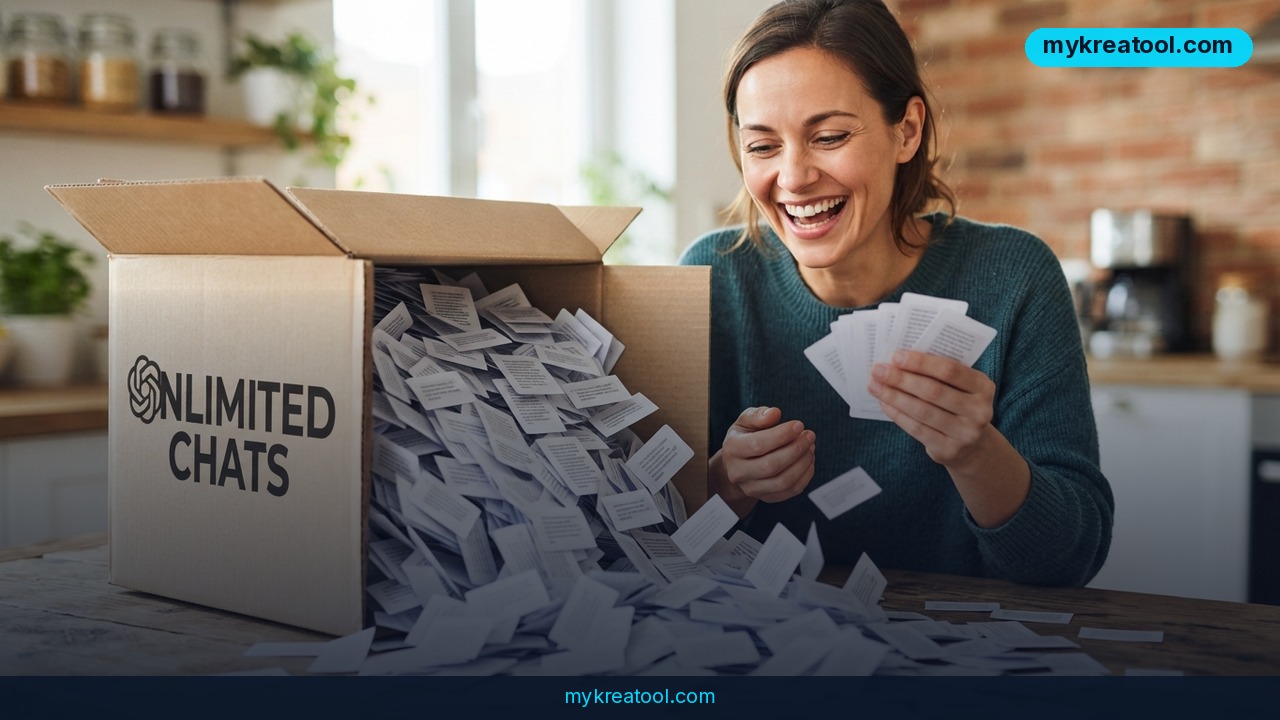
OpenAI just removed one of the biggest friction points in ChatGPT: starting next week, users on the free and Go tiers will get unlimited text chats, with no more rate limits capping how many messages they can send in a day. Previously, free and Go users would hit a wall after a certain number of text-only conversations, forcing them to wait hours before continuing. That cap is going away entirely for plain text messages. File uploads and image generation will still have separate limits, so this change is specifically about back-and-forth conversation, not every feature in the app.
A new "Think" button for deeper reasoning
Alongside the unlimited chats, OpenAI is rolling out a "Think" button for free and Go users next week. It lets people manually trigger a higher-reasoning mode for harder questions — math problems, multi-step logic, code debugging — instead of relying on the default fast-response model for everything. This week, free and Go users are also being upgraded to GPT-5.6 Luna as the new default model, replacing whatever version they were previously using.
Plus and Pro also get an upgrade
Paying subscribers aren't left out. Starting Thursday, GPT-5.6 Sol — the model used by Plus and Pro accounts — is being updated to be "more reliable with facts," according to OpenAI. The company says the model makes fewer mistakes on answers that depend on dates, numbers, sources, rules, or assumptions, largely by doing a better job of using the sources it retrieves. Responses are also becoming more direct, with tighter formatting and less unnecessary detail. A new slider lets Plus and Pro users control how much reasoning effort ChatGPT puts into each answer, from quick replies to deeper analysis.
Why it matters
Rate limits have long been the quiet dealbreaker for free ChatGPT users. Anyone using the tool for daily work — drafting emails, brainstorming content, debugging code — has run into the "you've reached your limit, try again in X hours" message at the worst possible moment. Removing that limit for text chats effectively puts free users on equal footing with paid tiers for the most common use case: conversation.
This also signals where OpenAI sees the real competitive battle. With Google's Gemini, Anthropic's Claude, and other assistants all offering generous free tiers, capping basic text chat was becoming a liability. Pairing unlimited access with a model upgrade (GPT-5.6 Luna) means free users aren't just getting more messages — they're getting a smarter model to send them to.
For Plus and Pro subscribers, the emphasis on factual reliability matters just as much. As more people use ChatGPT for research, reporting, and business decisions, mistakes involving dates, statistics, or sourcing are the errors that actually cost money or credibility. A model that's tuned to lean harder on retrieved sources rather than guessing is a direct response to that risk.
How to use it today
If you're on the free or Go tier, there's nothing to configure — the unlimited text chat rollout and the GPT-5.6 Luna upgrade happen automatically on OpenAI's timeline this week and next. Once the Think button appears, use it selectively: reserve it for questions where accuracy or multi-step logic matters, since higher-reasoning modes tend to respond more slowly than the default.
Plus and Pro users should test the new reasoning slider on tasks they already do regularly — try a low setting for quick drafts and a higher one for research-heavy prompts, then compare the outputs. This is also a good moment to audit your own AI workflow more broadly. If you're pairing ChatGPT with other lightweight utilities for tasks like image resizing, text formatting, or quick file conversions, a resource like mykreatool.com offers free AI tools that can fill in the gaps ChatGPT doesn't directly handle, without adding another subscription to your stack.
For teams and businesses
Marketers and small teams that avoided the free tier because of message caps can now realistically use it for internal ideation, first-draft content, or customer support scripting. It's worth revisiting whether a paid seat is still necessary for lighter use cases, and reallocating budget only to the accounts that genuinely need Pro-level reasoning or file handling.
Who benefits
The biggest winners are casual and budget-conscious users — students, freelancers, small business owners — who previously hit limits mid-task and had to switch tools or wait it out. Removing that cap makes ChatGPT viable as a daily driver without a subscription for anyone whose work is primarily text-based.
Content creators and marketers benefit from both changes: unlimited brainstorming and drafting on the free tier, plus more factually reliable output on Plus and Pro for anything client-facing. Developers and analysts who rely on GPT-5.6 Sol for research-heavy prompts should see fewer hallucinated dates, numbers, or citations, which reduces the manual fact-checking overhead that AI-assisted work usually requires.
Risks
Unlimited access doesn't mean unlimited accuracy. Even with GPT-5.6 Sol's improvements, OpenAI is describing a reduction in factual errors, not their elimination — outputs involving statistics, legal or medical information, and financial figures still need independent verification before you act on them.
There's also a capacity question. Removing rate limits for millions of free users increases load on OpenAI's infrastructure, and past model rollouts have occasionally come with slower response times or temporary instability during high-traffic periods. Businesses building workflows around ChatGPT should keep a fallback plan in case of service disruptions during the transition. Finally, easier, unlimited access can encourage over-reliance — teams should keep a human review step for anything that leaves the draft stage.
Conclusion
OpenAI's decision to strip rate limits from free-tier text chats, paired with the GPT-5.6 Luna and Sol upgrades, marks one of the more user-friendly moves the company has made this year. Free users get a genuinely usable daily tool instead of a capped trial, while paying subscribers get a model built to make fewer factual mistakes and respond more efficiently. The rollout lands this week and next, so most users won't need to do anything — just watch for the new default model, the Think button, and, if you're on Plus or Pro, the reasoning slider.


Comments 0