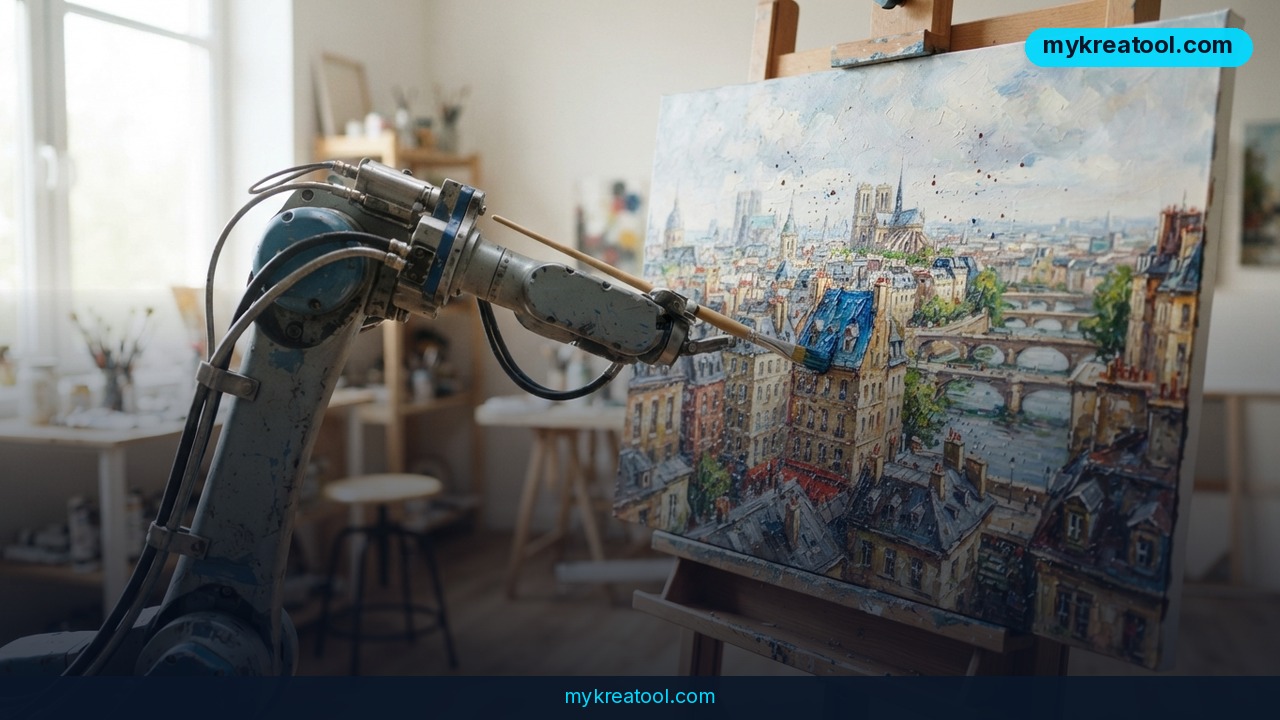
Claude Fable 5.2 doesn't generate images the way you're used to. Ask Anthropic's new model for a photorealistic scene and it won't hand you a finished picture refined out of noise — it writes a Python program, 1,000 to 2,000 lines long, that drives a simulated paint engine and lays down brushstrokes on a virtual canvas one at a time. In one demo, a shopping cart in a parking garage took roughly 700,000 of them.
What happened
Anthropic developer Jake Eaton posted the results on X in November 2026. He asked Fable 5.2 to make a painting as hard as possible to tell apart from a photograph. What came back was that parking garage: about 700,000 simulated strokes, with no external image model behind it and no pre-rendered or traced source image to copy from.
It writes code instead of pixels
Almost every image generator you've clicked on — Midjourney included — uses diffusion. Picture a photo buried under TV static, with a model slowly wiping the static away until the picture shows through. Fable 5.2 does something different. It works like a painter narrating every move out loud: this color, this brush width, this direction, this much paint.
For the opening stroke of a sunrise bird painting, the model output the color #30346a, a width of 90 pixels, and five slightly wobbling waypoints. It said the roughly seven-pixel wobble was deliberate — a human arm doesn't draw a perfectly straight line either.
It paints over its own mistakes
Anthropic engineer Michael Graczyk shared a chat log and a video of that bird test. The whole painting came together in exactly 111 strokes, and the video runs 21 seconds with a counter ticking up as the canvas fills in. There's no undo button. Once a stroke lands on the virtual canvas it stays there, so the model has to commit and then repair things the way a person would.
When the bird's back came out too thin and scraggly, it laid a bolder stroke over the top, and the stray bristle marks along the edges now read as ruffled feathers. A second piece, two people painting at dusk, used 280 strokes, with a late lighting pass pulling it together. Eaton also had the model invent its own artist personas — fictional backstories, consistent styles — after an earlier model, Opus 5.5, drew criticism for simply imitating existing art.
Where the seams show
On Anthropic's internal RoboDojo Sim benchmark, Fable 5.2 scored 64.9 percent against 29.8 percent for OpenAI's GPT-6 Astra. In a real-world test with a physical robot arm, though, the story flipped: Fable 5.2 was slower and less precise at fine motor control than its rival. Coding a painting and moving a real brush are not the same skill.
What it means for you
You don't need to care about Python to care about any of this. What's shifting is that an AI can now hand you an image and the reasoning behind every mark in it — and you can push back on that reasoning in plain words: less glare on the cart, heavier sky, warmer light. If you'd like to feel that difference before paying for anything, there's a free set of AI tools at MyKreaTool you can open today.
Around the house
Birthday posters, a kids' art project, one big print for a hallway that doesn't look like it came from a furniture catalog. Normally you fight with a diffusion prompt and end up with something plasticky. Here you can say 'thick oil strokes, like a 19th-century seascape' and get a hand that actually looks human, because the model carries a persona from picture to picture — a set of three prints made this way won't look like it came from three different planets. And you redirect it with a comment instead of rerolling the dice fifty times.
At work and in business
Pitch deck visuals, product illustrations, packaging concepts, a moodboard that holds together across ten slides. The quietly useful part for a small team is that the look lives in code: a script of 1,000 to 2,000 lines can be saved, handed to a designer, tweaked next quarter, and it still looks like your brand. That's a far cry from a folder of prompts and lucky accidents. Just don't plan a tight deadline around it — this thing thinks stroke by stroke, and 700,000 strokes is not a quick coffee break.
In the classroom
Art teachers get a demo that shows paint physics instead of hiding it: bristle texture, wet paint, canvas grain, a visible count of every stroke. Coding clubs get something better than another calculator — students write a brief, read the returned script, and see their description turned into marks they can argue with. It's also a neat way to teach why a human arm doesn't draw straight lines, which is exactly the seven-pixel wobble the model added on purpose.
For creators and side income
If you sell art or content, the format is almost as interesting as the picture. Graczyk's 21-second timelapse, with a stroke counter climbing toward 111, is the kind of thing people actually watch to the end. Commissions can be delivered with the script attached, so a buyer gets the process, not just a file. Be honest with yourself, though: the tool supplies the brushwork, not the taste. Knowing what's worth painting is still your job.
How to try it right now
Step 1. Start free. Before you spend a cent, block out your idea in a free AI image tool — the free tools linked above are a fine place to begin. Get the composition and colors roughly right there, so you know what you're asking for.
Step 2. Write the brief like a commission, not a prompt. Instead of 'a bird at sunrise, photorealistic, maximum detail', write what a client would tell a painter: the subject, the mood, the light, the medium. Vague briefs get vague brushwork.
Step 3. Ask Claude Fable 5.2 for code, not a picture. Tell it you want a Python program that draws the image stroke by stroke on a canvas, with each stroke defined by color, width and waypoints. That's exactly what the demos did.
Step 4. Give it a persona. Ask for a made-up artist with a short backstory and a fixed style, then reuse that persona for related images. This is how Eaton kept a consistent look and avoided the copy-an-existing-artist criticism.
Step 5. Fix by comment. Run the script, look at the result, and respond in words: 'the back is too thin, lay a bolder stroke over it.' The model checks the canvas between passes and reacts to its own mistakes, so your notes act like a creative director's.
Step 6. Check the numbers. Ask how many strokes went in, which colors and widths it chose, and where it painted over something. Those numbers are the honest version of the picture.
One honest note: Eaton and Graczyk shared demos and logs, not pricing or sign-up details, so access may depend on your Claude plan. If Fable 5.2 isn't in your account yet, run steps 1 and 2 free and keep the brief ready.
Upsides and what changes
A picture you can audit
With diffusion you get an image and a shrug. Here you get an image plus a script that says why. Every smear has a reason written down, which matters the moment money or reputation is on the line — a brand can point at the process and say where it came from.
Mistakes become texture
That scraggly back turning into ruffled feathers is the whole pitch. A human painter works this way: the wobble isn't a bug, it's the signature. Diffusion tends to sand those accidents off.
Style that stays put
A persona plus a saved script means next month's picture still matches this month's. For anyone building a recognizable look, that's the real upgrade.
Limitations
This is slow and stubborn, and you should plan around that. Hundreds of thousands of strokes per image means minutes to hours, not seconds, there's no undo so every slip has to be painted over rather than deleted, and fine detail still trails what diffusion models do in a single pass. The benchmark gap is real too: Fable 5.2 beat GPT-6 Astra badly in Anthropic's own RoboDojo Sim test, 64.9 to 29.8 percent, but fell behind it in speed and fine motor control when a physical robot arm had to do the work. And everything we've seen so far is a handful of demos from two Anthropic engineers — there's no broad, independent image-quality benchmark yet, so don't assume it beats your current tool for a product shot or a client deadline.
Conclusion and one action for today
Claude Fable 5.2 is less a new camera and more a new kind of brush: an AI that plans, places and repairs brushstrokes through code, then fixes its own mess the way a painter does. The photoreal parking garage took 700,000 strokes, the sunrise bird took 111, and neither needed a hidden image model underneath.
Your move: open a free AI image tool today and write one two-sentence brief for a picture you actually want — subject, mood, light. That brief is the hard part, and it's the part the model can't do for you.
Comments 0