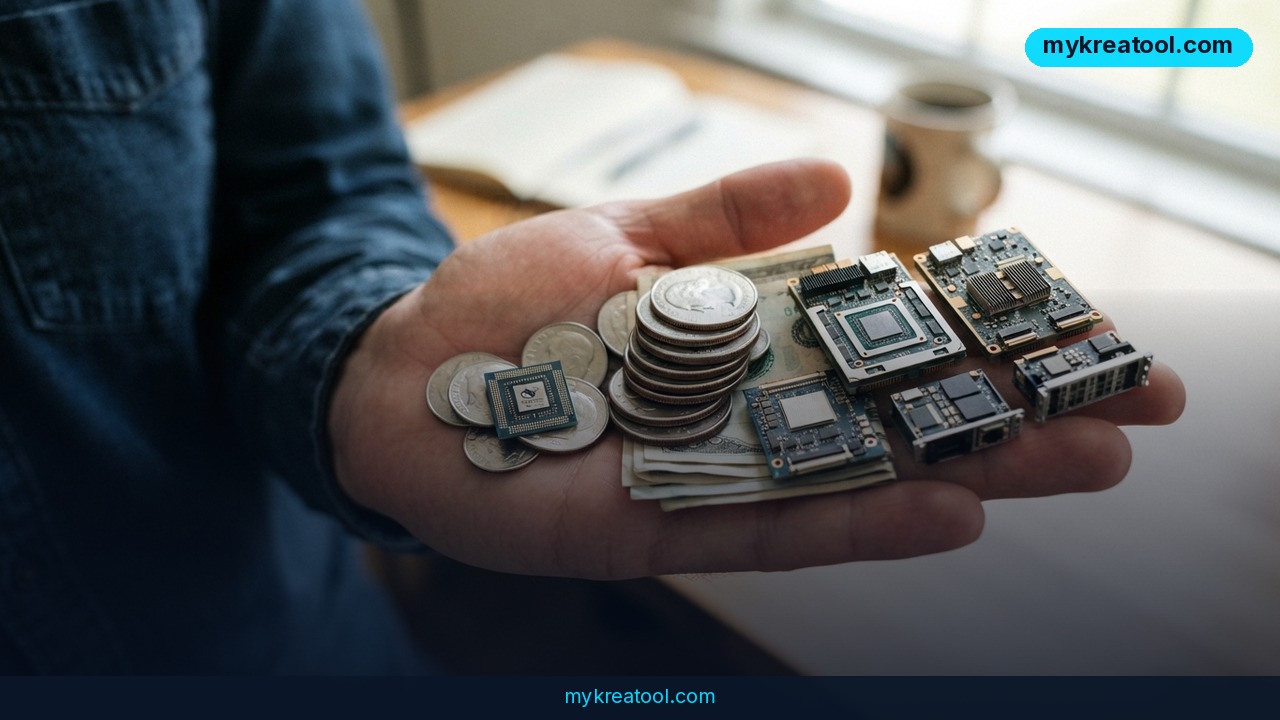
What happened
A new study is forcing businesses to ask an uncomfortable question: is your company paying 100 times more for AI than it needs to? Research firm Artificial Analysis just published a comparison of the cheapest AI model options on the market, measuring what it actually costs to run identical benchmark tests across the industry's leading systems.
The results, first reported by Reuters on August 3, 2026, show a staggering spread. DeepSeek's new V4-Flash model came out on top for affordability, averaging just 3 cents per benchmark test. Chinese rival Moonshot AI's Kimi K3 cost 86 cents per test — nearly 29 times more. On the U.S. side, OpenAI's GPT-5.6 Sol ran $1.86 per test, while Anthropic's Claude Fable 5 came in highest at $3.15 per test.
Do the math and the gap between the cheapest and most expensive model in the comparison is roughly 105x. For a single benchmark run, that's pocket change. At production scale — millions of API calls a month — it's the difference between a manageable line item and a budget crisis.
Why it matters
Token pricing isn't an abstract technical detail; it's a direct line to your monthly AI bill. Most businesses now run AI across customer support, content drafting, code review, data extraction, and internal search. Each of those workflows fires off thousands or millions of model calls.
If your team defaulted to a premium model like Claude Fable 5 or GPT-5.6 Sol for tasks that don't require top-tier reasoning — summarizing a support ticket, tagging a product description, drafting a first-pass email — you could be paying 30x to 100x more than necessary for comparable output quality on simpler tasks.
This pricing gap also reflects a broader trend: Chinese AI labs (DeepSeek, Moonshot AI) are aggressively undercutting U.S. competitors on cost while closing the performance gap on many benchmarks. That competitive pressure is good news for buyers, but it also means pricing sheets from six months ago are already outdated.
The real lesson isn't "switch to the cheapest model"
It's that most teams are running every task through the same expensive model by default, without ever benchmarking whether a cheaper option would do the job just as well.
How to use it today
Start by auditing your AI stack. Pull the last month of API logs and categorize your calls by task complexity: simple classification and formatting jobs versus complex reasoning, coding, or multi-step agent work. Simple tasks are prime candidates for a cheaper model swap.
Next, run your own side-by-side test. Take 20-30 real prompts from your workflow and run them through two or three models — one premium, one mid-tier, one budget option like DeepSeek V4-Flash — and score the outputs for accuracy and usability, not just cost.
If you want to experiment without committing to a paid API key or complex setup, you can test prompt formatting and compare AI outputs using free AI tools at mykreatool.com before deciding which model tier to route production traffic through. That kind of low-stakes testing is exactly how smart teams catch overspending before it becomes a habit.
Finally, consider a tiered routing strategy: send routine, high-volume tasks to the cheapest capable model, and reserve premium models for the small fraction of requests that genuinely need deeper reasoning.
Who benefits
Startups and solo founders stand to gain the most immediately — every dollar saved on inference is a dollar that stays in runway. Marketing teams running high-volume content generation (product descriptions, social captions, ad variations) can cut costs dramatically by shifting bulk work to budget models.
Developers building AI agents or chatbots that make frequent, small API calls will see the clearest savings, since costs compound with call volume. Agencies managing AI workflows for multiple clients can also improve margins by matching model cost to task complexity instead of using one model for everything.
Even larger enterprises benefit: at scale, a 10x or 100x price difference on routine tasks can free up budget to invest in premium models where they actually move the needle — complex analysis, high-stakes customer-facing content, or advanced coding tasks.
Risks
Cheaper isn't automatically better. Benchmark test costs measure token pricing under controlled conditions — they don't always reflect real-world task accuracy, latency, or reliability under your specific workload. A model that's 100x cheaper but produces output that needs heavy human editing may not actually save money once labor is factored in.
There are also practical considerations with providers like DeepSeek and Moonshot AI: data residency, content moderation policies, and terms of service differ from U.S.-based providers, which matters for businesses handling sensitive customer data or operating under strict compliance requirements.
Switching models also introduces integration work — prompt tuning, output formatting, and testing — that has a real cost even if the API itself is cheaper. And relying on a single low-cost provider creates vendor concentration risk if pricing or availability changes suddenly, which has happened before in this fast-moving market.
Conclusion
The Artificial Analysis study makes one thing clear: AI model pricing is no longer a minor line item to ignore. With DeepSeek V4-Flash running benchmark tests at roughly 3 cents versus Claude Fable 5's $3.15, businesses that aren't actively comparing model costs are very likely overpaying. The fix isn't to chase the cheapest option blindly — it's to match model tier to task complexity, test before you commit, and treat AI spend with the same scrutiny you'd apply to any other recurring cost.
Comments 0