What happened
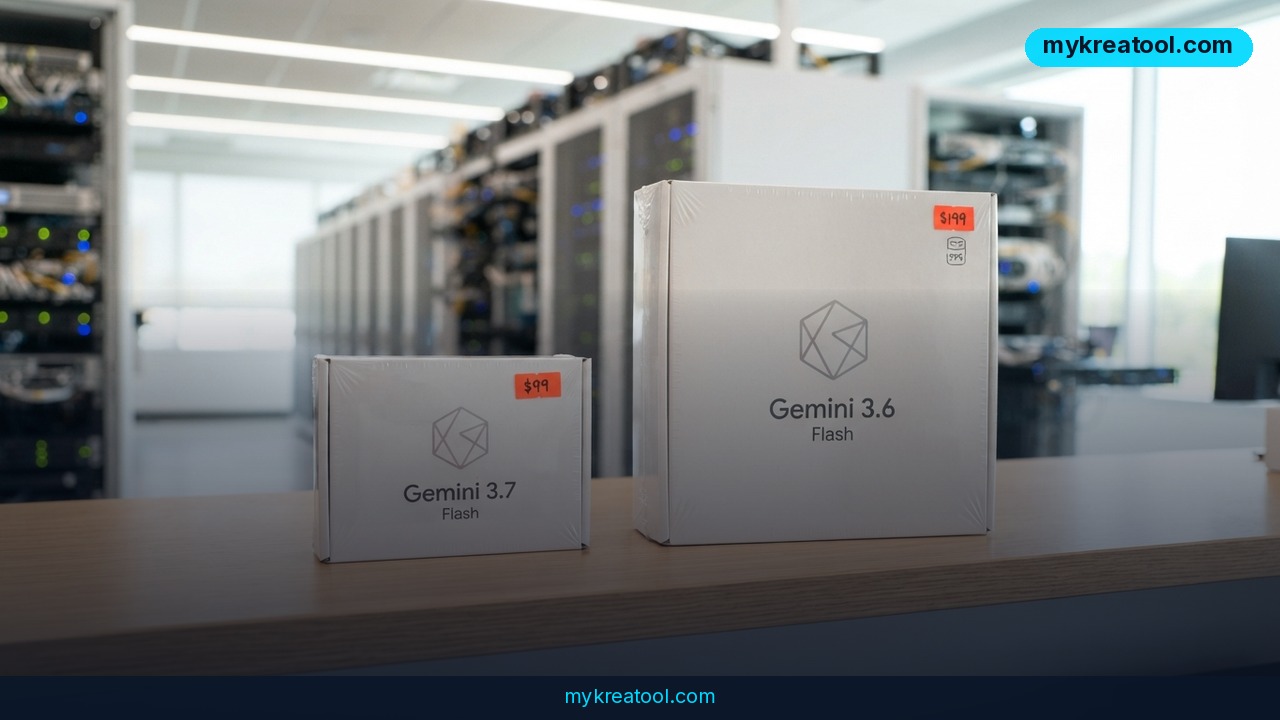
Google just shipped Gemini 3.7 Flash, and the timing alone is remarkable: it arrives only three weeks after Gemini 3.6 Flash, the model it replaces as Google's default "workhorse" for coding and AI agents. Google attributes the jump to what it calls "awesome algorithmic improvements" rather than a larger training run, and the numbers back up the claim. On the FrontierCode benchmark, Gemini 3.7 Flash scores 43.6 percent, up from 34.4 percent for 3.6 Flash. On DeepSWE, a benchmark focused on real-world software engineering tasks, it hits 65.3 percent versus 49.0 percent for its predecessor. Google also reports gains in web development, document comprehension, and business process automation, though those figures come from Google's own internal testing rather than an independent lab.
The pricing move is just as aggressive as the performance jump. Gemini 3.7 Flash launches at $0.75 per million input tokens and $3.75 per million output tokens — exactly half of what 3.6 Flash cost when it debuted three weeks ago. Google has also retroactively dropped 3.6 Flash to the same price point, so both models now sit at identical rates. The model is live now through the Gemini API, Google AI Studio, and Antigravity, Google's agentic coding environment.
The benchmark claims
According to Google's measurements, Gemini 3.7 Flash now outperforms both Claude Sonnet 5 and GPT-5.6 Terra on coding tasks. That's a bold claim worth treating with some skepticism, since vendor-run benchmarks tend to favor the vendor's own model. Still, the magnitude of improvement over 3.6 Flash — roughly a 9-point jump on FrontierCode and a 16-point jump on DeepSWE in just three weeks — is large enough to be meaningful even after accounting for benchmark-selection bias.
Why it matters
Three weeks between major model releases is an unusually fast cadence, even by 2026 standards. It signals two things at once: Google's training and evaluation pipeline for its Flash tier has become fast enough to iterate almost weekly, and the competitive pressure from Anthropic and OpenAI is forcing faster cycles across the industry. When a $0.75/$3.75 model claims to beat frontier competitors on coding benchmarks, it changes the calculus for any team currently budgeting API spend around a more expensive model.
The price cut matters just as much as the benchmark gains. Coding agents and automation workflows tend to burn tokens fast — long context windows, multi-turn tool calls, and iterative code generation all add up. Halving the cost per token while improving code quality effectively doubles the value per dollar for anyone running agentic workflows at scale. That's a meaningful shift for startups and solo builders who've been rationing API calls to stay within budget.
A narrowing gap between price and performance
What's notable is that Google isn't positioning 3.7 Flash as a budget option that trades quality for cost — it's explicitly framed as a price-to-performance leader that also claims to beat pricier frontier models on specific coding benchmarks. If that holds up under independent testing, it undercuts the assumption that better code generation always requires a premium-tier model.
How to use it today
Getting started with Gemini 3.7 Flash doesn't require waiting for a broader rollout — it's already accessible through three channels. Developers can call it directly via the Gemini API using the same integration patterns as previous Flash models, so migrating from 3.6 Flash should mean little more than swapping a model identifier. Google AI Studio offers a no-code way to test prompts and coding tasks in the browser before committing to production use. For teams building autonomous coding agents specifically, Antigravity is Google's dedicated environment for agentic workflows and is the most direct path to testing the DeepSWE-related gains.
Before migrating a production workload, it's worth running your own comparison rather than trusting benchmark tables alone — prompt a handful of real coding tasks through both the old and new model and compare output quality, latency, and token usage. If you want to experiment with prompts or compare outputs across different AI models without setting up API keys first, sites like mykreatool.com offer free AI tools that let you test ideas quickly before committing to a paid integration.
Practical migration notes
Since Google collapsed 3.6 Flash and 3.7 Flash to the same price point, there's no cost penalty for testing the new model against your existing prompts. The main variable to watch is output formatting — algorithmic changes between model versions can occasionally shift how code is structured or commented, so regression-testing any automated pipelines is worth the extra hour.
Who benefits
The clearest winners are teams building coding assistants, AI agents, or automation tools where token volume is high and margins are thin. Startups running customer-facing AI features on tight budgets get an immediate cost reduction without a quality trade-off, based on Google's benchmarks. Agencies and freelance developers using AI for code review, debugging, or scaffolding gain a cheaper option that Google claims performs competitively with premium models like Claude Sonnet 5. Enterprises running large-scale document comprehension or business process automation also stand to benefit from the reported gains in those categories, not just coding.
Marketers and creators building lightweight internal tools — dashboards, scrapers, simple automations — benefit indirectly too: cheaper, more capable coding models make it more affordable to have AI generate and maintain that tooling rather than paying a developer's hourly rate.
Risks
The biggest caveat is that all comparative benchmarks — including the claim of beating Claude Sonnet 5 and GPT-5.6 Terra — come from Google's own testing, not a neutral third party. Treat those specific claims as a starting hypothesis, not a verified fact, until independent evaluations appear.
The pricing itself is also explicitly temporary. Google states the $0.75/$3.75 rate holds only through the end of 2026, and given that 3.7 Flash replaced 3.6 Flash after just three weeks, it's reasonable to expect another model — and another price change — before the current one becomes outdated. Teams building long-term cost projections around this pricing should build in room for both.
Finally, this release cadence itself is a risk for anyone building stable production systems. A new model every few weeks means more frequent regression testing, more monitoring for silent behavior changes, and less certainty that today's benchmark numbers will still apply next month.
Conclusion
Gemini 3.7 Flash is a fast, aggressive move from Google: better coding benchmarks, a 50 percent price cut, and availability across the API, AI Studio, and Antigravity — all just three weeks after its predecessor. The claimed edge over Claude Sonnet 5 and GPT-5.6 Terra deserves independent verification, but the combination of lower cost and higher reported code quality makes this a model worth testing now, especially for teams running token-heavy coding agents or automation pipelines. Just don't assume today's price or ranking will still be true a month from now.


Comments 0