What happened
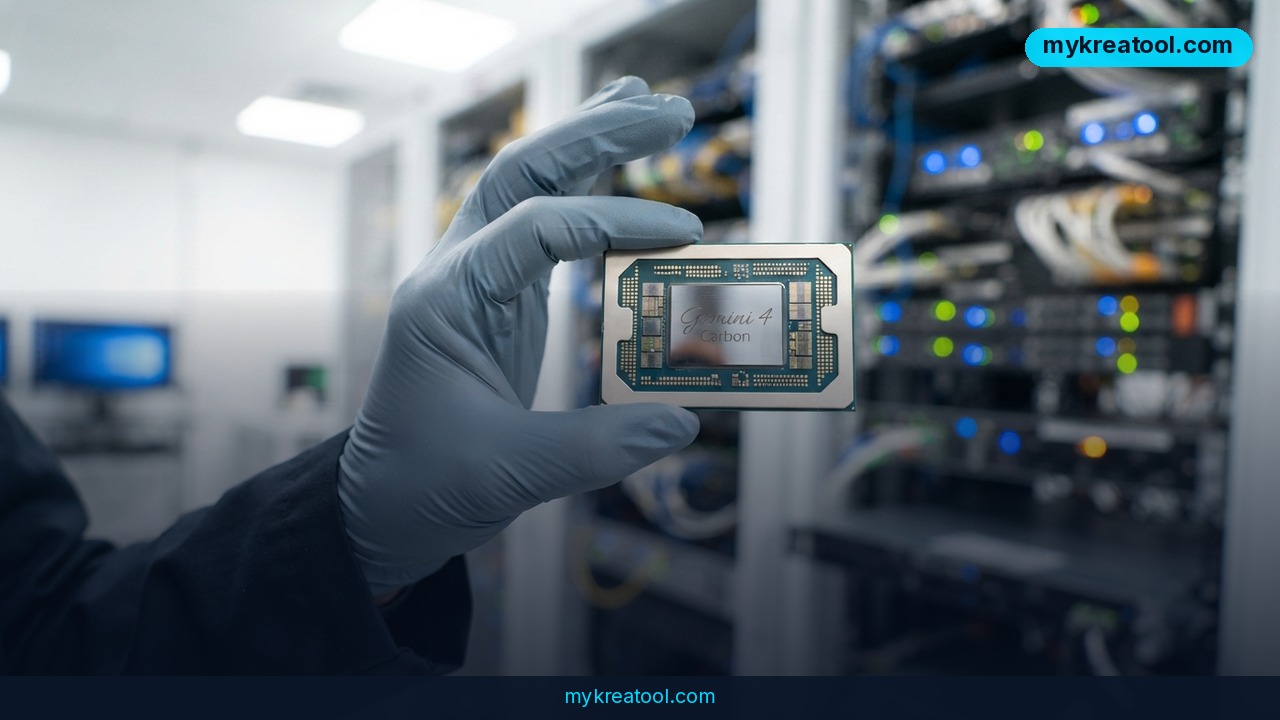
On November 10, 2026, Google DeepMind released Gemini 4 Carbon, its most capable model to date — the one it's billing as the strongest yet for cybersecurity work and for long, multi-step jobs in software engineering, knowledge work, and scientific research. Koray Kavukcuoglu, SVP of Google DeepMind and Chief AI Architect at Google, announced that developers, enterprises, scientists, and everyday consumers can all try it now.
"Frontier model" is jargon, so here's the plain version: labs ship several models at once, and the frontier one is the model they've pushed closest to the edge of what's possible. Think family sedan versus heavy-duty truck. Gemini 4 Argon, released shortly before Carbon, is still the sensible daily driver for most coding and office tasks. Carbon is built for the jobs that break lesser models — tangled multi-step debugging, open-ended research — and it spends more tokens (the word-chunks AI gets billed by) to think longer and check its own work.
Two weeks before the public launch, Google quietly put Carbon in the hands of a group of cybersecurity defenders through its Fairwind Program. That's usually a tell: a lab trusts a model's behavior enough to sit it next to people guarding real networks.
The scoreboard: three first places, less than half the price
Google ran Carbon against independent benchmarks built to test models inside real workflows instead of tidy test sets. It finished first on CursorBench 4.0, Perplexity's WANDR, and Zapier's AutomationBench — and did it at more than 2X lower cost per task than the next-best external model. Translated: it does the same job for less than half the money.
Google also partnered with Artificial Analysis to launch a new benchmark, the Multimodal Knowledge Agent (MKA), because existing tests didn't capture how agents read dense files stuffed with charts, images, blueprints, schematics, and tables. On MKA, Carbon ranks #2 while averaging more than 6X lower cost per task than the top performer. Second place at roughly a sixth of the price is usually the deal you actually take.
One prompt in, a whole team of agents out
Google is previewing /swarm inside Google Antigravity, its developer environment. Instead of one chatbot answering one prompt, /swarm turns a single request into a coordinated team of agents working in parallel isolated workspaces, with progress you can follow in real time. You assign Carbon to the roles that need the deepest reasoning — architectural design, coordination, auditing — and hand the lighter lifting to faster, cheaper models, while "adversarial verifiers" try to break every change before it lands.
The demos are the fun part. One Carbon swarm took historical photos and engineering plates and built an interactive Three.js 3D exhibition of the Eiffel Tower's 1887–1889 construction from a single prompt. Another chewed through seven public City Council planning PDFs — 206 extracted engineering drawing views — and produced a 906K-triangle Three.js reconstruction of Google's Platform 37 office across 10 overnight loops. A third turned an academic paper into an interactive textile visualizer with 3D yarn meshes and 110-fiber polar tracking, with minimal prompting.
What it means for you
You don't need to write a line of code for any of this to matter. The pattern underneath is simple: hand over a messy pile of documents or a vague goal, get back something finished. That pattern shows up in almost every part of life.
At home: renovation paperwork stops being a nightmare
If you've ever stared down a council planning file, you know the pain. The Platform 37 demo is the blueprint for ordinary people: feed in the PDFs, ask for the dimensions, conflicts, and a simple 3D model you can spin around. What used to be a weekend with a highlighter becomes a conversation.
At work: the debugging partner that never gets tired
Carbon is aimed at the tasks that make people give up — the bug that only appears on Tuesdays, the migration that touches forty files. It explores longer and verifies its own changes, which is the difference between a colleague who guesses and one who checks.
For a small business: dense documents, plain answers
Legal, finance, and enterprise operations are the launch targets. Carbon combines visual understanding with exhaustive retrieval so it can synthesize answers across large sets of dense documents, and follow strict schemas to generate polished spreadsheets, presentations, and reports. A two-person accounting firm can now answer a client's contract question in minutes without hiring a researcher.
For students: from paper to working model
The textile visualizer demo is a study tool in disguise. Instead of reading a paper about a virtual-fiber finite element framework and hoping it sticks, you get an interactive 3D model with stress-strain curves you can drag. Understanding compounds when you can poke at it.
For creators: history you can walk around
An interactive Eiffel Tower build made from the original construction photos and engineering plates, generated from a single prompt, is a taste of what a small studio can ship. If you make explainers, museum content, or brand worlds, the cost of producing a browsable 3D scene just fell off a cliff.
For your income: bidding on bigger jobs
Freelancers usually lose the big contracts because they can't staff them. A swarm of agents handling research, drafting, and review changes that math — you quote the project you couldn't have taken last year. If you want to sharpen your prompting before you spend a cent on API calls, free AI tools like MyKreaTool make a good warm-up bench.
How to try it right now
Step 1 — use what you already pay for. If you're a Google AI Ultra subscriber, Carbon is rolling out to you inside the Gemini app, in AI Mode in Search, and in Google Antigravity. Zero setup, no new bill, no credit card.
Step 2 — everyone else: open Google AI Studio. Sign in with a Google account and use whatever free usage your account includes to test prompts before spending anything. When you're ready to scale, the API costs $2 per million input tokens and $10 per million output tokens — the same introductory price as Gemini 4 Argon, so stepping up to the heavier model doesn't cost more per token.
Step 3 — ask for outcomes, not steps. "Rebuild this office from these seven PDFs as an interactive 3D model" beats "summarize page one." Carbon gets its best results when it has room to plan.
Step 4 — only then reach for /swarm. Inside Google Antigravity, try the preview on a project with clear pieces: one agent designs, others build in parallel, verifiers check the work. Start small — an overnight loop on a real task is cheaper than you'd guess.
Step 5 — keep a human on the final gate. Check anything that ships: code, contracts, numbers in a spreadsheet.
Upsides and what changes
The obvious win is price-to-performance. Best-in-class results on three workflow benchmarks at less than half the cost per task, plus a #2 spot on a brand-new multimodal benchmark at more than 6X lower average cost, means serious work stops being a budget line reserved for big companies. The second win is structure: /swarm moves AI from "one assistant answering questions" to "a small team with roles," which is how real projects actually get done. And because Carbon pairs with cheaper, faster models in parallel, you're not paying premium rates for busywork.
Limitations
A few honest caveats. Benchmarks measure what benchmarks measure — passing CursorBench 4.0 or Zapier's AutomationBench doesn't guarantee your specific, messy workflow works on day one, and vendor-adjacent scores always deserve a grain of salt. Carbon is deliberately token-hungry; it spends more to reason deeply, so a low per-token price can still produce a chunky bill if you let it run wild on an overnight loop. /swarm is a preview, which means features and interfaces can change under you. And frontier cybersecurity capability is a double-edged sword: the same reasoning that helps defenders also raises the stakes for everyone, which is exactly why Google's Fairwind Program ran before the public launch. Treat it as a very capable junior teammate who still needs review, not an oracle.
Conclusion
Gemini 4 Carbon is Google's bet that the next jump in AI isn't a better chat window — it's a model that thinks longer, costs less per finished task, and can be split into a tracked team of agents. The pricing is deliberately boring ($2 per million input tokens, $10 per million output tokens, same as Argon), which is a quiet way of saying: use the strong one.
Your one action today: open the Gemini app if you're on Google AI Ultra, or sign in to Google AI Studio otherwise, and give Carbon a single messy, real task from your own week — a stack of PDFs, a bug, a spreadsheet nobody wants to rebuild. One prompt, one honest test. That's how you'll know whether this changes your workflow.


Comments 0