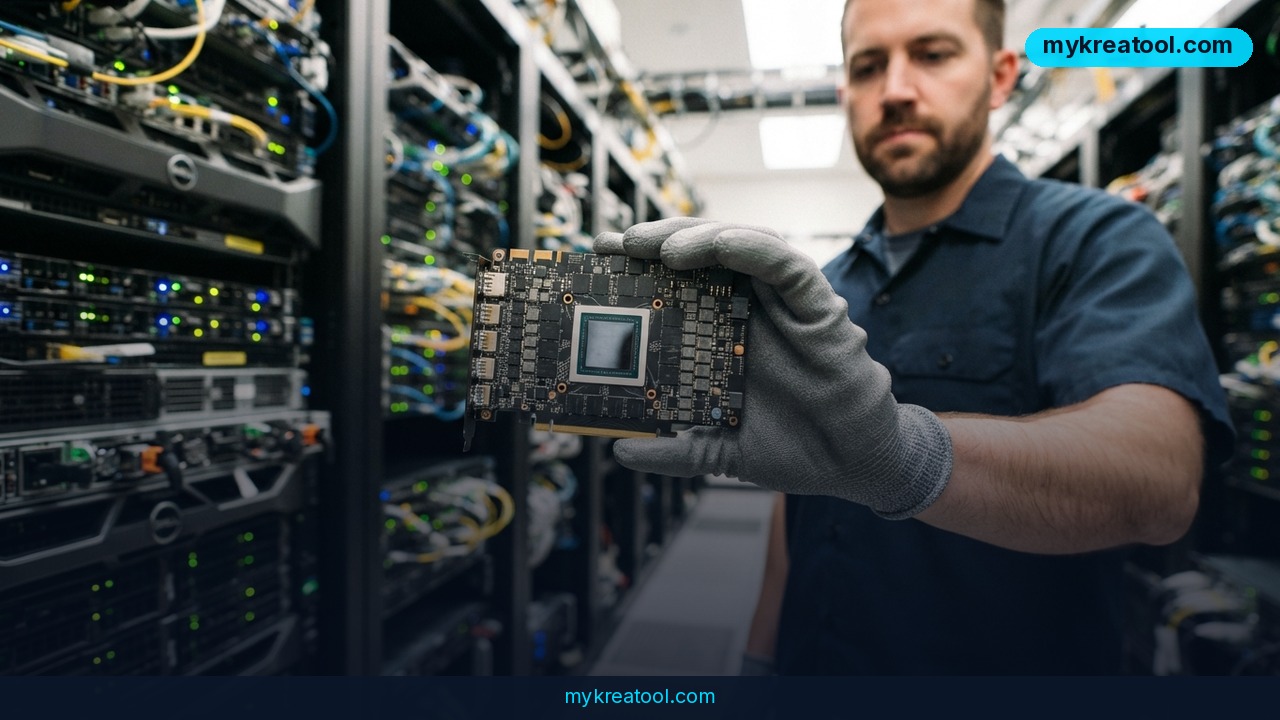
Eight times faster sounds like marketing math — until you picture what it does to a task you repeat all day. GPT-6 Astra Ultrafast is OpenAI's new speed tier for its Astra model, running on NVIDIA Blackwell GPUs. It's live now in the OpenAI API and for eligible ChatGPT Work and Codex users, and it generates tokens up to 8x faster than Astra Standard mode.
What happened
NVIDIA announced the launch on its own blog: same model, same quality of answer, dramatically quicker output. The speed comes from inference optimizations that tap into the capabilities of the NVIDIA Blackwell architecture.
Quick glossary, because the jargon gets thick fast:
• Inference is the moment a trained model actually answers you. Training is the years of studying; inference is the exam itself.
• GPU is a chip built to do thousands of simple calculations at once — perfect for language models, which are basically giant piles of multiplication.
• Blackwell is NVIDIA's current generation of that chip design.
Put it together and the story is simple: OpenAI didn't shrink the model to make it fast. It taught the same model to run far more efficiently on the hardware it already lives on.
What "8x faster tokens" actually means
A token is a chunk of text, roughly three-quarters of an English word. "Tokens per second" is just how fast the model types. At 8x, a passage that used to appear in about eight seconds shows up in roughly one.
On a single question, that's pleasant. Inside a loop that runs fifty times, it changes what's possible.
Why agent loops are where speed really pays
An AI agent doesn't answer once and stop. It writes code, runs a tool, reads the result, and decides what to do next — over and over until the job is done. As NVIDIA frames it, faster generation shortens a coding agent's edit-test-debug cycle, trims the time spent generating responses between tool calls, and makes interactive apps feel more responsive.
Think of a kitchen. A fast cook is nice. A fast cook working a 40-order dinner rush is the difference between a restaurant and a meltdown.
Philippe Tillet, inference lead at OpenAI, credits NVIDIA's investment in tooling and documentation with making OpenAI's models "exceptionally good at programming Blackwell and Rubin GPUs," adding that Astra turns that knowledge into high-performance kernels. Performance also doesn't freeze at launch: OpenAI is using its own models to keep refining the inference software running on NVIDIA GPUs, so responses can keep getting faster over time.
What it means for you
You don't need to know a GPU from a toaster. You do need to care about how many times a day you sit and wait.
At home
If you use AI to plan a trip, draft an email, or untangle a grocery list, the shift is subtle: the answer lands before your attention wanders. That matters more than it sounds. Most people abandon an AI task not because the answer was bad, but because they started scrolling while they waited. Faster output keeps you in the flow instead of half-checked out.
At work
Knowledge work is full of little loops: draft, check, revise. When each pass takes one second instead of ten, you stop batching chores for "later" and just finish them. Reports, summaries and cleanup jobs shrink from a scheduled event into something you knock out between meetings. If you want a free side bench for a few of those everyday jobs, the tools at MyKreaTool are worth a look.
For business owners and freelancers
Every second of wait time is a second you're paying for. Support bots answer faster, onboarding flows stall less, and customer-facing tools feel sharper. The income angle is direct: if you bill for output — copy, code, designs, reports — you fit more finished work into the same working day without hiring anyone.
For students
Long reading, note-taking and practice questions are all repeat-loop work. Faster responses mean less dead air between "I don't get this" and "here's another way to see it." Use that speed to ask more and better follow-up questions, not to accept the first answer and run.
For creators
Iteration is the entire job. Ten versions of a hook, a rewrite in a different voice, a fresh set of descriptions — most of the work is waiting for v2 through v15. Cut that wait 8x and a "maybe later" idea becomes something you actually ship this afternoon.
How to try it right now
1. If you already have ChatGPT Work or Codex — check whether your account is eligible. Ultrafast is available to eligible users, so open your workspace or Codex session, find the model or speed selector, and pick GPT-6 Astra Ultrafast if it's showing.
2. If you're a developer — GPT-6 Astra Ultrafast is available through the OpenAI API today. OpenAI's Ultrafast guide covers access, pricing and implementation details, so read that before you touch anything in production.
3. Free option first — no access yet? You'll still get real work done on the free tier of ChatGPT for everyday drafting and research, and you can save your heaviest agent-style jobs for whenever your workspace gets Ultrafast. The speed boost is a bonus, not a gate.
4. Run one honest test — pick a task you repeat daily and time it. Do it today on your current setup, then again once you have Ultrafast. If the loop drops from five minutes to forty seconds, you'll feel it without any benchmark rig.
Upsides and what changes
The obvious win is throughput: AI shifts from an event you schedule to a utility humming in the background. Developers get the biggest jump, because the time between "I changed a line" and "here's what broke" is where their day actually goes.
There's a quieter upside too. NVIDIA's platform is programmable, which means the same infrastructure can be reused across training, inference and reinforcement learning as models evolve. Teams can repurpose compute when demand shifts, get better utilization, and avoid overbuilding for every single workload. In plain English: same hardware, more jobs, less waste — and less waiting on your end.
Limitations
Be clear about what 8x buys you. It's 8x faster token generation, not 8x smarter — a vague prompt gets a vague answer quicker. The headline number is a best case tied to NVIDIA Blackwell hardware and to real-world load, so don't expect an identical multiplier on every request. Availability is limited for now: Ultrafast reaches the OpenAI API and eligible ChatGPT Work and Codex users, which means plenty of people can't switch it on yet, and pricing isn't spelled out in this announcement — check the Ultrafast guide for that. Faster loops also burn through usage and budget faster if you pay per token, so it's worth watching spend in the first week. And none of this fixes the basics: agents still make confident mistakes, so you still check the output.
Conclusion and one action for today
GPT-6 Astra Ultrafast is the same Astra intelligence with the waiting stripped out — up to 8x faster token generation on NVIDIA Blackwell GPUs, served through the OpenAI API and to eligible ChatGPT Work and Codex users today. It won't rewrite your business, but it will shave the friction off everything you do on repeat.
Your one action: write down the single task you do at least five times a day, time how long one full round takes you right now, and check whether your ChatGPT Work or Codex account already has Ultrafast. That number — today's minutes versus tomorrow's seconds — is the only benchmark that matters.


Comments 0