What happened
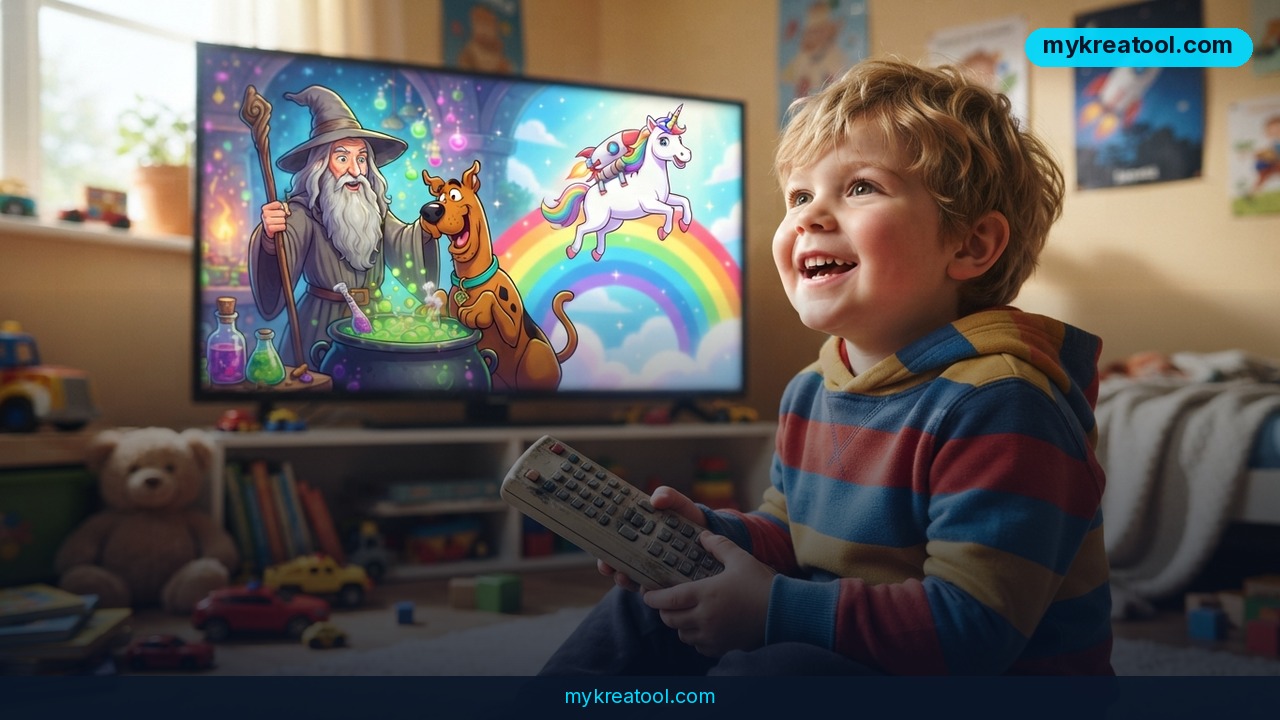
A Russian AI company called GPTunneL just launched something that sounds like a joke until you actually watch it: an AI TV channel where anyone can type a prompt into a chat box and see their own video, generated entirely by artificial intelligence, air live on screen roughly 20 to 25 seconds later. It's called Grom TV, and it bills itself as the first ongoing, never-ending AI-generated TV channel of its kind. Instead of a programming schedule, there's a chat window. Instead of actors, there's a video model rendering whatever the crowd asks for — in real time, in front of everyone watching.
Type "Walter White brews potions in Snape's classroom" or "Mickey Mouse in film noir style" and the system generates an 8-second video clip, complete with synced audio, and slots it into the live stream. If there's dialogue, the model even syncs the mouth movements to the words — what's called lip-sync. Other people's clips play right alongside yours, so the channel becomes a weird, constant mashup of everyone's ideas at once.
You can watch and try it yourself at gptunnel.ru/lab?section=tv. It's free to sign up, and the prompt box sits right next to the video player.
Why this is technically hard
Most AI video tools work like ordering takeout: you submit a request, wait, and pick up the finished file whenever it's ready. A live channel can't work that way. If the AI falls even half a second behind the broadcast, the stream stutters or freezes completely — think of a factory conveyor belt where a new part has to appear before the last one rolls off, or the whole line jams.
GPTunneL says each 8-second clip takes about 7.8 seconds to generate. That 0.97 ratio (generation time versus playback time) means the system is generating video very slightly faster than people can watch it, which is the only way a live, unscripted, prompt-driven channel can stay online without buffering. The whole thing reportedly runs on a single Nvidia B200 chip, with a second one sometimes added for speed — not a data-center's worth of GPUs, which is notable given how compute-hungry video generation usually is.
The idea isn't entirely new. In late 2022, a studio called Mismatch Media ran "Nothing, Forever" on Twitch — an endless, AI-generated parody of Seinfeld where a language model wrote the jokes and a text-to-speech engine voiced them. It went viral fast. Grom TV pushes the same never-ending, always-on concept into full video instead of just dialogue and cartoon frames.
What it means for you
You don't need to work in tech for this to be useful or just fun. A few concrete ways people are already using tools like this:
• At home: Put on a themed "channel" for a party — feed it prompts based on an inside joke or a shared fandom and let guests add their own live.
• At work: Marketers and social teams can rapid-prototype short video concepts — mashups, character crossovers, mood boards in motion — without booking a video editor for a first draft.
• Running a business: Test which visual ideas or characters get attention before committing budget to a full production; a live audience reacting to clips is a cheap focus group.
• Studying: Media and film students can see, in seconds, how a prompt translates into shot composition, lighting style (the noir example above), and character consistency — a fast way to learn visual language.
• Creative projects: Writers and artists can use it as a mood-board generator, throwing out odd combinations to spark ideas they wouldn't have storyboarded themselves.
• Income: Streamers and community managers could run a themed channel as an interactive draw, since the format is inherently a live, participatory show rather than a one-way broadcast.
If you want to experiment with other free AI tools for writing, images, or quick utilities before committing to a paid subscription anywhere, a site like mykreatool.com is a reasonable place to start, since it bundles several no-cost AI tools in one spot rather than making you sign up for five different services.
How to try it right now
1. Go to Grom TV — that's the free option, and it's the only way to try this specific product right now.
2. Create a free account (basic registration, no credit card mentioned).
3. Type a prompt into the chat field next to the video player, the same way you'd message a friend.
4. Wait about 20 to 25 seconds.
5. Watch your clip play live on the channel, alongside everyone else's.
That's the entire process — no software to install, no video editing skills needed, no waiting in a render queue for a file to download.
Upsides and what changes
The biggest shift here isn't the video quality — 8-second clips at roughly 24 frames per second aren't going to replace a film studio. It's the format. Video generation stops being a solitary, asynchronous task (type a prompt, wait, download a file, watch alone) and becomes a shared, live event, more like a group chat than a content pipeline. That changes what people use it for: less "I need a finished asset," more "let's see what happens." It also lowers the bar for casual experimentation, since there's no learning curve beyond typing a sentence, and the near-8-second generation-to-playback ratio proves that real-time AI video, at small scale, is no longer purely theoretical — it's running today on a single high-end GPU chip rather than a server farm.
Limitations
Be realistic about what this is and isn't. Clips are short (8 seconds), so it's not a tool for telling a longer story or producing marketing-ready video out of the box. Output quality depends entirely on how well the model already "knows" the characters or styles you reference — the examples that work best (Mickey Mouse, The Simpsons, well-known movie scenes) lean on characters the model was already trained to recognize, so wildly original or highly specific requests may render less convincingly. It's also a live, public feed: your prompt and the resulting clip are visible to everyone else watching at that moment, so it's not the place for anything private or work-sensitive. And since it's a new product from a single company, expect rough edges, possible downtime, and no guarantee the free access stays free or unlimited forever.
Conclusion
Grom TV shows that AI video generation has crossed a real threshold: fast enough to broadcast live, not just render offline. It won't replace produced video content, but as a genuinely new, low-effort way to see an idea turned into moving pictures in under half a minute, it's worth five minutes of your time today. Action for today: open Grom TV, register, and type one specific, weird prompt — you'll know within 25 seconds whether this kind of live AI video has a use for you.


Comments 0