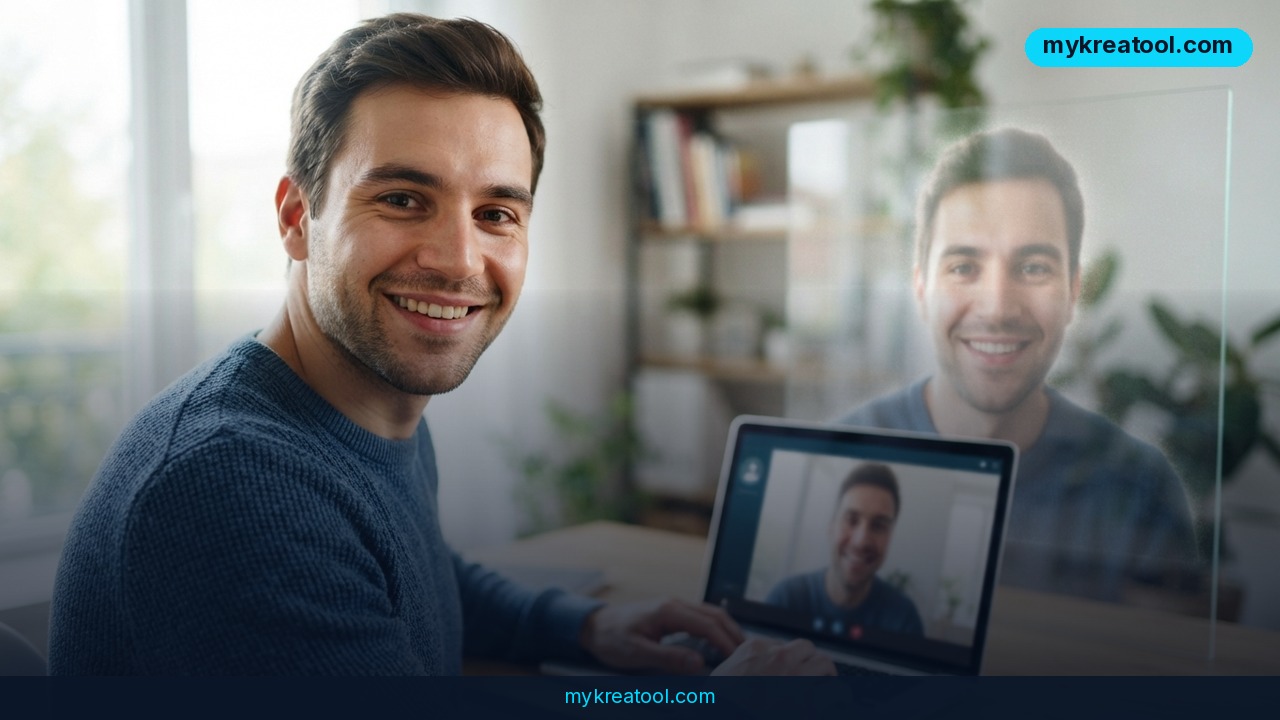
Imagine wrapping up a one-minute video call with a friendly stranger, then finding out there was never a person on the other end. That's what happened to 48% of the people who tried a new AI avatar from Tavus, a San Francisco startup. Nearly half of them finished a short video chat convinced they'd been talking to a human. The previous best result on this kind of test was two percent.
What happened
Tavus launched a system called Griffin, which the company calls the first "Human Interaction Model," or HIM. If "model" sounds like jargon, here's the plain-English version: a model is the engine under the hood. A car engine turns fuel into motion; an AI model turns input into responses. The twist with a HIM is that it's built for face-to-face talk, not typing.
Griffin handles the messy parts of conversation — speech, facial expressions, tone of voice, gestures and pauses — while it's both listening to you and generating video of itself. So it's not a chatbot with a camera taped on. It's closer to a video partner who watches you while you speak.
Griffin reads the room, not just a script
Older AI video tools were basically talking heads on a loop: they played a clip and waited for you to finish your sentence. Griffin reacts in real time. In plain terms, it's reading the room — your raised eyebrow, the half-second pause before you answer, the way your voice drops when you're unsure.
Think of the difference between a voicemail greeting and a barista who notices you look tired and asks if everything's okay. One plays a recording. The other responds to you.
The numbers that make this a story
• 48% of study participants believed Griffin was a real person after a one-minute video call.
• Previous systems topped out at two percent.
• In a test Tavus describes as independent, Nvidia measured how human an AI feels in a live audio-video conversation. Griffin scored 3.83 points.
• Actual humans scored 3.92. The best previous AI model managed 2.80.
Look at that last pair. Griffin sits 0.09 points below us, while the old state of the art was more than a point behind. On this particular yardstick, the gap between "clearly a machine" and "basically a person" has almost closed.
What you can actually get today
A preview called Griffin-Lite is available to "select testers as a research preview." A more capable version is coming once "safety concerns are addressed," according to Tavus. The company lists tutoring, practicing difficult conversations, and camera-based tech support as potential use cases.
Background worth knowing: Tavus was founded in 2020 and has raised about $64 million. It started out making personalized AI videos for sales and marketing, then moved into live video conversations with digital personas. More details are in the Tavus research report.
What it means for you
You don't need a research lab to feel this shift. If a machine can pass as human for a full minute, the question stops being "is this impressive?" and becomes "where does this show up in my life?"
At home
Think about the last time you spent twenty minutes on hold with a utility company, or helped a parent figure out why their printer stopped working. A patient avatar that can see your screen, hear your frustration and walk you through it — that's what Tavus is pointing at with camera-based tech support. The upside is real. So is the unease of not knowing whether the helpful person on the other end is a person at all.
At work
Remote interviews, vendor demos, and quick client check-ins are all one-minute conversations that could plausibly be handled by an avatar. That cuts both ways. You'll save time on routine calls, and you'll also need a new habit: verifying who's actually on the other side when money or access is at stake. A one-minute call is no longer proof of anything.
In business
For founders and marketers, the pitch is straightforward. Instead of recording a video and hoping it lands, you can run a live, personalized conversation at scale — the same thing Tavus started out doing with AI videos for sales. For small teams, that's a lot of reach for very little money. For buyers, it means the "sales rep" in the demo may not exist.
For studying
Tutoring is one of the named use cases, and it's the least controversial one. A language partner who never gets bored, a patient explainer for a subject you're embarrassed to ask about twice, a rehearsal partner for a presentation — these are genuinely useful. The catch is trust: you need to be sure the avatar isn't confidently making things up.
For creative work
Writers, filmmakers and game designers get a new kind of performer. You can hold a scene, test how a line lands on a face, and rewrite on the spot instead of booking a shoot. The flip side is the same fight the music and stock-photo industries already had — when a performance can be generated, what's a performer worth?
For a side income
Opportunities usually show up where a new tool meets an old bottleneck. Personalized video outreach, niche tutoring, and avatar-run tech support are three obvious ones. If you want to test the waters cheaply, mykreatool.com collects free AI tools you can experiment with before spending a cent.
How to try it right now
Free option first: Griffin-Lite itself. It's the research preview Tavus is handing to select testers, so access is free but approval is gated — you can't just sign up and start talking today.
1. Ask Tavus for Griffin-Lite access. Go to the Tavus site and request the research preview. Don't expect an instant yes; it's explicitly limited to select testers.
2. Write a 60-second script. One minute is the benchmark from the study, and it's also long enough for an avatar to slip up. Pick a topic you know cold so you notice when it fudges.
3. Run the blind test on a friend. Don't tell them what's on the call. Ask one question afterward: human or machine? That's the same question 48% of participants got wrong.
4. Keep a tell list. Note the exact moment you felt something was off — a late pause, an unnatural blink, an answer that arrived a beat too fast. This is how you build judgment for the real thing.
5. If you're waitlisted, practice with free avatar and voice tools in the meantime. They're nowhere near 3.83, but they'll teach you where these systems break.
Upsides and what changes
The most useful change is availability. A patient tutor, a low-stakes rehearsal partner, and screen-share help for your parents stop being a scheduling problem. Tavus has roughly $64 million and six years of work behind this, which tells you it's not a weekend demo.
The second change is social. Once someone passes for human in a one-minute video call, "I saw their face on camera" stops being a reliable way to confirm identity. Expect that to shift how people handle interviews, contracts and account verification.
Limitations
Keep the headline number honest: 48% believed it, which still leaves plenty of people who didn't. That was also a one-minute call — plenty of people crack the illusion at minute two. The Nvidia score of 3.83 still trails real humans at 3.92, and a single number can't capture how it handles accents, fast talkers, or someone who interrupts. Griffin-Lite is a gated research preview, not a product, and Tavus is holding the fuller version back until "safety concerns are addressed" — a phrase that cuts both ways. There's also the obvious darker use: impersonation and fraud, which will arrive faster than any fix. We don't know pricing, language coverage, or how the system handles being recorded.
Conclusion
Griffin matters less because it's clever and more because it's close. A 3.83 against a human 3.92, and a 48% fool rate after 60 seconds, means the line between "talking to software" and "talking to someone" is now about a minute wide. That's a big deal for tutoring, for support calls, and for anyone who trusts a face on a screen.
One action for today: write down three conversations you'd happily hand to an AI avatar — and one you never would. That list is your strategy, whichever way this goes.

Comments 0