What happened
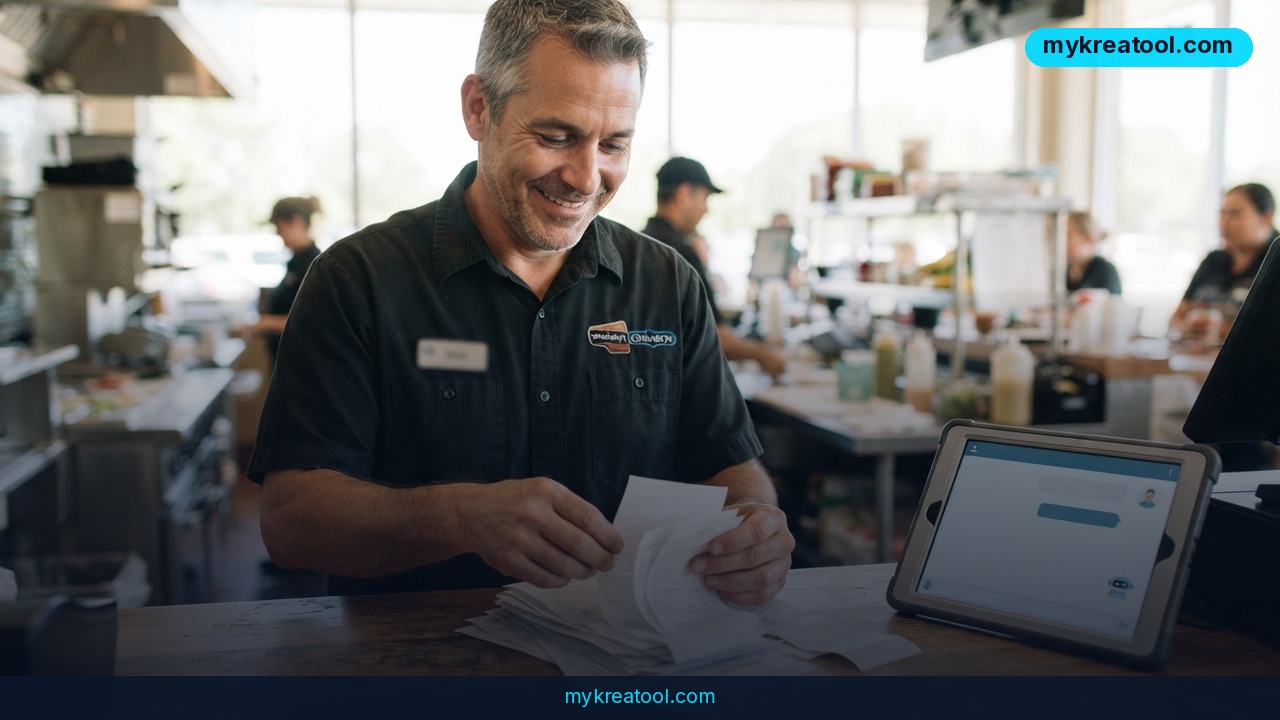
Ted Taylor spent 25 years in semiconductors before he got into the restaurant business. Today he's an independent franchisee running three co-branded Schlotzsky's and Cinnabon restaurants across New Mexico, and he's using ChatGPT Work to get through the parts of the job customers never see: menu pricing, staffing, equipment, policies, schedules.
The numbers OpenAI published on October 20, 2026 are the kind that make an operator stop scrolling:
• Pricing analysis time dropped 95%, from five days to one to two hours.
• Monthly cash reconciliation takes 94% less time.
• Every payroll run saves four hours of manual work.
• Optimizing the labor workflow could free up as much as $100K in annual cash flow.
No custom software. No analyst hire. Just a chat window, a spreadsheet, and clear instructions.
Menu repricing: five days down to an afternoon
Repricing a menu sounds like rounding a few numbers up. It isn't. You're weighing recipe costs, item popularity, local competitor pricing, portion sizes, and the fact that in-store and delivery orders run on completely different economics. Done properly, it used to eat about five days of Ted's year.
Now it takes one to two hours. He starts by asking ChatGPT Work to research competitors' pricing trends, portion sizes and relative food quality so he can set his targets. Then he hands over a categorized list of menu items with current in-store and delivery prices, says how much each group should rise overall, and flags which items should absorb bigger or smaller increases. Add item-level sales history and supplier prices and the model will estimate how sales react to each price change and optimize item by item around cost-of-goods targets. What comes back is a spreadsheet of recommended prices, tied to a strategy — protecting customer retention, avoiding price shocks, positioning add-ons well.
"ChatGPT Work's recommendations are so good that it's much faster to start there and then make adjustments," Taylor said. The first time he ran it, he also did the analysis by hand as a check. The model made a deeper local comparison and steered him away from increases that would have made some items uncompetitive. He never bothered doing the first pass manually again.
Where the payroll hours went
Labor was the second target. Taylor gave ChatGPT Work read-only access to his sales and labor data. On each run it compares scheduled, budgeted and actual hours against forecast and actual sales across all three restaurants, then tells him where each store needs attention. It also tests a better way to build the weekly schedule. Payroll runs now take four hours less, and the monthly cash reconciliation — matching what the books say against what actually landed in the bank — is 94% faster.
What it means for you
You don't need three restaurants for this to matter. The pattern is always the same: one recurring decision that pulls in a dozen messy factors, rebuilt from scratch every single time. ChatGPT Work behaves less like a search box and more like a tireless junior analyst — you hand over the ingredients, tell it what "good" looks like, and it drafts the answer.
Three plain-English terms before the examples:
• Prompt — the instruction you type. Think of it as a brief you'd give a new employee on their first morning.
• Workflow — a repeated sequence of steps for one job, like a recipe you follow every month.
• Data access — you let the AI read a file so it works with your real numbers instead of generic advice.
At home
Your household has a repricing problem too: insurance renewals, utility plans, subscriptions you forgot about. Instead of guessing, drop three months of spending into a chat and ask which categories grew fastest and where a cheaper alternative would save the most. It's the same logic Taylor used on his menu — find the items where a small change doesn't hurt anyone and quietly frees up cash.
At work
Anyone who owns a recurring report knows the drill: export, clean, cross-check, format. That's a workflow, and workflows are exactly what this tool is good at. Feed it last month's numbers plus the budget, ask for the variances ranked by size, and you've got the first draft of the review before your coffee goes cold.
Running a small business
This is where the story hits hardest. A single-location shop can do what Taylor did at three: price checking against local competitors, labor hours versus sales, and a monthly reconciliation that doesn't swallow a weekend. If you want to poke at cheaper tools before paying for anything, there's a decent free starting point at mykreatool.com — good for testing whether AI actually fits your workflow before you commit.
Studying
Students face the same shape of problem as a repricing pass: a big pile of inputs that has to turn into one structured answer. Give the model your syllabus and lecture notes, ask it to map topics to exam weightings, then check its summary against the source material. The drafting gets faster; the judging stays yours.
Creative projects
Creators usually stall on the boring middle — naming things, writing variants, cutting a long draft down. Ask for ten options with the reasoning behind each, then pick and edit. Treat it as a first draft machine, not a ghostwriter.
Earning extra income
Freelancers can bill the hours they used to burn on research. Competitor scans, quote comparisons, spec sheets — the kind of prep that used to take a day and can now take an hour, with the same deliverable on the invoice.
How to try it right now
Step 1 — Start with the free version
Open ChatGPT and use the free tier. You don't need to pay anything to find out whether this way of working suits you.
Step 2 — Write a brief, not a wish
The weak version is "help me with pricing." The strong version names the role, the job and the output format: "You're a pricing analyst. Here are my costs, competitor prices and sales history. Recommend item-level prices and return them as a table with a one-line reason for each change."
Step 3 — Give it real inputs
Paste or upload the actual list. A prompt with no data gets you generic advice, which is worth about what you paid for it.
Step 4 — Ask for a table you can paste back
Spreadsheet-shaped answers save you the reformatting step. Ask for columns, not paragraphs.
Step 5 — Check one run by hand
The first time, do what Taylor did: run the analysis yourself in parallel. It costs you an afternoon once and tells you exactly where the model is sharp and where it's guessing.
Step 6 — Move to ChatGPT Work when volume justifies it
Once a workflow proves itself, ChatGPT Work is the version built for pulling together large volumes of data across sales, forecasts, schedules and labor and handing back recommendations on where to focus. That's the setup behind the 95% and 94% numbers here.
Upsides and what changes
The obvious win is time: five days of pricing work becomes two hours, and four hours vanish from every payroll run. But the bigger shift is what gets done at all. When an analysis costs five days, you do it once a year and hope nothing moved. When it costs two hours, you can revisit pricing quarterly, or when a supplier raises costs, or when a competitor across the street drops their combo price.
There's also a quality effect Taylor didn't expect. His manual process had blind spots — competitive positioning on individual items, in his case — that the model caught because it was comparing more data than a person bothers to gather on a Tuesday night. And because the recommendation is a starting point rather than a final answer, his own judgment gets applied where it's worth the most.
Limitations
Being honest: this is not a set-and-forget machine. The model is only as good as the inputs and the instructions, and Taylor's results came from a specific person who knew his business well enough to brief the tool properly and to catch a bad suggestion. Pricing, scheduling and cash reconciliation all touch real money, so anything it returns needs a human check before it goes live — the 94% and 95% figures describe time saved on the analysis, not a guarantee that every recommendation was right. Small operators also need to think about who can see their sales and labor data before granting read-only access, and about the cost of the paid tier against the hours it actually saves them. Run it on one workflow first, measure the real result, and don't hand over the final decision.
Conclusion
A franchisee with a 25-year semiconductor career and three sandwich shops found $100K of potential cash flow and a pile of reclaimed hours by treating AI as a junior analyst rather than a magic button. The lesson isn't about restaurants — it's that the value sits in one specific, recurring, data-heavy decision you keep rebuilding from scratch.
One action for today: pick your version of menu repricing — the report, the reconciliation, the quote comparison — write a proper brief for it, and run it once in ChatGPT for free. Then compare the output to what you'd have produced by hand. That single test tells you more than any article can.



Comments 0