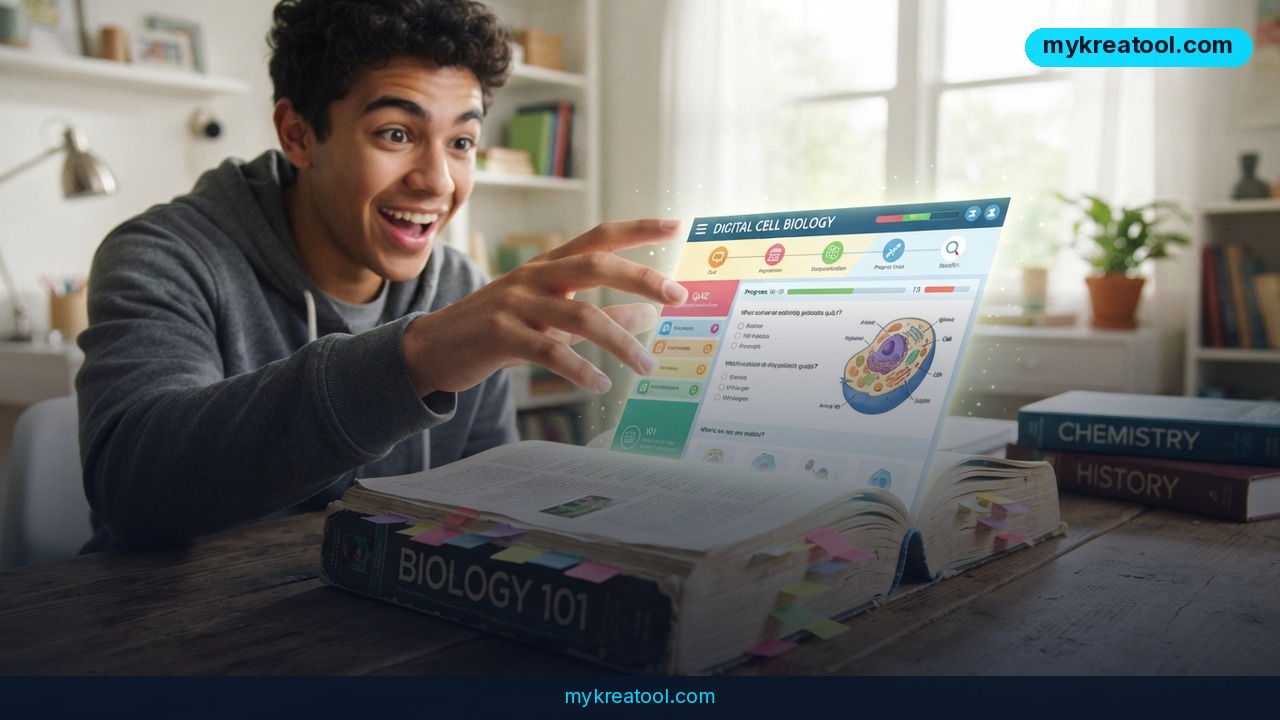
If you've ever stared down a 300-page textbook and felt your motivation evaporate, you'll want to see this. A hobbyist developer has built a free service on top of Claude — Anthropic's AI assistant — that turns any textbook into an interactive course: a personal learning site with plain-English explanations, practice tasks and quizzes. Within days of being posted on Telegram, the write-up racked up 1,749 views, 81 reposts and 19 reactions on the channel @gptpublic. That's a lot of people quietly thinking: finally, someone built the thing I actually need.
What happened
The concept is almost insultingly simple. You upload a textbook — any discipline, from organic chemistry to contract law — and the tool hands back a personal learning website built around that material. Instead of dumping hundreds of pages of dense text on your lap, the AI walks through topics one at a time, explains each one in plain language, then gives you tasks and quizzes so you can check whether any of it actually stuck.
The creator's own framing is the best pitch: this turns studying from "I have to read 300 pages" into something interactive. And it works at no cost.
The engine under the hood is Claude
None of this is a magic trick pulled out of thin air. Claude is already documented as being able to generate educational content — structured web pages, quizzes and study materials — directly from documents you upload. Xavier University's teaching-with-technology resource library lists Claude among the tools instructors use for exactly this kind of work, and Anthropic runs Claude for Teachers, a free program that gives educators access to Claude's classroom capabilities.
So the enthusiast didn't invent a new AI. They built a friendly front door around a capability that already existed — which is arguably more useful, because it means you can do the same thing yourself today. No invite, no app store, no waiting list.
The numbers behind the buzz
The original Telegram post landed 1,749 views and 81 reposts, with 19 reactions — modest by viral standards, but the repost-to-view ratio is high. People weren't just reading it; they were forwarding it to friends who study. That's usually the sign of a tool that solves a real, boring, recurring problem.
If you want more shortcuts like this — free AI tools that do one job well — there's a running collection at MyKreaTool.
What it means for you
Strip away the novelty and what you've got is a way to convert any static document into a teaching loop: explain, test, repeat. That shape fits a surprising number of everyday situations.
Studying for exams without the panic
If you're a student sitting on a PDF of lecture notes and a deadline, this changes your evening. Upload the file, ask for the chapters to be broken into short lessons, and have Claude quiz you after each one. You'll spot the gaps in your understanding in minutes instead of discovering them in the exam hall.
Helping your kid with homework
Say your 14-year-old is stuck on cell biology and you haven't touched the subject since school. Upload the chapter and ask Claude to explain it at a 14-year-old level, then generate ten practice questions. You've just become the tutor — without pretending to know things you don't.
Turning a work manual into onboarding
Every company has a 90-page PDF that new hires are supposed to read and never do. Feed it to Claude and ask for an interactive version: a summary, five key points, and a short quiz at the end of each section. New teammates actually finish it, and you can see who passed.
Training a small team on a budget
If you run a business, employee training usually means either an expensive course platform or a sad shared drive full of slides. This does the same job for the cost of your time. Upload your process documents, generate a course, share the link, and update it whenever your process changes.
Creators: an ebook becomes a course
Wrote a guide? Have a stack of blog posts? Upload them and ask for a structured course with modules, exercises and quizzes. Suddenly you've got a product to sell, not just a file to download.
An extra income stream
Tutoring and course creation are services people pay for. If you can produce a custom mini-course from any source document in an afternoon, you can sell that skill — test prep, language learning, professional certification — without writing every lesson from scratch.
How to try it right now
You don't need the original service to do this. The free option is Claude itself, and you can start in about ten minutes.
Step 1. Pick your document. A PDF textbook, lecture notes, a training manual — anything text-heavy.
Step 2. Open Claude and start a new chat. A free account is enough to begin; educators can get broader free access through Claude for Teachers.
Step 3. Upload the file and tell it what you want. Don't ask for a summary — ask it to teach. Something like: "Break this into eight short lessons. For each one, explain the core idea in plain English, give one everyday analogy, then ask me three questions."
Step 4. Answer the questions. This is the part most people skip, and it's the whole point. Answering forces your brain to retrieve information instead of just recognizing it.
Step 5. Ask for a quiz. "Now build a ten-question quiz on lessons 1 to 3, hardest questions last." Or ask for flashcards you can copy into any flashcard app.
Step 6. Ask for a web page. If you want the "personal learning site" experience, ask Claude to build the course as a single HTML page you can open in your browser and click through.
For a visual walkthrough of what Claude can build from a document, these demos are worth a few minutes: demo one and demo two. To see the original post that started this, look up the Telegram channel @gptpublic.
Upsides and what changes
The obvious win is cost. A personal tutor used to be a luxury; a course platform used to be a monthly bill. This collapses both into "upload a file and ask."
The second win is pace. You can go from raw document to working study material in one sitting, which means you'll actually do it instead of adding it to a someday list.
The third is the loop itself. Most study advice boils down to explaining things in your own words and testing yourself. This bakes that cycle in automatically, so passive reading turns into active recall.
And it makes difficult subjects less intimidating. Nobody is scared of a five-question quiz. Everybody is scared of 300 pages.
Limitations
Let's be honest about what this isn't. The specific enthusiast's service hasn't been independently identified or verified, so treat the original post as a proof of concept rather than a polished product — what's documented and reliable is Claude's underlying ability to generate lessons, quizzes and web pages from documents, plus free access for teachers. Beyond that: AI makes mistakes, and quizzes are no exception, so a wrong "correct answer" can quietly teach you something false. Textbooks are copyrighted, so what you upload and how you share it is on you. Long PDFs chew through usage limits on free plans, and no quiz can replace a teacher who notices you're confused. Use it as a study partner, not an oracle.
Conclusion
One hobbyist post just showed the world how to turn any pile of text into an interactive course for free.
Your action for today: pick one PDF you've been avoiding — a manual, a textbook chapter, lecture notes — open Claude, upload it, and ask for five questions on the first section. Answer them. You'll know within ten minutes whether this belongs in your routine.

Comments 0