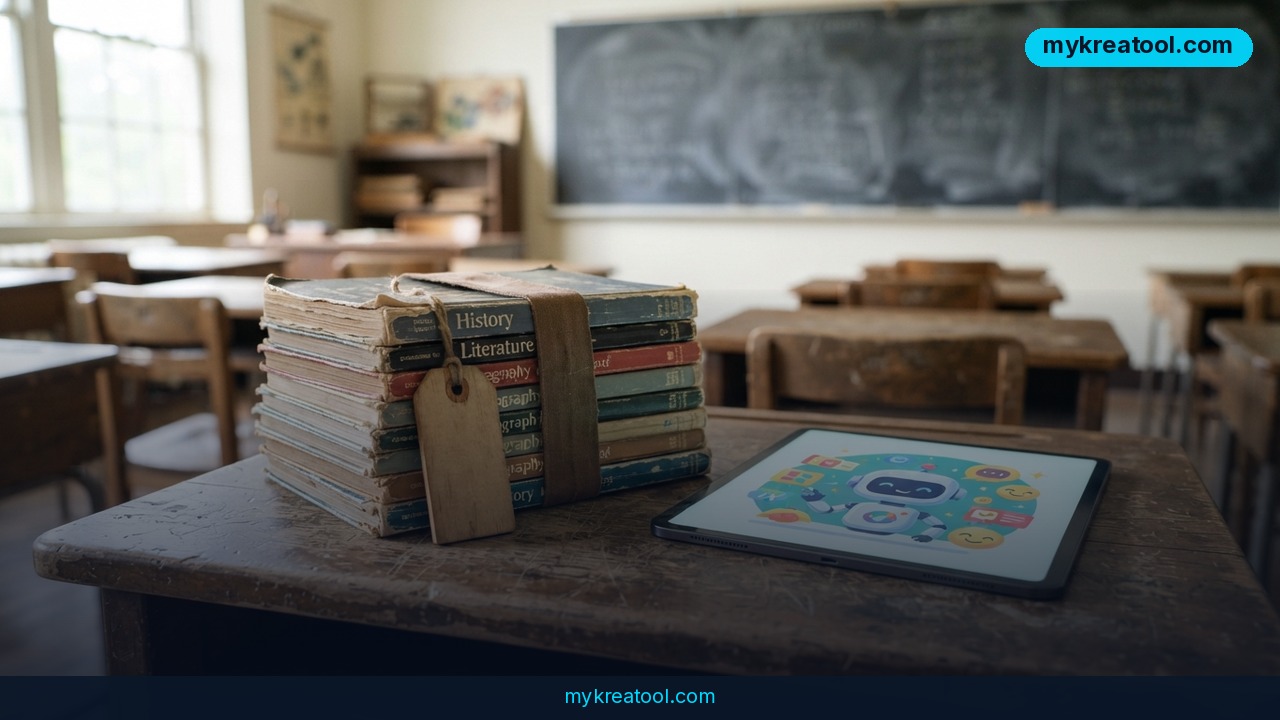
An AI tutor now costs about as much as two takeaway lunches a month, and one of Australia's best-known tutoring brands has just said out loud what that means for its business. Dymocks Tutoring and Talent 100 is closing its five education centres in Sydney, and its chief executive, Mark Buckland, says AI has made the service look outdated and overpriced. If you've ever wondered whether an AI tutor can really replace a human one, this story is the first big real-world data point.
What happened
A tutoring chain closes its doors
Dymocks Tutoring and Talent 100 is shutting all five of its Sydney centres. That's not a small pop-up business quietly folding: Dymocks is a household name in Australian retail, and its tutoring arm was a familiar option for parents who wanted extra help for their kids. The closure was reported in late September 2026 by several outlets, including Blocktempo and The Neuron's daily AI digest, and it was also shared on social media by OzVue and in another widely circulated post.
What made the news travel was the reason. Buckland didn't blame the economy or rent. He said the technology has changed the maths for families: most of them are better off spending their hard-earned money on cheap AI tools than on tutoring at premium prices.
The numbers behind the decision
The price gap is stark. An AI chatbot subscription runs about $20-30 a month. A human tutor, by contrast, can cost hundreds of dollars per subject for each school term. Do the sums for a family with two kids and three subjects each, and the tutoring bill climbs fast while the AI bill barely moves.
Dymocks still believes a live teacher beats a chatbot on quality. But its own conclusion is telling: for most households, the quality gap no longer justifies the price gap. Think of it like a taxi versus a bus. The taxi is nicer, but if the bus gets you there most of the time for a fraction of the fare, plenty of people will take the bus.
Students got there first
The families aren't the only ones moving. In the US, the share of high school and college students doing homework with AI jumped from 48% to 62% between May and December 2025. That's roughly six in ten students, and it happened in just seven months. Dymocks, in other words, isn't leading a trend so much as catching up to one.
What it means for you
You don't have to run a tutoring company for this to matter. Here are six everyday situations where the same logic applies.
At home: homework help without the hourly rate
If your child is stuck on fractions at 8 p.m., a chatbot can walk through the problem step by step, explain it a different way when the first attempt doesn't land, and never sigh. It's like having a patient older cousin on call who happens to know every subject.
In your own study: learning a new skill
Adults are students too. Whether it's Excel, Spanish or accounting basics, you can ask an AI to build a four-week plan, quiz you, and explain your mistakes. Most people find that the quizzing is the part that really sticks.
At work: getting up to speed fast
Starting a new role? Paste in a document you don't understand and ask for a plain-English summary and a list of terms to learn. It's a quick way to bring yourself up to speed without bothering a busy colleague.
In business: a warning sign for service companies
If you sell a service that's mostly explaining things to people, such as coaching, training or consulting, Dymocks is a preview. Customers compare your price to a $20 subscription. The businesses that hold up will sell what a chatbot can't: accountability, personal attention and results.
For income: tutors can use AI too
Independent tutors aren't doomed. Many will do better by using AI to prepare lesson plans, generate practice questions and handle routine explanations, then spending live time on motivation and problem-solving. One tutor with good AI tools can serve more students than before.
For creativity: a study partner for any hobby
Learning guitar theory, screenwriting or photo editing? An AI can explain concepts, critique your drafts and suggest exercises. It won't replace practice, but it shortens the awkward beginner stage.
How to try it right now
You don't need to spend anything to test whether an AI tutor works for you. Start with a free option and only pay if you hit its limits.
Step 1: Pick a free chatbot
Good free starting points are ChatGPT, Claude and Gemini. All three offer a free tier with daily usage limits, so you can try them for a week and see which explanation style suits you. If you'd like to experiment with a range of free AI tools in one place, have a look at the free AI tools on MyKreaTool.
Step 2: Tell it to teach, not just answer
The biggest mistake is asking for the answer. Instead, paste in the problem and type something like: “Act as my tutor. Don't give me the answer. Ask me one guiding question at a time, and tell me when I'm right.” That one sentence turns a answer machine into a coach.
Step 3: Give it context
Say who you are and what you're aiming for: “I'm in Year 9, working on quadratic equations, and I get confused when there's a minus sign.” The more specific you are, the more useful it gets. It's like telling a personal trainer about your bad knee before the first session.
Step 4: Quiz yourself and check the work
After a study session, ask for five practice questions, answer them, then ask it to mark you. For anything important, such as an exam or a legal or medical topic, double-check the explanation against your textbook or a trusted source.
Step 5: Decide if you need more
If you're using it daily and hitting free limits, a paid plan at roughly $20-30 a month is the price range that Dymocks cited. Compare that with what you'd pay a human tutor before you decide.
Upsides and what changes
The obvious upside is cost. A subscription in the $20-30 range replaces a bill that can hit hundreds of dollars per subject each term. The second is availability: an AI tutor works at 6 a.m. before an exam and at 11 p.m. on Sunday, with no scheduling and no travel.
The third is patience. You can ask the same question five times without feeling embarrassed. For shy students in particular, that matters more than it sounds.
What changes is the role of human teachers. Expect fewer people paying for basic explaining and more paying for things like exam strategy, motivation and accountability. Tutoring won't vanish, but it will likely get more specialised and, for many families, more of a luxury than a default.
Limitations
It's worth being honest here: Dymocks itself says a live teacher is still better than a chatbot, and that's not just loyalty to its own trade. AI tools can state wrong answers with total confidence, they can't see a child's frustrated face or notice when a student has quietly stopped understanding, and they make it very easy to copy answers instead of learning. Students who rely on them to do the work rather than teach them can end up with good homework and weak exam results. The 62% figure also tells us how many students use AI with their homework, not how well it works for them, so treat it as a sign of popularity rather than proof of better learning. Younger children, and anyone with learning difficulties, will often still do better with a real person alongside the tool.
Conclusion
The Dymocks closure isn't proof that human teachers are finished, but it shows that price now matters as much as quality. When a $20-30 monthly subscription competes with hundreds of dollars per subject each term, many families will choose the subscription, and students are already voting with their homework habits.
One action for today: open a free chatbot such as ChatGPT, Claude or Gemini, paste in one problem you or your child is stuck on, and type: “Act as my tutor and ask me one guiding question at a time.” Ten minutes will tell you more than any headline.

Comments 0