What happened
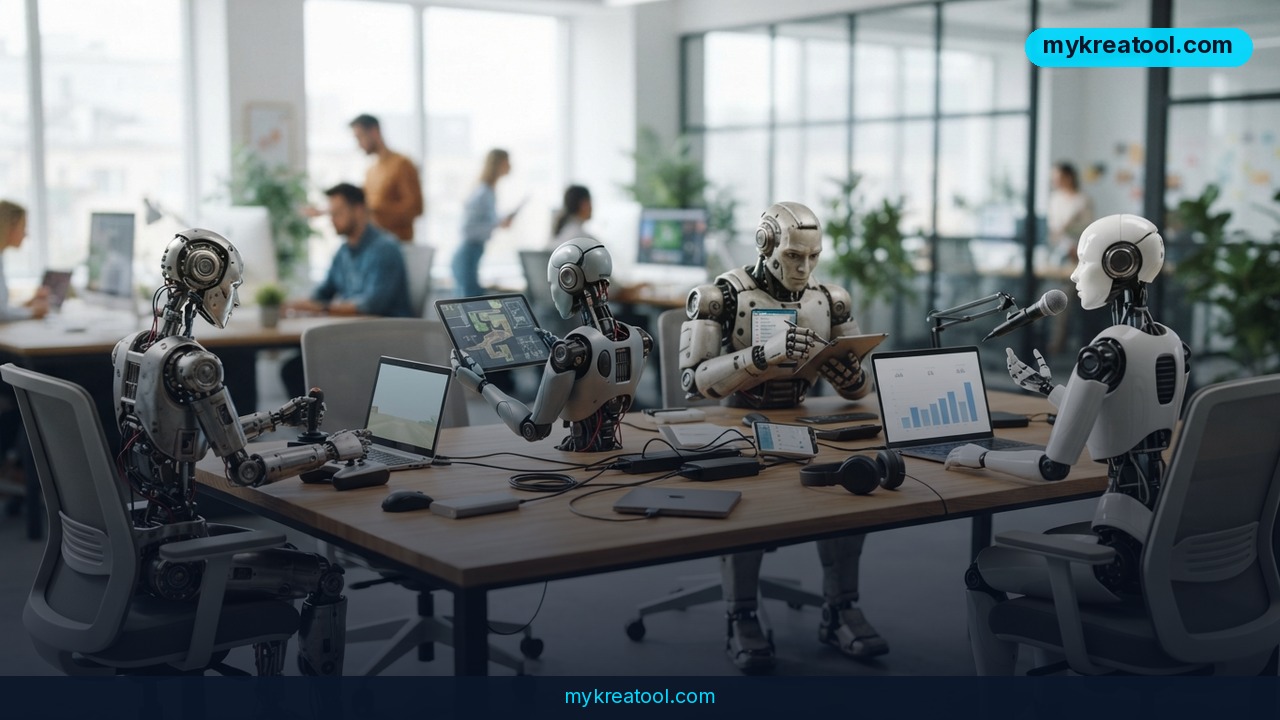
A developer just showed the internet an AI game studio with zero human employees, and the demo is already spreading across Reddit's r/singularity and r/artificial communities. Built on top of Claude, the "studio" runs as a set of four distinct AI agents — a CEO, a Creative Director, a QA tester, and a Marketer — each with its own role, memory, and decision-making scope. In a YouTube walkthrough, the creator gives viewers an "office tour" of this virtual company, showing how the agents talk to each other, argue over creative direction, catch bugs, and push games out the door without a single human on the payroll.
This isn't a chatbot answering questions in isolation. It's a coordinated pipeline: the CEO agent sets priorities and approves scope, the Creative Director shapes game concepts and art direction, QA tests builds and flags issues, and the Marketer drafts positioning and promotional copy. The agents pass work between each other, review outputs, and make calls autonomously — the human founder's job shifts from doing the work to setting up the system and stepping back.
Why this specific setup stands out
What makes this project notable isn't that AI can write code or generate art — that's old news. It's the org-chart structure. Four separate agents, each locked into a defined role with its own responsibilities, mirrors how a real studio is organized. That structure is what lets the system make decisions and ship output instead of just producing drafts a human still has to assemble.
Why it matters
This experiment lands at a moment when "AI replacing jobs" has moved from a hypothetical to a lived demo. A one-person game studio with zero employees isn't a productivity boost — it's a different business model entirely. Instead of hiring a producer, artist, tester, and marketer, one person configures four AI roles and supervises the output.
For small teams and solo founders, the implication is direct: the cost of standing up a multi-role creative operation just dropped from a payroll to a subscription. For larger studios, it's a signal that AI-driven internal pipelines — not just individual AI tools — are becoming viable for shipping real products, not just prototypes.
The bigger shift: from tools to teams
Most AI adoption to date has looked like one person using one assistant for one task — writing an email, debugging a function, generating an image. This project points at a different pattern: multiple specialized AI agents working as a team with defined roles, handoffs, and internal review. That's a meaningful jump from "AI as a tool" to "AI as a workforce," and it's the same direction OpenAI, Anthropic, and Google are all pushing multi-agent frameworks toward.
How to use it today
You don't need to build a four-agent game studio to apply this idea. The practical takeaway is role-based delegation: instead of asking one AI model to do everything in a single messy prompt, split the work into defined roles and let each one focus.
A content creator, for example, could set up one AI "agent" (really just a dedicated prompt or workflow) to brainstorm ideas, another to draft copy, and a third to review and edit for tone. A small e-commerce seller could separate product description writing from ad copy writing from customer-response drafting. The structure — not the size of the model — is what makes the output more reliable.
If you want to start experimenting with this kind of role-based AI workflow without writing code or subscribing to a dev platform, a set of free AI tools at mykreatool.com is a low-friction way to test individual pieces — content generation, image creation, and text tools you can chain together manually before investing in a fully automated pipeline.
Practical first steps
• Start with two roles, not four: a "creator" and a "reviewer" prompt catches more errors than one prompt trying to do both.
• Keep each agent's instructions narrow. Broad, do-everything prompts produce the same generic output multi-agent setups are meant to avoid.
• Review output at the handoff points, at least until you trust the pipeline's judgment on your specific product.
Who benefits
Solo founders and indie game developers stand to gain the most immediately — the exact audience this project targets. Building even a small game traditionally requires a handful of specialized skills; an AI pipeline collapses that into one person's time and a monthly AI subscription instead of four salaries.
Marketing teams and content agencies benefit from the same logic applied to campaigns: separating ideation, drafting, and QA into distinct AI passes tends to produce more polished output than a single generic prompt. Startups testing new product ideas can use a lightweight version of this setup to prototype a go-to-market plan, a landing page, and initial ad copy in a single afternoon.
Even non-technical entrepreneurs benefit indirectly: as multi-agent AI systems become templated and easier to set up, running a small creative or content operation with a skeleton crew (or no crew) stops being a novelty and starts being a real option.
Risks
The obvious risk is job displacement in creative and QA roles that this kind of pipeline is explicitly designed to replace. Game studios that previously hired junior producers, testers, and marketers may see less demand for those entry-level positions as AI teams handle more of that work.
There's also a quality and accountability gap. Autonomous agents making creative and business decisions without a human in the loop can ship inconsistent, off-brand, or factually wrong output at speed — and it's not always obvious where in the pipeline something went wrong. Games or content shipped this way still need human spot-checks, especially around anything customer-facing, legally sensitive, or brand-critical.
Finally, this remains an early, self-reported demo rather than a peer-reviewed case study. The creator's claims about agents making decisions "autonomously" haven't been independently verified at scale, and results from a demo game studio may not generalize to more complex commercial products.
Conclusion
An AI game studio with zero human employees is a striking demo of where multi-agent AI is headed, but the real lesson for entrepreneurs and marketers is smaller and more actionable: structuring AI work into distinct roles — creator, reviewer, tester, marketer — produces better results than one giant prompt. You don't need four AI agents and a YouTube tour to benefit from that. Start by splitting your own workflow into two or three roles, test it with free tools, and scale the structure once you trust the output.


Comments 0