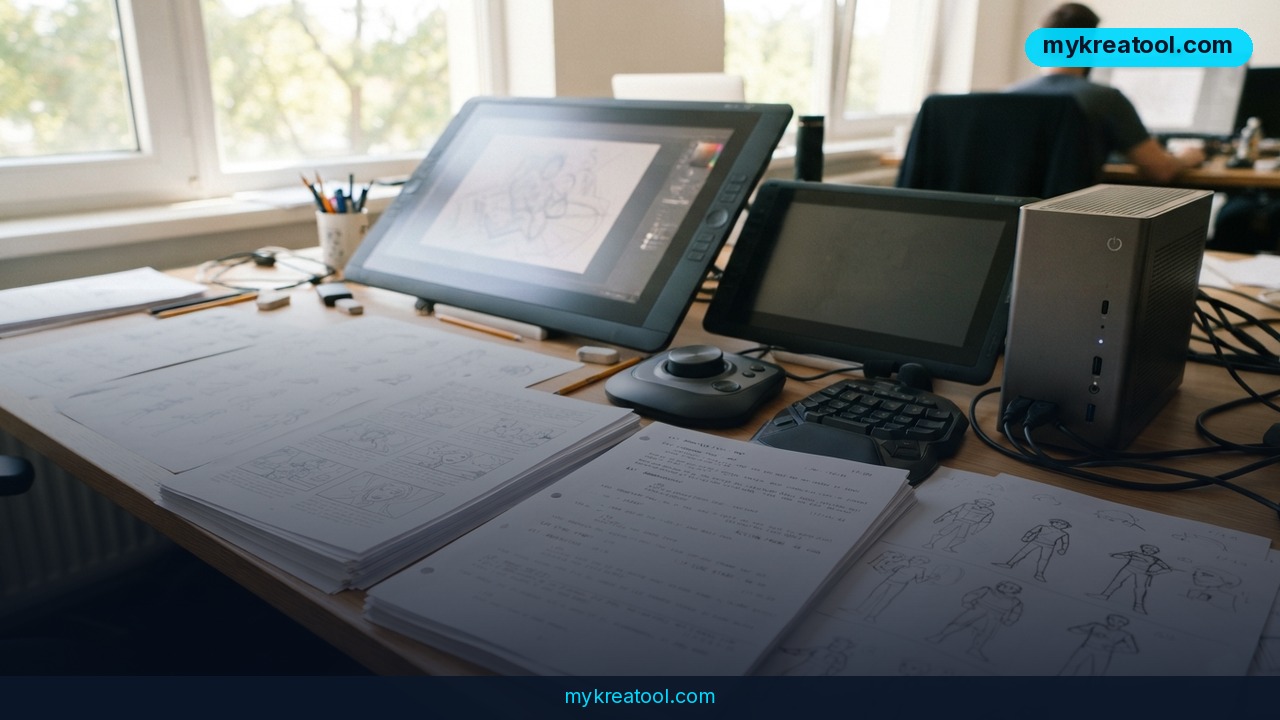
What happened
A small team building a vertical AI cartoon series called Forest Street took one 24-second episode and rebuilt it roughly ten different ways over three days at the end of October. They pushed the same scenes through Wan, Kling, Veo, Seedance, GPT Image and Nano Banana Pro, then wrote down what broke. The characters stay the same from episode to episode, the dialogue is in Russian, and the finished file comes out in a vertical 1080-wide frame, 23–26 seconds long, with loudness around −14 LUFS.
And to be upfront about the claim: there are no audience numbers yet. This is a production log, not a growth story. Two episodes have shipped — "And Where's the Phone?" and "You'll Swap?" — while "No Campaigning Allowed" and "Sitting Around Later" are still test runs.
The surprise: a script timed to the second
The team assumed picking the right model would be the big lever. It wasn't. The early takes died because the story was fuzzy, the prompts were fuzzy, and there was nothing for the models to hold on to. Once a scene was written second by second — every line, every pause, every raised eyebrow — the models got it right almost on the first pass.
"Almost" is doing some work in that sentence. Still images needed one or two redos per episode. Kling needed three takes on the same scene. What saved them was an anchor: a fixed reference like a character sheet, so the hero doesn't grow a new face between shots, plus one locked location so the background doesn't wander off.
The step order is the whole trick
The pipeline runs cheap work first and expensive work last:
1. Character bible — a short doc that pins down who everyone is.
2. Script by seconds — what happens at second 3, at second 9, and where the laugh goes.
3. Human yes/no — a person approves the story before a single image is generated.
4. Anchors — character sheets and one location.
5. Frames in GPT Image — ten stills tell you whether the story reads at all.
6. Voices in ElevenLabs eleven_v4 — lines recorded with the delivery already decided.
7. Assembly with camera moves — this alone is the budget version of the episode.
8. Automated check — lines confirmed by speech recognition, frames verified.
9. A human watches the draft.
10. Only if it's a yes: Kling 4.0, one shot, 2–3 takes.
11. Voice Changer, another check, release.
The logic is simple: test the story on cheap pictures, and spend animation money only on a scene somebody already likes. Nothing heavy runs locally — home computers queue jobs, store files and do the editing. Generation happens in the cloud.
The 15–25 second rule
Before any of this, the team took apart 16 other people's projects and 24 published episodes. Rough measurements on seven short foreign samples showed a gap: movement inside the frame filled about 70% of the runtime at the median, against 3.7% for their own "moving comic." The payoff landed at second 8–13 in those samples, around second 35 for theirs. Those ran about 26 seconds; theirs ran 40–45.
It's a small sample, but it gave them a working frame: 15–25 seconds, the first second already inside the situation, the payoff at 8–12 seconds, and a closing line or gesture. There's also a pre-flight test — the first frame has to show the hero, their goal and the obstacle at a glance. And before release, a fresh assistant describes the episode frame by frame with the sound off. If the description doesn't match the intent, the episode doesn't ship.
What broke, and what got fixed
An early Kling take showed the pastries at second 5; the third take revealed them at second 21, right on the punchline — same story, better timing instructions. In another scene, both Svetlana and Zina delivered the same forbidden line, a straight-up continuity error. And the first Kling prompt asked for "restrained facial expressions," which produced flat, dead faces. Switching to second-by-second acting notes — glances, brows, listener reactions — put life back in the frame. The team can't prove cause and effect there, but the difference was visible on screen.
What it means for you
You don't have to be building a cartoon series to steal this. What the team actually built is a cost-control habit: prove the idea on the cheapest medium you've got, then pay for the expensive one.
Around the house
Want a 20-second animated birthday card, or your kid's crayon drawing turned into a mini-cartoon? Write the scene by seconds first — Granny opens the box at second 4, gasps at second 9 — and generate stills before you spend a single credit on animation. A fuzzy idea produces a fuzzy result, and that's true whether you're running a series or a family group chat.
At work and in business
This is where the pipeline earns its keep. Product explainers, onboarding clips, social cutdowns: sketch the whole thing as five or ten stills, get sign-off from whoever signs off, and only then animate. In this test the animation stage was the slow, expensive part, and it came last on purpose. If you're pitching a concept, stills plus camera moves are enough to win the room.
For students, creators and side income
Short vertical video is a real market, and 15–25 seconds is a friendly length: one situation, one payoff, one closing line. If you've been putting off a channel because "animation is too slow," the honest takeaway here is that the writing is the slow part now. Half a page of second-by-second script is where the quality comes from.
How to try it right now
You can run the first five steps tonight, for free, before you spend anything.
1. Write a one-page character bible. Names, a line of personality each, one visual quirk. That's your consistency insurance.
2. Rewrite a scene you already have as a second-by-second script. Twenty rows, one per second. Mark the laugh.
3. Get a second opinion from an actual human. Cheap now, painful later.
4. Make anchors. One flat character sheet per hero, one location, reused in every prompt.
5. Generate ten stills in GPT Image. That's the whole budget version of your episode. If you need free options to explore first, the AI tools at MyKreaTool will get you started without a subscription.
6. Run the sound-off test. Ask an AI assistant to describe the ten frames in order. If the description isn't your story, fix the script, not the model.
7. Record lines in ElevenLabs eleven_v4. Decide the delivery in the script, not on the fourth take.
8. Assemble the stills with camera moves. Congrats — you have a publishable draft.
9. Now pay. Kling 4.0, one shot, plan on 2–3 takes. The winning scene here cost 54 Higgsfield credits for a single take, so budget for retries rather than hoping for a first-try miracle.
10. Finish with Voice Changer, run the automated check, watch it once yourself, publish.
Upsides and what changes
The big win is where the money goes. Because the story is approved on cheap stills first, you never animate a scene nobody wants. That flips the usual order, where you find out a script is boring only after you've burned your animation budget.
Second, the whole thing is repeatable without a studio. Home machines only manage jobs and edit; the heavy lifting is in the cloud, and AI assistants handle assembly plus the technical checks. A human stays in the loop for exactly two decisions — is the story good, and does the final cut land.
Third, the numbers are refreshingly unglamorous. Movement was 3.7% of runtime in their old format and around 70% in the reference clips they studied. Payoff at second 35 versus second 8–13. Those are the kinds of fixes you can make with a stopwatch instead of a budget.
Limitations
Read this as a lab notebook, not a leaderboard. The team tested single trials, didn't measure repeatability, and explicitly says this can't be used to rank Wan against Kling against Veo. There are no viewer numbers either, so nobody knows whether a 24-second episode with the payoff at second 10 actually holds an audience. Image models still needed one or two redos per episode, Kling needed three takes for the same scene, and at least one continuity bug (two characters saying the same line) slipped through to a take. Some things stayed broken and are listed as such. If you need predictable cost per episode, you'll have to run your own trials — this is a starting point, not a guarantee.
Conclusion
The interesting part of this case isn't that AI can animate a cartoon. It's that the winning move was writing a better script and putting the expensive step last. A 24-second vertical episode, ten rebuilds, three Kling takes, 54 credits on the best one — that's what the finished thing actually costs in effort.
One action for today: open a blank doc and write twenty lines, one per second, for a scene you already have. Don't touch a model until the lines read well out loud. That single habit is what separates a ten-take mess from a first-try win.
Comments 0