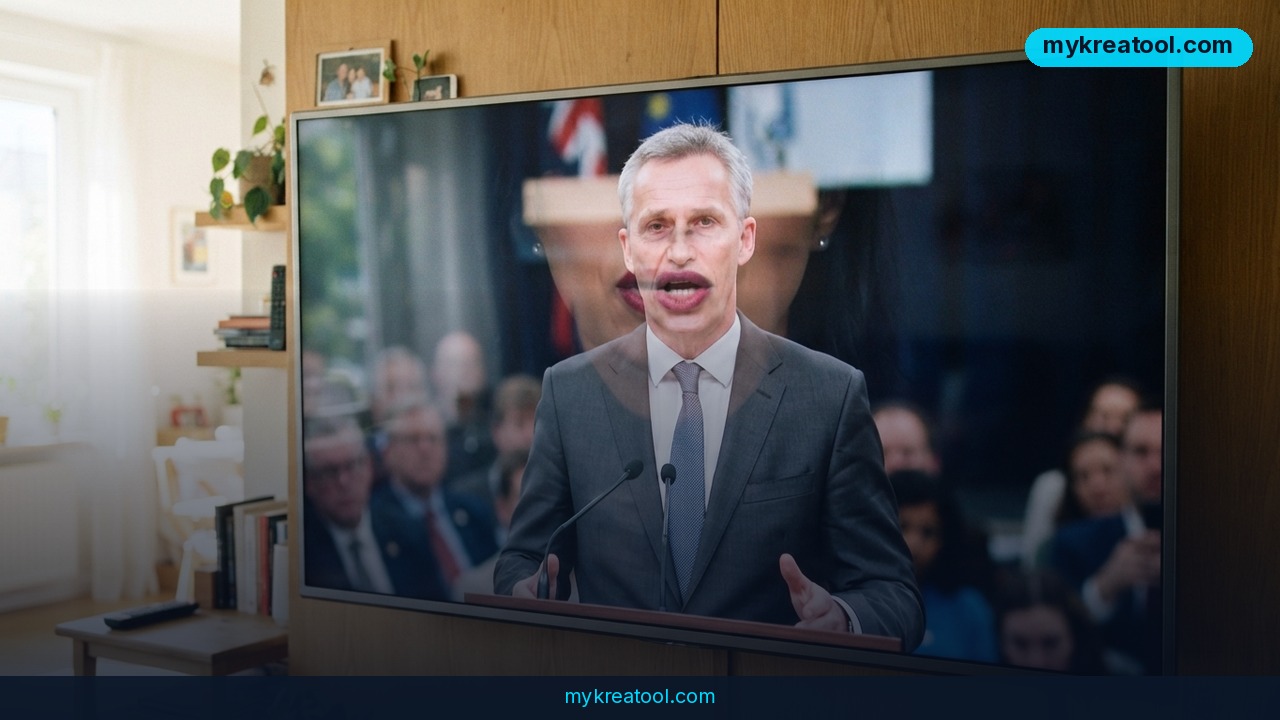
Picture a live interview where someone says something you never actually get to hear. Not because the feed dropped — because the system swapped their words before they reached your speakers, then redrew their mouth so it looks like they said the new version all along. That's the promise behind a new Microsoft AI voice-changing patent, and it's a lot less science fiction than it sounds.
What happened
A newly reported Microsoft patent describes technology that can alter speech and lip movements in real time. In practice, the system would listen to a person's voice, watch their video feed, and flag specific words or phrases. Generative AI would then build a replacement — delivered in the speaker's own voice — and the video would be reshaped so the lips move in sync with the new words. To anyone watching, it looks completely natural, even though the original sentence is gone.
Put simply: imagine autocorrect, but for spoken sentences on live TV, complete with the speaker's face moving to match. Microsoft's filing doesn't stop at cleaning things up. It sketches a much wider set of uses, from live translation to AI-written summaries delivered in the person's own voice and face.
How the swap works, in plain English
Three moving parts, and none of them require an engineering degree to understand:
• Listen and watch. The system processes the audio and the video of the speaker at the same time, so it knows both what was said and how the mouth moved.
• Flag. It picks out certain words or phrases — swearing, a mispronunciation, filler like "um", or anything on a blocklist.
• Replace and re-sync. Generative AI writes new audio in the same voice, and the mouth movements are regenerated so they line up with the new words.
Think of it as a translator whispering over a speaker — except this one also reaches into the video and moves the speaker's lips for them.
What Microsoft says it's for
The patent lists uses that go well beyond basic editing:
• Translating speech into another language while making the lips match the new words
• Stripping out profanity
• Fixing mispronunciations
• Removing filler words like "um"
• Rewriting statements using information pulled from online sources
• Generating shorter clips where a person appears to deliver an AI-written summary of their own remarks
One scenario stands out as genuinely unsettling: two people watching the same live broadcast could see and hear entirely different versions of the same sentence, each tailored to their own preferences. You might ring a friend to talk about an interview, only to find the conversation you each watched wasn't the same conversation at all.
What it means for you
You probably won't meet this technology as a product next week — patents are plans, not shipping software. Still, the direction of travel matters, because the same tricks are already creeping into everyday tools. Here's where it lands in ordinary life.
At home: the group chat gets weird
That two-viewer scenario is the household version of the problem. If your partner watches a stream on one platform and you watch it on another, you could end up arguing about words that were never said. The fix is boring but effective: when something sounds off, go back to the original upload rather than the clip someone forwarded.
At work: meetings that tidy themselves
Filler words gone, mispronunciations fixed, your rambling answer turned into three clean sentences. Sounds great on a sales call. It also means the recording of you that gets shared internally may not match what you actually said — worth remembering before you joke about the boss on a video call.
Running a business: localization without a studio
Today, translating a training video or a customer testimonial usually means re-recording, subtitles, or a slightly uncanny dub. Real-time translation with matched lips would let a small team ship one video in five languages — a serious saving in time and money for anyone selling across borders.
Studying: lectures in your own language
A recorded lecture translated live, with the professor's mouth matching the translated words, is a real win for international students. The summary feature is the trap: if the AI compresses an hour of teaching into two minutes of "key points", check the source material before you revise from it.
Creative work: one take, many versions
Actors and creators could reshoot less. One performance, several language versions, no dubbing studio. The catch is disclosure — audiences forgive a lot, but they don't forgive being fooled, and "wait, was that real?" is a hard question to come back from.
Earning income: a new service, and a new competitor
There's money in being early. Freelancers who can deliver clean multilingual video will be able to sell localization to clients who could never afford it before. The flip side: the same tools let a rival fake a testimonial in an afternoon, which is why "we don't alter what people said" may become a selling point worth printing on your site.
How to try it right now
Microsoft hasn't turned this patent into a product you can download, so you can't test the real thing yet. You can, however, get a feel for the pieces — translation, dubbing and cleanup — with free tools today.
1. Start free. Open MyKreatool and pick a voice or video tool instead of paying for a subscription on day one.
2. Record 60 seconds of yourself. Say something with a deliberate "um", a mispronunciation and one sentence you'd rather rephrase. You now have a baseline.
3. Run it through three jobs. Translate it, strip the filler, and fix the mispronunciation. Compare how each output feels.
4. Check the lips. Watch the result with the sound off. Lip-sync is where AI dubbing usually falls apart, and once you've spotted it, you'll spot it everywhere.
5. Write your own rule. Decide now what you'll disclose, and to whom. One line in your brand guide is enough: "We translate our videos with AI; the words are ours."
6. Keep the original. Store the untouched file. If anyone ever questions a clip, you'll have the receipt.
Upsides and what changes
The upside is mostly about access. Live translation with matching lips makes video usable for people who'd otherwise need subtitles or a full dub. Small businesses get multilingual marketing without a studio budget. Livestreams get cleaner, mispronunciations stop being a permanent embarrassment, and speakers who use English as a second language get a fairer hearing.
It also changes what counts as proof. Once a face can say anything in its own voice, the value moves from the video itself to the chain around it — the original file, the metadata, the platform that says "this one wasn't edited". Expect "unmodified audio" labels to become something people actually look for.
Limitations
Be clear-eyed here: a patent is not a product, and the filing doesn't name a launch date, a price or a brand. Even if it ships, real-time voice matching and lip regeneration are hard — accents drift, fast speech breaks models, and every correction adds delay that a live broadcast can't afford. The bigger limit isn't technical, though. It's trust. If viewers believe any sentence can be swapped mid-air, the safest assumption becomes that nothing on screen is real, and that skepticism lands on honest broadcasters too. There's also a legal minefield around consent, defamation and broadcast rules that no patent can solve.
Conclusion
Microsoft's patent points at a future where the words coming out of someone's mouth are negotiable — and where the mouth agrees. The technology will arrive in pieces, through translation and dubbing tools, long before anyone offers a full live swap. So the useful question isn't "is this scary?" It's "what's my rule?"
Your one action for today: take a 60-second clip of yourself, run it through a free translation or cleanup tool, and watch it with the sound off. If the lips don't match, you've just learned how to spot the fakes — and how much disclosure you owe your own audience.
Comments 0