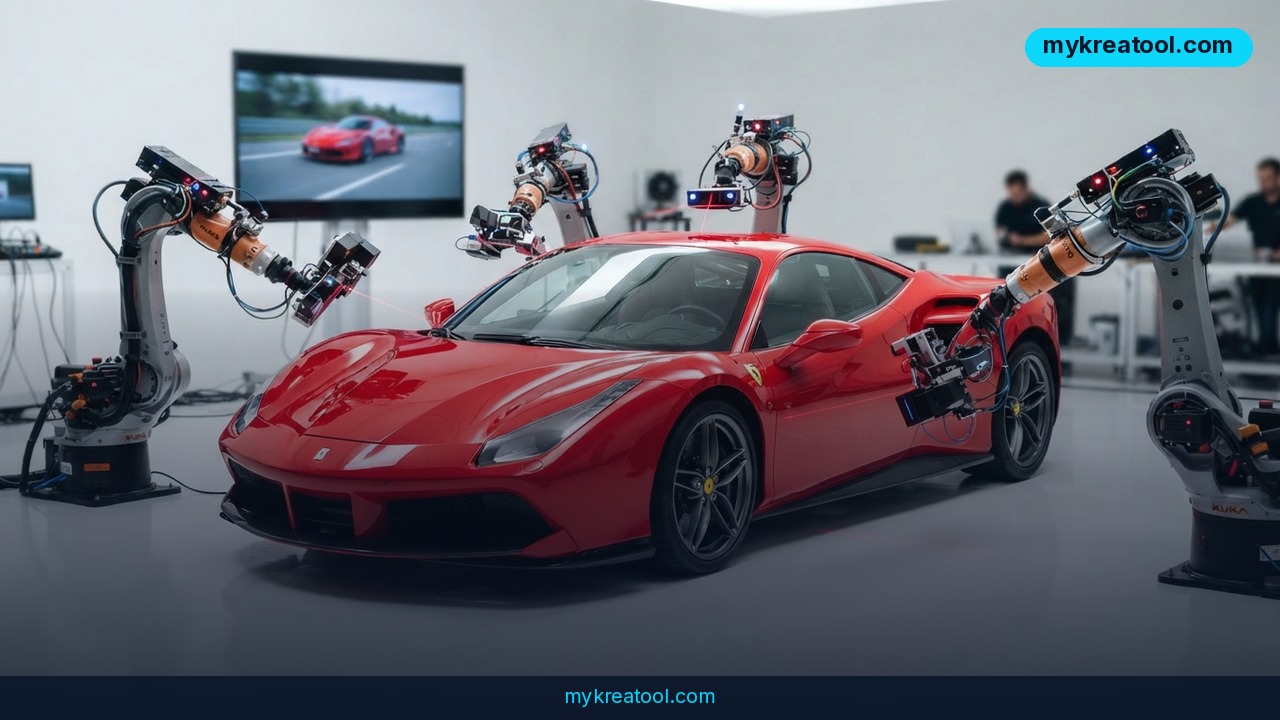
The most persuasive argument for AI video in advertising isn't a slick demo reel — it's a finished commercial that never needed a camera crew. Mazda just shipped one, and it's why every roundup of the best AI commercial makers for automotive brands suddenly has a real-world benchmark to point at.
What happened
Brief to broadcast-ready in under two weeks
Mazda released its first fully AI-produced commercial, made with the agency Boundless and the video model Luma. The timeline is the headline: under two weeks from brief to broadcast-ready delivery. Not two months. Not after six rounds of location scouting and weather delays.
The spot was for the Mazda MX-5. No physical car shoot, no transport, no talent call sheets, no waiting on a cloudy sky to clear. Just prompts, revisions, and a finished film.
If you've ever worked on automotive advertising, you know that number is the whole story. The visuals are impressive, sure. But the calendar is what moves budgets, and a two-week turnaround breaks the old math entirely.
Why cars are the hardest thing to fake
Car content has always been technically brutal, and that's exactly why this matters. A car is basically a rolling mirror. Chrome trim, glass, and glossy paint all have to reflect the world around them — and bend those reflections correctly as the camera moves. Get it wrong and the whole shot screams "fake."
Then there's paint depth, the geometry of a wheel spinning at speed, and the way a heavy car leans into a corner as its weight shifts. Those details are how your eye knows a car is real. The platforms that work for automotive brands understand all of it.
So the real question for any creative team isn't whether AI can generate car footage. It's whether that footage survives an OEM brand-standards meeting. (OEM just means the carmaker itself, not a dealer or a reseller.)
What Luma Ray 3.2 actually brings
Luma Ray 3.2 sits at number one on the current list of AI commercial makers, and the Mazda MX-5 campaign is the reason. Here's what's inside, in plain English:
• It understands three-dimensional space. Car interiors and exteriors keep proper depth instead of flattening into a generic render. Think of it as the AI knowing the difference between a dashboard and a photo of a dashboard.
• Multi-frame sequencing. You control how a scene progresses and how the camera moves, like handing the AI a storyboard and having it follow along.
• Layers-powered editing. This is Photoshop logic applied to video. Swap a headline, update a product badge, or adjust regional messaging — and everything else in your approved layout stays exactly where it was.
• HDR and professional workflows. HDR means brighter highlights and deeper shadows, so the footage drops into the pipeline you already use.
• Video upscaling to 4K HDR for broadcast-quality output.
• Professional export formats including ProRes, the file type editors and colorists actually work with.
What it means for you
If you run a dealership or a small car business
You don't need a cinematic hero film. You need inventory videos — and some platforms now sync automatically with your lot, turning a spreadsheet of stock into social-ready clips. Specialized tools are often a better fit here than a full cinematic model, because the job is volume, not artistry.
If you're a freelancer or a boutique agency
This is where the money is. A client who used to need a three-day shoot can now get a concept film in days, which means you can pitch more projects and take on work that used to require a production crew. Luma fits higher-end launch films; lighter platforms handle the agency-led social production that pays the monthly bills.
If you sell something else entirely
The Mazda lesson isn't about cars. It's about products that are hard to photograph — shiny, reflective, heavy, expensive to stage. Appliances, furniture, gadgets, cosmetics. The same workflow compresses your launch timeline, and you can test three creative directions in the time it used to take to book one studio.
If you're a creator chasing ad income
Brands are actively looking for people who can produce polished video fast. Learning one of these tools gives you a service you can sell this month, and a portfolio piece.
If you're a student or a total beginner
You don't need gear. You need a brief and 20 minutes. If you'd rather not spend anything while you learn the basics, start with free AI tools at mykreatool.com — no card, no commitment, just a place to get a feel for how prompting actually works before you graduate to a paid platform.
How to try it right now
1. Name your tool. For anything cinematic, the tool is Luma Ray 3.2. If you want a free starting point first, play with the free AI tools at mykreatool.com to practice writing prompts.
2. Write a one-page brief. Product, mood, three shots, and the feeling you want in the last frame. Keep it short — the AI reads structure well and vague poetry badly.
3. Start with the establishing shot. Generate the wide shot first. If the hero shot doesn't work, nothing after it matters.
4. Lock the camera move with multi-frame sequencing. Describe the motion beat by beat: slow push in, then a drift to the right, then a hold. Treat it like a shot list.
5. Use Layers for revisions. Client hates the on-screen headline? Change the text layer only. Nothing else regenerates, so nothing else breaks.
6. Finish at 4K HDR and export ProRes. Hand that file to your editor and it slots into normal post-production without conversion gymnastics.
7. Send it to review early. Brand feedback is the real deadline. Get eyes on a rough cut on day three, not day twelve.
Upsides and what changes
The calendar collapses
Scouting, transport, weather backups, talent coordination, post-production, and color grading used to stretch across months. That whole chain compresses into days. For anyone managing a marketing budget, this is the biggest shift on the list.
Revisions stop being rebuilds
Traditional reshoots mean going back on location. Layers means changing one element while the rest of the approved composition stays locked. Approved creative work stays workable instead of forcing a restart — which is the difference between a tweak and a re-budget.
Roles shift rather than vanish
You still need someone who knows what a good shot looks like. Direction, taste, and brand judgment matter more than ever now that generation is cheap. What disappears is the logistics overhead, not the craft.
Limitations
Let's be honest: none of this removes the hard parts. The Mazda spot still needed an agency, a clear brief, review cycles, and a post-production pipeline — AI handled the shooting, not the thinking. Generated footage still has to survive brand review, and every automotive brand has its own review process and its own tolerance for risk. You also can't hand a client a raw generation and call it finished; sound design, editing, color, and legal clearance are still real jobs done by real people. Treat these tools as a very fast camera, not a replacement for the people who point it.
Conclusion and one action for today
A car commercial that would normally eat two months of calendar time landed in under two weeks, with no shoot day at all. That's not a novelty anymore — it's a working production method, and it's available to freelancers and small businesses on the same day it's available to Mazda.
Your one action today: write a one-page brief for a product you'd love to advertise, then generate a single establishing shot with Luma Ray 3.2 or a free tool. One shot. That's it. You'll learn more from that one attempt than from a week of reading about prompts.


Comments 0