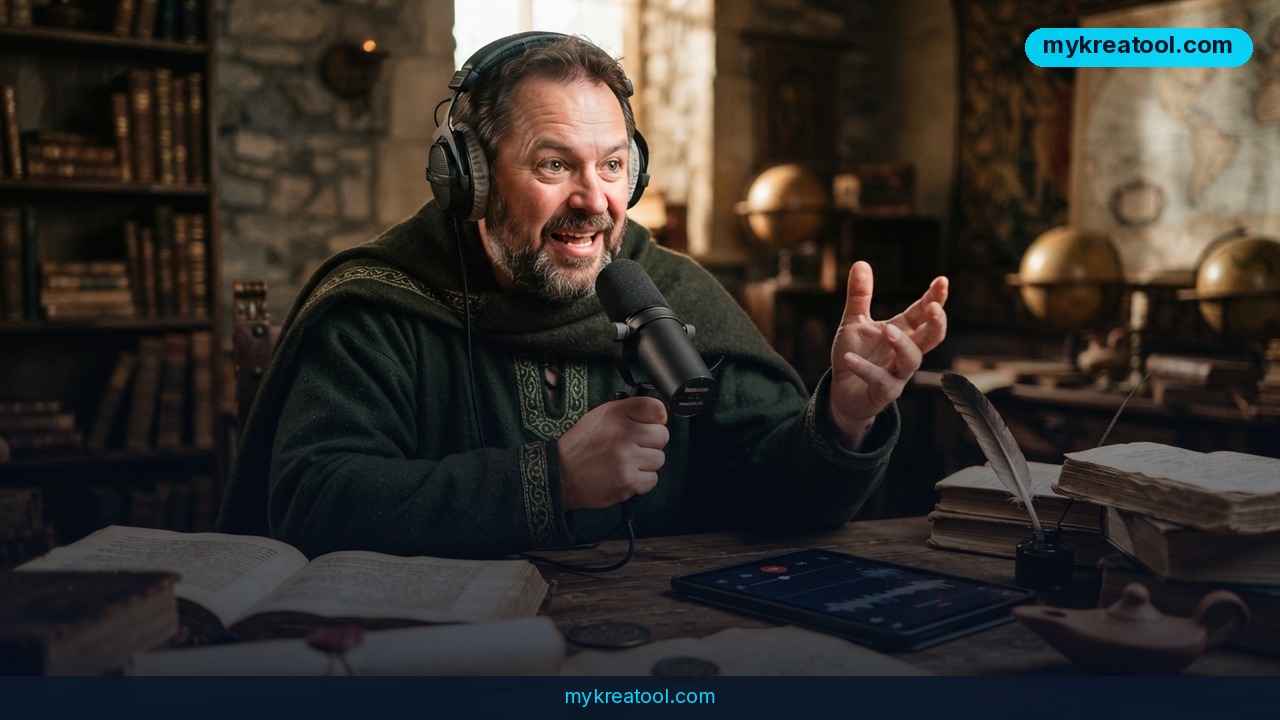
If an AI podcast generator could hand you a finished show in about two minutes, would you still spend an afternoon cutting audio? Historai.ca is betting you wouldn't. You type in a topic, a moment, or a person's name, and roughly two minutes later, two hosts are telling you that story — researched with sources and paired with artwork that fits the period.
It sounds simple. What's actually happening behind the scenes is the interesting part. Here's the whole thing in plain English, no engineering degree required.
What happened
A maker posting under the handle u/Goldenchild123 put Historai.ca on Reddit with a short pitch and one call to action: try it without an account. No signup wall, no credit card — just a text box and a two-minute wait.
You give it any topic, moment, or person. About two minutes later, two hosts are telling you the story. The research comes with sources attached, and the visuals are period artwork rather than the usual generic stock filler.
That's the elevator pitch. The reason people are paying attention is how the thing is put together.
Two hosts and a mic you can actually press
The feature the maker says they're proudest of isn't the speed. It's the microphone.
Press the mic in the middle of an episode and ask whatever you're wondering about. The hosts answer, then weave your question back into the story instead of dropping it and moving on.
Think of it as interrupting a podcast — except this podcast interrupts back. Normally, when you're listening to a show and something doesn't click, your options are to rewind, open a new tab, or stay confused. Here, you just ask. If you've ever paused a documentary to look something up, you already understand why that matters.
It isn't one AI model doing everything
Time for one quick definition, because it makes the rest make sense. A model is the AI engine behind a job — the thing that takes your request and produces an answer, whether that answer is text, an image, or a voice.
Most tools pick one model and run everything through it. Historai's maker did the opposite: they ran bake-offs — head-to-head tests — between GPT, Claude, and Gemini models, and picked a separate winner for each job:
• Research and planning — figuring out what the episode should actually cover
• Writing the script — the back-and-forth between the two hosts
• Picking artwork — matching visuals to the era
• Voices — the text-to-speech that makes two hosts sound like two people
The differences were bigger than the maker expected. Some models write great dialogue but plan poorly. Some plan beautifully and write flat. And the cost of running them swings hard from one model to the next, which matters a lot when you're paying per episode.
The takeaway is small but useful: there's no such thing as the best AI model. There's only the best model for a specific job.
What it means for you
At home, on a rainy Sunday
Type in the eruption of Krakatoa, or whatever your kid is currently obsessed with. Two minutes later you've got a two-host show with era-appropriate artwork and a child who can press the mic and ask why the sky turned red. It's the rare kind of screen time that ends with a question instead of a meltdown.
At work, when you need to sound informed by 9 a.m.
You've got a meeting about a topic you know just enough about to be dangerous. Instead of skimming six browser tabs, you type the topic in, listen on the commute, and interrupt with the two questions you actually need answered. You walk in sounding like you did the reading — because in a sense, you did.
For business: a training show without a studio
Onboarding, product explainers, internal briefings — the material that normally dies inside a 40-slide deck. Because listeners can interrupt and get real answers, it behaves more like a conversation with a knowledgeable colleague than a video everyone skips past. That's a different job than simply making a podcast, and it's a genuinely useful one.
For students: a study buddy that talks back
Reading a textbook is passive; asking questions isn't. A two-host episode on the French Revolution, with a mic button you can hit the second something confuses you, turns revision into something closer to a conversation. The sources attached to the research also give you somewhere to go next, which is more than most study videos offer.
For creators: a first draft in two minutes, not two days
Coming up with the concept is usually the slow part, not the recording. Here you get a structured script, a story arc, and a visual direction before your coffee goes cold. Even if you rewrite half of it, you're editing instead of staring at a blank page. And if you want to wrap the audio in a title, a description, or a thumbnail idea, the free AI tools at MyKreaTool can cover the text side while Historai handles the sound.
For income: a production line you can rent out
Two minutes per episode changes the math on content. History channels, niche explainer shows, language-learning clips, bedtime stories aimed at one specific age group — anything where volume matters more than a Hollywood budget. The tool doesn't hand you an audience. It hands you back your afternoons, which is usually the thing standing between you and one.
How to try it right now
The free option first: [Historai](historai.ca/) — you can try it without creating an account.
1. Open historai.ca in any browser. No signup needed to test it, according to the maker's post.
2. Type a topic, a moment, or a person. Be specific. The eruption of Mount Tambora will get you a better episode than a vague one-word prompt.
3. Wait about two minutes. That's the maker's own number, and it's roughly the time it takes to make a cup of tea.
4. Listen, then check the sources. The research comes with citations, so you can see where the story came from.
5. Press the mic and ask something. This is the part worth testing properly — ask a follow-up the script skipped over.
6. Take one step further. Pull the episode apart into a blog post, a set of social captions, or a study sheet.
Upsides and what changes
Questions beat rewinds. The mic button turns listening into something closer to a conversation. That's a quiet shift in how we use audio: less sitting still, more poking at the thing.
Speed changes what's worth making. When an episode takes two minutes instead of two days, you stop asking whether an idea deserves a show and start asking which version is better.
Model-mixing beats model loyalty. Picking a different AI winner for research, script, artwork, and voices is a smarter pattern than betting everything on one provider. Expect more builders to copy it.
Sources come attached. A researched episode with citations is easier to trust and easier to verify than a confident-sounding monologue with nothing behind it.
Two hosts are easier to follow than one. Dialogue has rhythm. Two voices trading a story hold attention better than a single narrator reading a page, and the period artwork gives your eyes something to do.
Limitations
The honest caveats first: this is an early tool, announced by its maker in a Reddit post, and the two-minute, source-backed, interrupt-anytime claims come from that maker — the post offers no independent benchmarks, and it mentions no pricing, so what's free today may not stay free. AI research can still get things wrong even when it cites sources, and a citation isn't the same as a fact check, so verify anything you'd put your name on. The microphone only helps while you're listening live — it won't rescue a dull episode, and it can't dig up a detail the research never found. Voices have improved fast, but they're still not a trained human host with a point of view, and two pleasant voices agreeing with each other isn't journalism. Treat it as a fast, cheap first draft of understanding, not the final word.
Conclusion and one action for today
Historai.ca does one clever thing well: it treats a podcast as a conversation you're allowed to join, and it gets there in about two minutes by giving each job to the AI model that does it best. The result isn't a replacement for the shows you already love. It's the thing you use when you want a topic explained, on your terms, before your tea goes cold.
Here's your one action for today: open historai.ca, type in the one subject you've been meaning to understand for months, and when the two hosts start talking, press that mic button once. That single press is the whole difference between listening and learning.

Comments 0