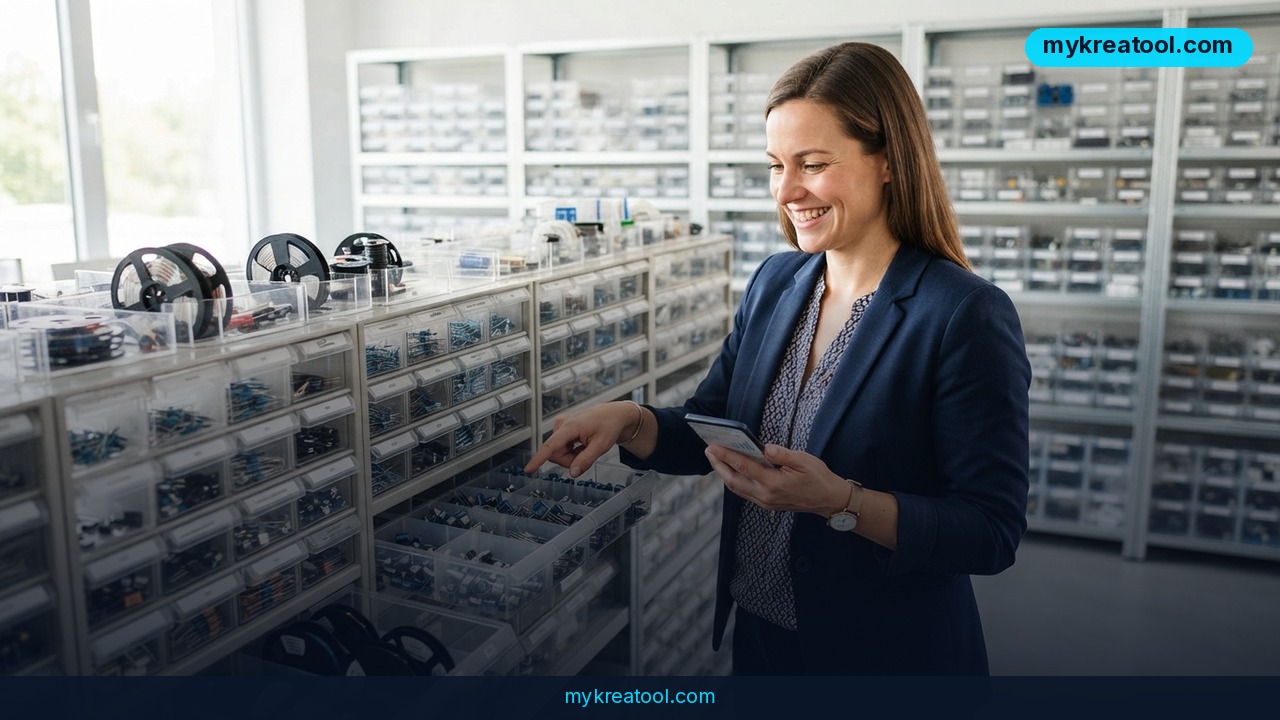
A technical director at a small electronics manufacturer just published a number worth stealing: AI warehouse automation took a job that was eating 40 hours of an engineer's time and turned it into 8 hours of an office manager's time. Same shelves, same parts, same stop-and-start production schedule. Just a fivefold cut in the most miserable week of the quarter.
What happened
A small shop with a big counting problem
The author is technical director — and part-owner — of a company that designs, builds and installs lighting control systems. Since 2013 they've developed around 15 circuit boards and ship several thousand controllers a year. Those controllers are the little computers that run lights in a building. Production starts 4–5 times a year, not continuously.
They buy components themselves (cheaper, faster, and it keeps the critical parts under their own roof), then hand them to a contract assembler in the next town. A "component" here means a chip, a resistor, a connector — the tiny hardware that gets soldered onto a board. Components arrive on reels: spools of parts stuck to a strip of tape, like a very expensive ribbon of candy.
The real problem wasn't counting. It was knowing what you counted
The team tried proper warehouse software — 1C, MoySklad, others — over several years. None of it stuck, and the reason is embarrassingly ordinary: production runs four times a year with two-to-three-month dead zones in between, so nobody ever owns the system long enough for it to become a habit. The ledger dies quietly in the gap.
So the ritual goes like this. Boxes of leftovers come back from the assembler. An office manager with a reel counter and a scale spends a full day counting. After that day, they know exactly how much they have. They still have no idea what they have.
Where the week disappeared
That's when the engineer gets pulled in. He prints out the BOM — the bill of materials, basically the recipe list that says which parts a board needs — brings empty boxes, and starts sorting roughly 200 reels by hand, jotting notes on scraps of paper so the counts can be typed into Google Sheets later.
A week of skilled engineering time, gone. And that's before ordering new parts, re-sorting them into boxes, and remembering which box holds what so he can answer questions from the contract assembler.
What the AI layer actually changes
The fix sits exactly where the bottleneck was: reading the label. Part numbers printed on a reel are a language that evaporates from any human brain within about a week — the author admits that after a month away from the reels, even he struggles. Instead of training a person to decode it, the system reads the label, matches it to the BOM, and tells the office manager where the reel goes and which row to update.
That's it. No robots, no conveyor belts, no six-figure integration. An office manager photographs a reel, the software recognizes it, and the spreadsheet updates. The engineer's 40 hours became 8 hours of someone else's time — a 5x reduction, and a week of engineering capacity handed back to the business.
What it means for you
The pattern here is bigger than microelectronics. Any time you've got a pile of physical things whose labels only one person understands, you've got the same bottleneck. Here's how it shows up in ordinary life.
At home
Think of your garage, your pantry, or the boxes of cables and chargers everyone hoards. You know roughly how much stuff is there. You don't know which adapter fits which device. Photograph the labels once, let a vision model read them, and you've built a searchable list in an afternoon instead of a weekend.
At work
Anyone who's inherited a filing cabinet, a stockroom, or a shared drive knows the feeling: full boxes, no index. The lesson is to stop asking the newest hire to memorize the code and start capturing the code automatically at the moment it enters the room.
In a small business
If your product is physical and your runs are lumpy — seasonal, project-based, made-to-order — you probably don't have a full-time warehouse person. This is the exact scenario the case describes: no dedicated staff, a team that partly dissolves between runs, and a system that decays in the gap. Automated label capture is the cheapest way to stop rebuilding institutional memory from scratch every quarter.
For studying and research
Anyone cataloguing samples, specimens, slides, or archive boxes hits the same wall. Labels are written in a shorthand that means something to one person and nothing to the next. A camera plus a model turns that shorthand into text you can search.
For creative work
Photographers, prop houses, and workshops with bins of parts, fabrics, and hardware live or die on findability. The five-minute version — snap, read, tag — beats the perfect inventory system you never actually build.
As a side income
Small manufacturers, pharmacies, repair shops and dental practices all have unlabeled stock and no appetite for a full software rollout. If you can set up a photo-based label-reading workflow and a clean sheet, you're selling a day of work that saves them a week. Free tools to start with are easy to find at Kreatool, which rounds up free AI tools that handle image and text work.
How to try it right now
1. Free first: test the label reading. Grab 20 items with printed codes — parts, boxes, sample vials, books, anything. Photograph each label with a free OCR scanner app or Google Lens, or upload the photos to a free AI chatbot that accepts images. You want to see how often the code comes back clean and correct.
2. Build the sheet. Paste the results into Google Sheets, one item per row: code, description, quantity, location. That's your BOM-to-stock mapping. No database, no consultant.
3. Add a location column that a human can follow. "Bin 4, row 2" beats "shelf by the window." The whole point is that the office manager, not the engineer, can put the reel away.
4. Write a two-line rule for the gap. Who updates the sheet after each production run, and when? The original team's software didn't fail because of the tool — it failed because nobody owned it for three months.
5. Only then buy software. Once you know your labels scan reliably and your sheet works, a paid inventory tool has something clean to plug into. Buying first is how the first three attempts died.
Upsides and what changes
• The bottleneck moves to the cheapest pair of hands. Sorting 200 reels was a week of engineer time. It's now 8 hours of office manager time. Different person, different hourly rate, same result.
• No long rollout. Nobody had to train a team or migrate data or fight an ERP. The change happened at the point where the pain was: the label.
• Knowledge lives in the system, not a head. Part-number shorthand drains out of a person's memory in about a week. Software doesn't forget during a two-month production gap.
• It scales down. A company making a few thousand units a year doesn't need enterprise warehouse automation. It needs the counting week to stop costing a week.
Limitations
Be clear about what this is: one company's account, with no vendor named, no error rate published, and no independent test. The 5x compares an engineer's hours to an office manager's hours, which flatters the math a bit — those hours aren't priced the same. Vision models also stumble on faded, greasy, handwritten or half-torn labels, and no camera tells you whether a partly used reel actually has 30 parts left or 12; that still needs a human or a scale. Most importantly, the fix targets the label, not the root cause. If production stays stop-start and nobody owns the sheet between runs, you'll get the same slow decay — just with nicer photographs. Treat this as a strong argument for testing label recognition on your own stock this week, not as a proven system you can buy off a shelf.
Conclusion
The interesting part of this case isn't the AI. It's that a company spent years failing to install inventory software and then solved the real problem — a label no one could read — in a way that gave back 32 hours of engineering time per production run. That's the pattern worth copying.
One action for today: pick the ten items you most often have to identify by squinting, photograph their labels with a free OCR app, and see how many come back correct. Fifteen minutes tells you whether you have a label problem worth automating — or just a training problem.


Comments 0