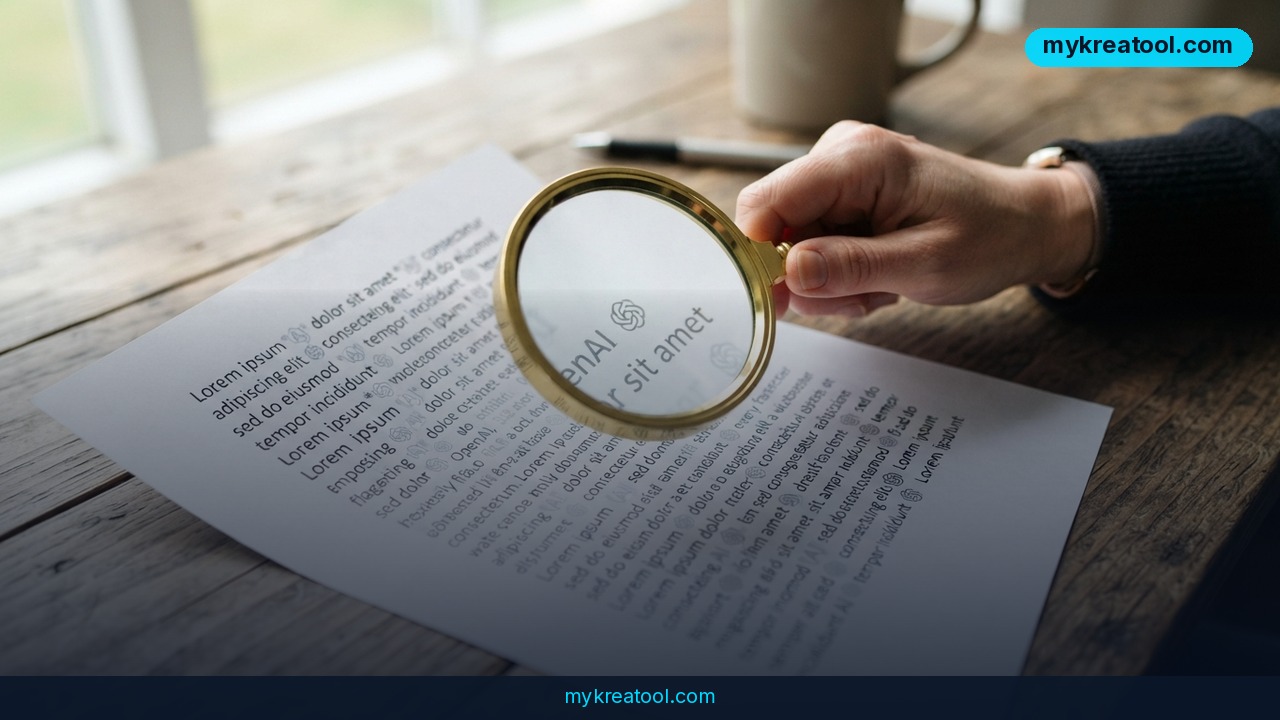
If you've ever pasted a ChatGPT answer straight into an email and hit send without a second thought, that quiet shortcut is about to get a lot less invisible — at least to the right software. OpenAI has confirmed it's baking an invisible ChatGPT watermark into text generated by both ChatGPT and Codex, using a technique it calls textGrain. Your screen won't look any different. The tell sits inside the word choices themselves, not on top of them. Bitdefender's security blog was among the first to report the details, and the reasoning behind it is straightforward: regulators increasingly want to know when a machine wrote something.
What happened
Here's the short version. OpenAI is adding an invisible watermark to AI-generated text. A watermark here means a hidden pattern woven into the wording — think of it as a faint stamp pressed into paper that you only notice when you hold it up to a light. In text, that "stamp" is a statistical signature in how the sentences are assembled. Nothing gets tacked onto the words you read; the pattern lives in the way the model picks them.
The technology is called textGrain. OpenAI says there are two reasons for it: complying with the EU AI Act, a European law that requires AI-generated content to be labelled so people know it didn't come from a human, and making it easier for detection tools to recognise machine-written copy. Mashable covered the announcement alongside a wave of other outlets, and 9to5Mac laid out the technical details of the system.
Timing is where things get slightly tangled, so let's untangle it. Watermarks are being woven into text from ChatGPT and Codex inside the European Union over the coming weeks. For API clients around the world — that's developers and companies plugging OpenAI's models into their own products — the feature has been available since October 5, but it's switched off by default. Translation: if you build with the API and you don't opt in, nothing changes for you yet.
Who has to use it, and who can skip it
The rule splits neatly into three groups:
• EU users of ChatGPT and Codex: mandatory, rolling out over the next few weeks.
• API clients worldwide: available since October 5, off by default, entirely your call.
• Anyone who wants to run a detector: you can't, at least not yet. OpenAI's watermark-detection tool won't be public at launch. It'll be restricted to approved researchers and organisations.
That last point is the one that catches most people off guard. A watermark nobody can scan for is less a public service and more a quiet commitment to regulators.
What it means for you
The honest answer is: it depends entirely on who's reading your output and why. Here's how it plays out in real life.
At home
If you use ChatGPT to draft a birthday toast or a note to your landlord about the leaky tap, nothing changes. Nobody is running a watermark scanner over your text messages. The mark only matters when someone has both a reason and a tool to check — and right now, almost nobody does.
At work
This is where it gets interesting. Plenty of companies already run AI-detection software on reports, applications and submissions. Those detectors have always been shaky — they flag human writing as AI-generated constantly. A watermark could, in theory, make them more reliable. The catch: detection is still limited to approved researchers and organisations, so your manager probably can't check anything today.
For your business
If you publish AI-assisted blog posts, product descriptions, newsletters or support macros, you now have a transparency question to answer. Do you disclose that AI helped draft the copy? The EU AI Act increasingly pushes you toward yes. The upside is that a watermark gives you a defensible position: you can say the content is AI-assisted and mean it in a verifiable way.
In school and study
Students are the group most likely to feel this. But before you panic: editing, translating or shortening AI-generated text can significantly hinder watermark detection. So can paraphrasing in your own words. The practical takeaway isn't "stop using ChatGPT." It's "stop submitting the raw output." Reworking a draft by hand is exactly what good writing instruction has always asked for.
For creators
If you're a blogger, YouTuber or newsletter writer, the watermark quietly resets expectations. Raw AI output becomes a first draft you're expected to add value to, not a finished product. That's not a punishment — it's a nudge back toward the thing audiences actually pay for: a point of view.
For freelancers and side income
Plenty of people earn money by rewriting, editing and polishing AI drafts. That work just became more valuable, not less. If clients want human-sounding copy that doesn't carry a machine signature, someone has to do the rewriting — and that someone can charge for it.
How to try it right now
There's no public button to check for a watermark, so "trying it" really means getting ahead of it. Here's the practical sequence.
1. Work out which bucket you're in. Are you a consumer using ChatGPT in the EU? You'll get watermarked output whether you like it or not. Are you calling the API from anywhere in the world? The feature has been live since October 5 and sits off by default.
2. If you're an API client, decide deliberately. Don't just inherit the default without thinking. If your product serves EU customers, opting in early may save you a scramble later.
3. Don't wait for a detector. OpenAI's detection tool is limited to approved researchers and organisations at launch. Building a workflow around "I'll just check it" won't work, because you can't.
4. Rewrite instead of copy-paste. This is the single highest-leverage habit. Editing, translating and summarising AI text can significantly hinder watermark detection, because you're changing the statistical pattern the mark lives in.
5. Keep a free toolkit within reach. Tools like the ones at MyKreatool are a sensible starting point for rewriting, summarising and repurposing drafts without paying for a subscription — handy when you're processing a lot of AI-assisted copy and need to shape it into something that sounds like you.
6. Log your process. If you're producing content professionally, note when AI helped and how much you changed. That's a paper trail you'll want if disclosure rules tighten.
Upsides and what changes
Watermarking sounds ominous, but there's a real upside buried in it. For the first time, there's a plausible technical answer to "did a machine write this?" rather than a coin-flip guess. That could mean fewer false accusations against students and writers wrongly flagged by detectors that never worked properly.
For businesses, it's a compliance shortcut. The EU AI Act wants AI content marked. A built-in watermark means you don't have to bolt on a separate labelling system.
What changes most is the incentive to edit. Raw, unedited AI output becomes the lazy option — easy to spot, easy to dismiss. Human editing, rewriting and original thinking get pushed back toward the centre of the value chain. For anyone who actually has something to say, that's good news.
The API angle matters too. Because the feature is optional and off by default for API clients worldwide, developers get to choose rather than being forced. That's a notably softer approach than the EU mandate.
Limitations
Let's be honest about what this doesn't do. The detection tool isn't public — it's restricted to approved researchers and organisations, which means the whole system runs on trust rather than transparency. Watermarks also aren't bulletproof: editing, translating or shortening AI text can significantly hinder detection, so anyone determined to strip the mark has an obvious path. And it only applies to OpenAI's models, so text from a competitor's chatbot sails through untouched. Add the fact that watermark strength can vary by language and by task, and you've got a useful signal rather than a courtroom-grade proof. Treat it as one clue among many, not a verdict.
Sources
Conclusion
The headline is simple: OpenAI is weaving invisible marks into ChatGPT and Codex text, mandatory for EU users within weeks and optional for API clients worldwide since October 5. There's no public detector, so you can't inspect your own output — but you can change how you work with it.
Here's your one action for today: take the last piece of AI-generated text you were about to publish or submit, and rewrite it in your own words from scratch. Not paraphrasing a sentence here and there — genuinely reworking it. That habit protects you under the new rules, and it makes the writing better anyway. The watermark just gave you a reason to do what good writers were already doing.


Comments 0