What happened
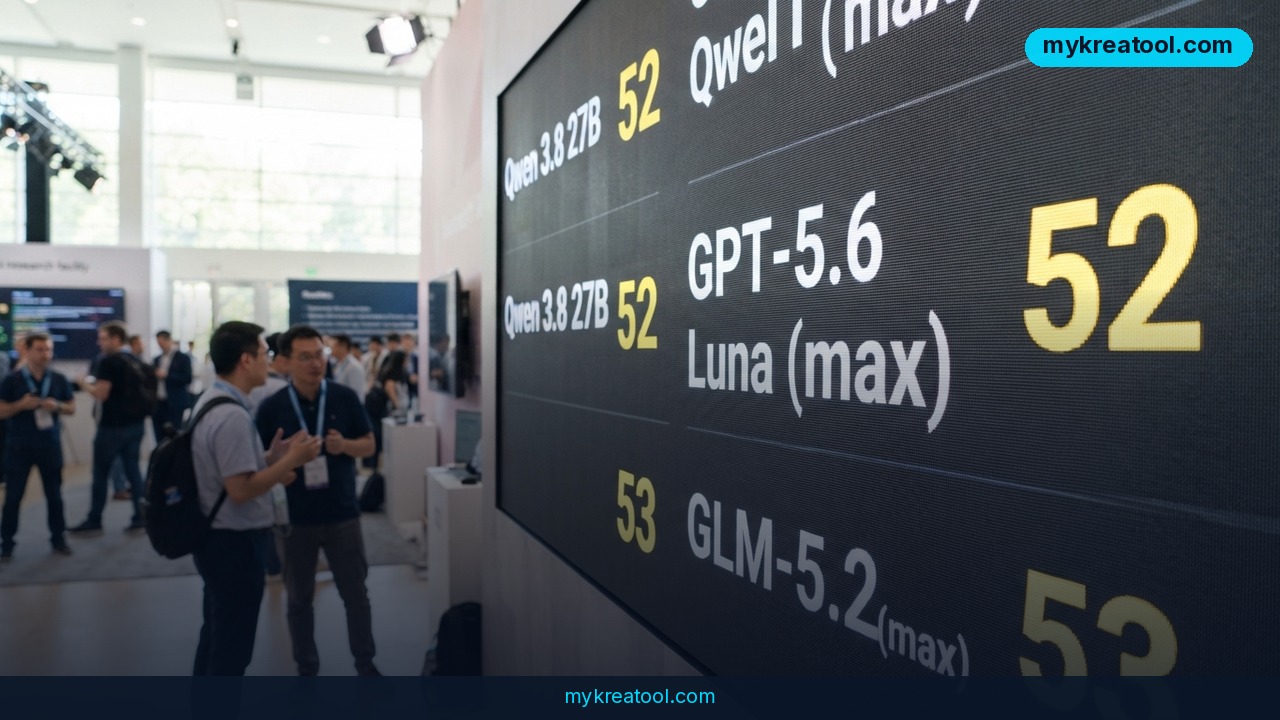
Qwen 3.8 27B just posted a score of 52 on the Artificial Analysis Intelligence Index, the independent benchmark that tracks how well large language models reason, code, and follow instructions. That number matters less on its own than in context: 52 is exactly the same score as GPT-5.6 Luna (max), and just one point behind GLM-5.2 (max) and DeepSeek V4 Pro 0813 (max), both of which weigh in far heavier — GLM-5.2 runs at roughly 753 billion parameters, while DeepSeek's flagship is built on a dramatically larger architecture than Qwen's compact 27 billion.
The comparison was first flagged by developer Simon Willison, who called Qwen 3.8 27B "a truly astonishing model" in a link post on his blog dated 17 August 2026. He'd already noted a few days earlier that the model has a tendency to overthink simple prompts — but the raw intelligence-per-parameter ratio is what's turning heads.
The numbers in plain terms
Put simply: a model roughly 20 to 30 times smaller than its closest rivals is producing benchmark results in the same tier. That's not a marginal efficiency gain — it's the kind of jump that changes which businesses can realistically run frontier-level AI in-house instead of renting it by the API call.
Why it matters
Model size directly drives cost: inference price, GPU memory, latency, and how many concurrent users a single server can handle. A 27B model can run on hardware that a 753B model simply cannot — think a single high-end GPU or even strong consumer-grade setups, versus multi-GPU clusters.
For entrepreneurs and product teams, this reframes the buy-versus-build calculus. Until now, "frontier-level reasoning" meant paying frontier-level API prices or building infrastructure for a massive model. Qwen 3.8 27B suggests that gap is closing fast, and open-weight Chinese labs are driving much of that compression — a trend Willison has been tracking closely across his "ai-in-china" coverage.
Efficiency beats raw scale
The Intelligence Index isn't a perfect proxy for real-world usefulness, but it's become a standard reference point precisely because it lets you compare models of wildly different sizes on equal footing. When a 27B model ties a much larger competitor, it signals that architecture and training data quality are starting to matter more than sheer parameter count — good news for anyone without a hyperscaler's budget.
How to use it today
If you want to see this efficiency shift for yourself, the fastest path is hands-on testing rather than reading benchmark tables. Run the same prompt — a customer email draft, a code snippet, a data-extraction task — through Qwen 3.8 27B and a larger model side by side, and compare not just the answer quality but the response time and cost per query.
For marketers and creators who want to experiment without setting up local infrastructure, a good starting point is trying lightweight, no-signup tools before committing to a specific model or API. You can prototype prompts and compare outputs quickly using the free AI tools at mykreatool.com, which is useful for validating whether a smaller model actually meets your quality bar before you invest engineering time in self-hosting one.
A practical checklist
• Benchmark your actual use case, not just the leaderboard score — overthinking on simple tasks (a known quirk of Qwen 3.8 27B) can slow down latency-sensitive workflows.
• Check hosting requirements: a 27B model opens the door to self-hosting on modest hardware, cutting recurring API costs.
• Compare licensing terms before deploying commercially, since open-weight models vary in how freely they can be redistributed or fine-tuned.
Who benefits
Startups and solo creators stand to gain the most immediately. Running a 27B parameter model in-house is a realistic proposition for a small team, where renting equivalent capability from a 750B-plus model was previously out of reach financially. Agencies building AI-powered products for clients can now offer more competitive pricing by swapping in efficient open models for specific tasks like summarization, classification, or first-draft content generation.
Developers building agentic workflows — the kind of "agents register users, no sign-up form" pattern gaining traction in tools like WorkOS's auth.md — also benefit, since smaller models mean cheaper, faster background tasks that don't need top-tier reasoning for every single step.
Risks
Benchmark scores don't capture everything. Willison's own follow-up noted that Qwen 3.8 27B can wildly overthink straightforward requests, generating excessive reasoning chains that slow down responses and inflate token costs even when the model is technically smaller. That's a real tradeoff: efficiency on paper doesn't always translate to efficiency in production.
There's also the usual caution around rapidly shifting leaderboards — a model that tops the chart in August can be overtaken within weeks, and Intelligence Index scores are aggregate measures that may not reflect performance on your specific domain, language, or safety requirements. Treat any single score as a starting signal, not a final verdict.
Conclusion
Qwen 3.8 27B's score of 52 on the Artificial Analysis Intelligence Index — matching GPT-5.6 Luna and trailing much larger models by just a single point — is a concrete signal that AI efficiency is catching up to raw scale faster than expected. For entrepreneurs, marketers, and creators, that means frontier-level reasoning is becoming accessible on smaller budgets and simpler infrastructure. The smart move now isn't to chase the biggest model on the leaderboard, but to test compact options like this one against your actual workload and see how much you can save without losing quality.



Comments 0