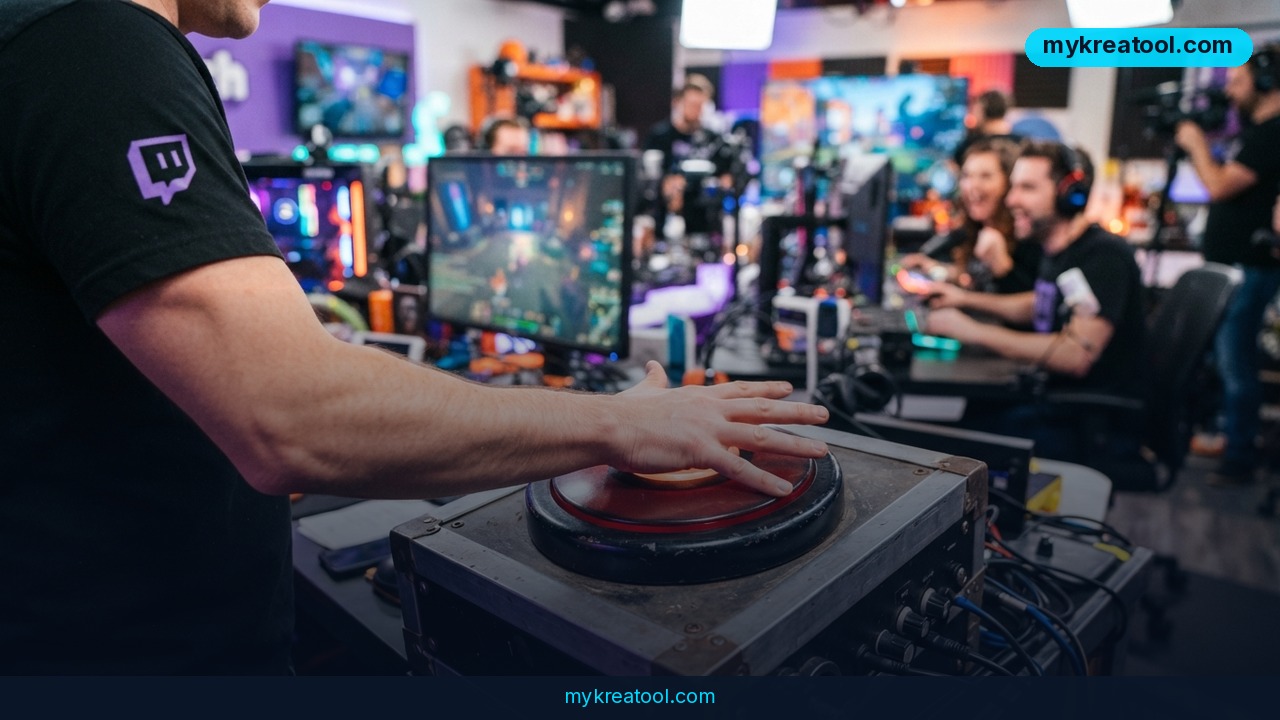
Twitch AI training is now the default setting for every streamer on the platform, and most creators had no idea until Amazon's plans leaked into public chat. On August 12, 2026, Twitch confirmed that recordings from streamers will be used to train generative AI models for its parent company, Amazon — unless creators manually dig into their settings and turn it off. The announcement triggered immediate backlash from a community that has spent years pushing back against AI trained on scraped, non-consensual data.
What Happened
Twitch quietly rolled out a new privacy toggle that lets streamers opt out of having their channel content used to train generative AI models across Amazon. The catch: opting in is the default. Every existing and new streamer is automatically enrolled unless they find the setting and switch it off themselves.
The Livestream That Explained It
Twitch Head of Community Mary Kish and Chief Product Officer Mike Minton addressed roughly 3,000 viewers on the official Twitch channel to explain the change, and the chat was reportedly flooded with anti-AI comments. Minton didn't dodge the obvious question — why opt-out instead of opt-in — and gave a blunt answer: "If this was opt-in, nobody would opt in. That's honestly the answer."
Confusion Over Past Recordings
Things got murkier when a streamer asked whether their past videos had already been used for training. Minton admitted he didn't actually know, saying he wasn't aware of what Amazon had already done with existing footage. That single exchange summed up the core complaint: creators can't meaningfully consent to something they can't verify has already happened.
Why It Matters
Twitch streams are a goldmine for AI training. Unlike static images or text scraped from the web, livestreams offer thousands of hours of synchronized audio, video, natural speech, and real-time human reactions — exactly the kind of multimodal data that's expensive and hard to source elsewhere. For creators who stream for many hours every week, that means their voice, face, and personality are now raw material for Amazon's model training pipeline by default.
The move also puts Twitch in the same camp as Meta, which already trains its AI models on public content from Facebook and Instagram. Kish pointed out that Twitch isn't unique here — but she also acknowledged that even offering an opt-out is a direct response to community backlash, not a proactive privacy decision. For an audience that has been vocally anti-generative-AI for years, framing the change as "adding a setting" rather than "we're now training on your content" only deepened the trust problem.
How To Use It Today
If you stream on Twitch, checking this setting takes less than a minute. Here's the exact path:
1. Go to your channel settings — not the creator dashboard, which is a common mix-up.
2. Open the security and privacy tab.
3. Scroll to "training for generative AI."
4. Toggle it off.
That's it — no confirmation email, no separate form. Creators managing multiple accounts or team channels should repeat this for every login with stream access, since the setting appears to be account-specific rather than organization-wide. If you're building AI-adjacent content or tools yourself and want to experiment responsibly, free resources like the tools at mykreatool.com are a useful way to test AI workflows on content you actually own and control, rather than relying on platforms that default to using your data without asking.
Who Benefits
Amazon is the clearest winner. Training data of this scale and quality — synchronized video, audio, and live audience interaction across gaming, IRL, and creative categories — is difficult to replicate through licensing deals or public datasets. It directly strengthens Amazon's generative AI ambitions, which compete with OpenAI, Google, and Anthropic.
Twitch itself benefits indirectly: better AI models could eventually power moderation tools, clip generation, translation, or recommendation features on the platform. Marketers and brands running influencer campaigns on Twitch may also see downstream benefits if AI-assisted tools improve content discovery and audience matching. The losers are the streamers themselves, who get no compensation, no clear audit trail, and had to be told about the change during a live damage-control stream rather than through a proactive email.
Risks
The biggest risk is the default itself. Opt-out models rely on inattention — most users never touch settings they don't know exist, which is precisely why Minton admitted opt-in would have failed for Amazon's purposes. That dynamic raises real questions about informed consent, especially for creators who monetize their voice, likeness, and personality as their core product.
There's also the retroactive data problem: Twitch couldn't confirm whether previously recorded streams were already used for training before the opt-out existed, meaning some creators may have no way to "undo" consent they never explicitly gave. For businesses and agencies that manage streamer talent, this creates a compliance blind spot — contracts and brand deals rarely address AI training rights, so legal exposure could surface later. Finally, this sets a precedent: if opt-out becomes the industry norm on platforms like Twitch, Meta, and others, creators will increasingly need to actively police their own privacy settings across every platform they use just to keep control of their own content.
Conclusion
Amazon's decision to train generative AI on Twitch content by default marks another step toward platforms treating user-generated content as free training data unless explicitly refused. The opt-out toggle is real and takes under a minute to activate, but the bigger issue — retroactive use, lack of compensation, and eroding trust — isn't solved by a settings menu. For streamers, marketers, and anyone building on top of AI tools, the lesson is the same: check your privacy settings proactively, read the fine print on every platform update, and favor tools and workflows where you control what happens to your content.

Comments 0