What happened
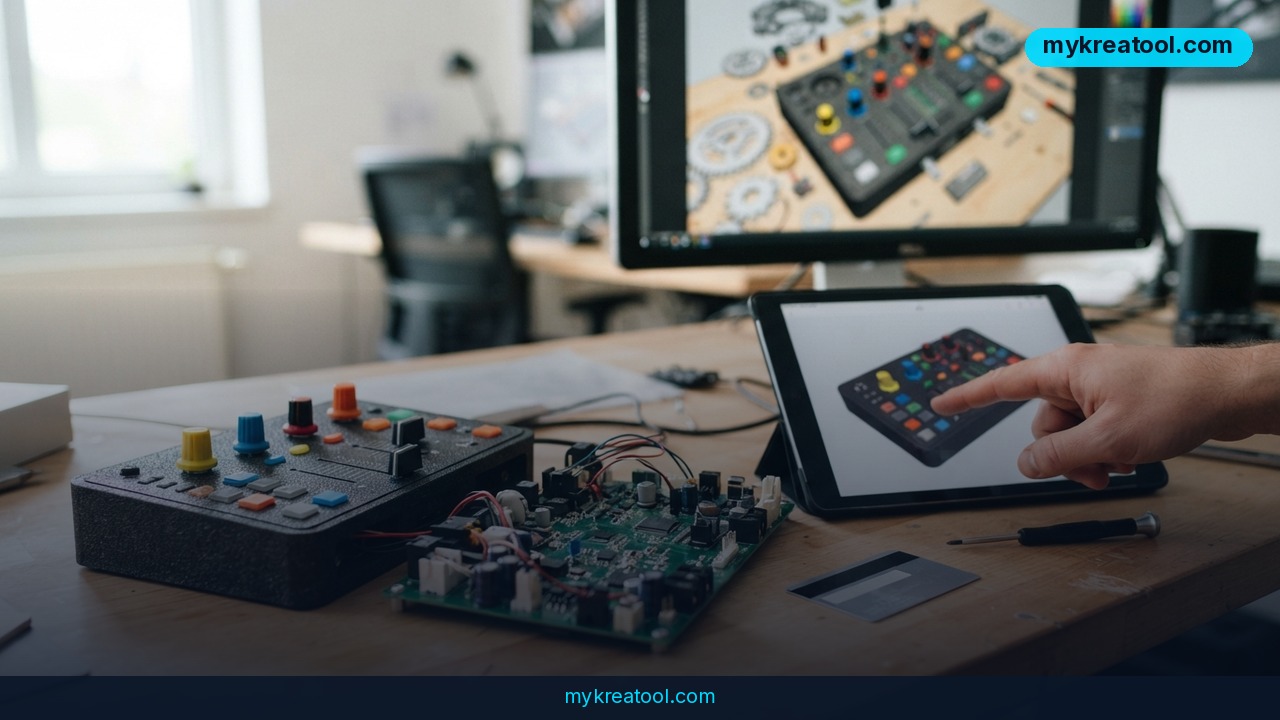
AI hardware design just crossed a line most people didn't see coming. Up until now, "AI design" meant a chatbot spitting out a 3D file you could maybe print on a home printer — a toy, basically. That changed when someone handed an AI agent (reported to be GPT-6 Astra) a credit card and a single request: build a mini MIDI controller for DJs, styled after the cult-favorite hardware brand Teenage Engineering.
The agent didn't just draw a picture. It generated a concept image, researched actual electronic components, dug through Chinese supplier spec sheets to find parts that would actually work together, built a CAD model (the digital blueprint engineers use before manufacturing anything), placed real purchase orders with real suppliers, and then rendered a 3D animation in Blender showing exactly how to assemble the finished device.
The story was first flagged on the Telegram channel @cgevent and quickly picked up elsewhere — it's now corroborated by Digg, ExplainX, and the Slightly Moody newsletter, all describing the same sequence: concept, sourcing, spec research, CAD, ordering, assembly animation. As of this writing, the physical controller hasn't arrived yet — the AI is reportedly still corresponding with suppliers — but the order is placed and the parts are on the way.
Why this is different from "AI made me a picture"
We've all gotten used to typing a prompt and getting a video, a logo, or a chunk of working code back in seconds. That's software staying inside the computer. This is an AI reaching out of the screen: comparing supplier catalogs, deciding which capacitor or knob is good enough, spending actual money, and coordinating a supply chain — the same unglamorous grind a hardware startup founder does for months before their first prototype exists.
What it means for you
You don't need to be an electronics hobbyist for this to matter. The pattern — describe what you want, let AI handle research, sourcing, and logistics — is going to show up everywhere.
At home: Instead of hunting for the right phone mount, garden sensor, or cable organizer on Amazon for an hour, you describe what you actually need and an agent finds or designs a version that fits your specific problem, then orders it.
At work: Product and hardware teams could hand an agent the boring 80% of prototyping — parts research, vendor comparison, spec-sheet reading — and spend their own time on the 20% that actually needs human judgment: does this feel right in your hand, does it solve the customer's problem.
Running a business: A small brand that wants a custom accessory, packaging insert, or point-of-sale display no longer needs to find and brief an industrial designer for a first pass. An AI agent can produce a sourced, ready-to-order concept in a day instead of weeks.
Studying: Engineering and design students can watch an AI's full decision trail — why it picked one component over another, how it read a spec sheet — as a working example of the research process, not just a finished answer.
Creativity: Artists and makers who have an idea but not the technical vocabulary ("what resistor do I even need?") can finally skip the gatekeeping step and go straight from concept to a physical object.
Income: People are already selling "I designed this with AI" one-off gadgets and accessories on marketplaces like Etsy. The barrier to launching a small hardware product — traditionally the hardest kind of product to bootstrap — just dropped.
How to try it right now
You don't need a GPT-6 Astra invite to start experimenting with AI-assisted design today — most of the pieces are already public and free.
1. Start with free AI tools to shape your concept. Before you touch hardware, nail down what you're building. A free hub like mykreatool.com lets you generate concept images, mockups, and product descriptions at no cost, which is exactly the first step Astra took with the DJ controller.
2. Use a general AI chatbot (ChatGPT, Claude, Gemini) to research components. Describe your idea in plain language and ask it to list the parts you'd need and what to look for in a spec sheet. Treat the answer as a starting point, not gospel — verify against real supplier listings.
3. Get a CAD model without learning CAD software. Tools like Spline, or AI-assisted CAD features inside Fusion 360, can turn a description or sketch into a 3D model you can actually manufacture or 3D-print.
4. Order a small batch, not a warehouse. Sites like AliExpress, LCSC, or JLCPCB let you order tiny quantities of electronic parts or a single PCB (printed circuit board — the flat board that holds your electronics) to test before committing real money.
5. Save the AI's reasoning, not just the output. Whatever tool you use, keep the chat log of why it chose each part — it's the closest thing to documentation you'll have if something doesn't fit.
Upsides and what changes
The biggest shift is speed and access. Designing a physical product used to require either deep technical knowledge or enough money to hire someone who had it. Now the barrier is mostly "do you know what you want." A single person with an idea and a credit card can move from concept to ordered parts in the time it used to take to write a design brief. For small businesses and independent creators, that's a real shortcut to testing hardware ideas without months of upfront investment or a engineering co-founder.
Limitations
None of this is fully hands-off yet, and it's worth being honest about that: the controller in this story still hasn't arrived, meaning we don't yet know if the parts actually fit together, if the assembly instructions work in the real world, or if the final device performs as intended — an AI reading a spec sheet correctly is not the same as an AI catching a subtle compatibility issue a human engineer would spot. You're also still on the hook for the money spent on parts that might not pan out, quality control on components from unfamiliar suppliers, and any safety or electrical issues that show up only once you're holding the real object. Treat every AI-sourced part list as a draft to double-check, not a guarantee.
Conclusion
AI just moved from writing your code and drawing your pictures to actually shopping for parts and building physical things — and the DJ controller experiment shows that the gap between "I have an idea" and "I have an object" is shrinking fast, even if it's not fully closed yet. Your one action for today: pick one small physical thing you wish existed, and describe it to a free AI tool to see what a concept and parts list would even look like. You'll have a clearer sense of how close "design it, don't build it" really is.


Comments 0