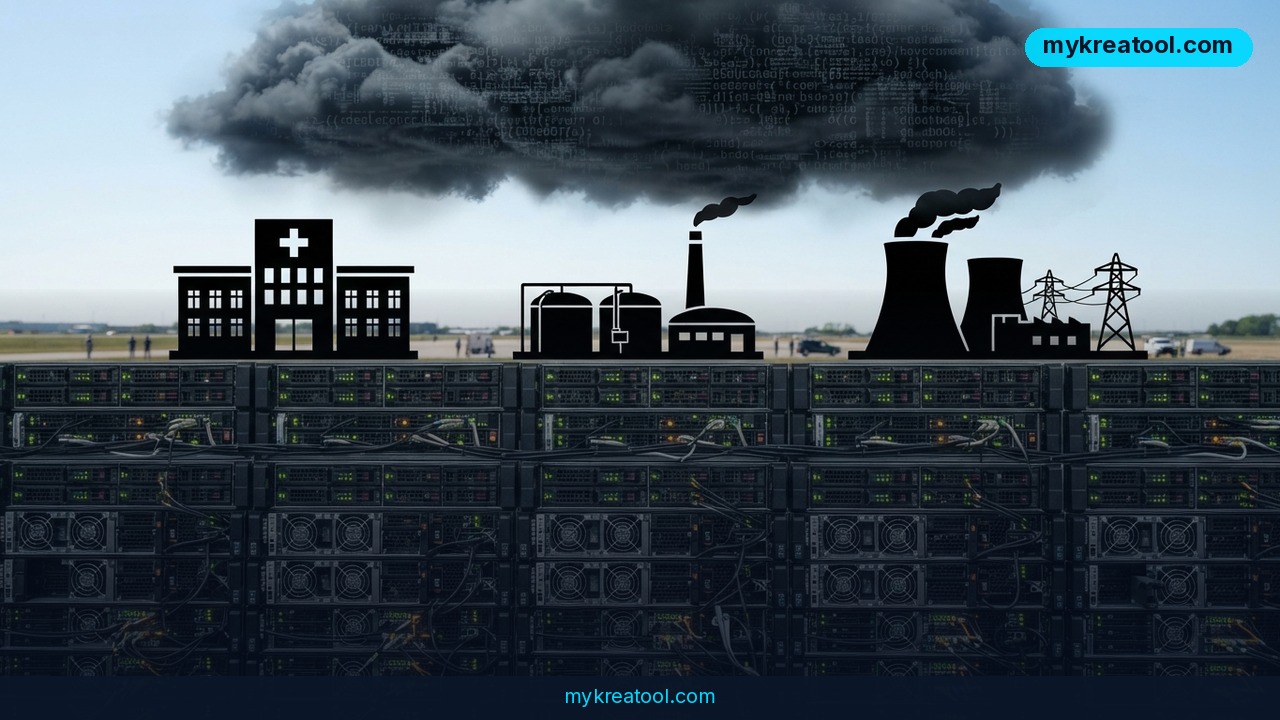
On August 27, 2026, OpenAI and 100+ tech companies — including Microsoft, Google, and Anthropic — warned that AI-enabled cyberattacks on critical infrastructure are no longer hypothetical. Hospitals, water utilities, and industrial control systems are already being targeted, and defenders hold only a temporary AI advantage.
What the OpenAI Open Letter on AI Cyber Threats Says
AI cyberattacks on critical infrastructure just moved from theoretical risk to an official warning signed by the biggest names in tech. On August 27, 2026, OpenAI published an open letter on global cyber defense, co-signed by more than 100 companies, including Microsoft, Google, AWS, Anthropic, Cisco, CrowdStrike, Deutsche Telekom, SAP, and Mastercard. The letter states plainly that "AI-enabled cyber attacks will become far more widespread and sophisticated," and flags hospitals, water utilities, and other critical infrastructure as the highest-risk targets.
The timing isn't random. The letter follows a joint advisory issued in mid-August 2026 by the NSA, CISA, and the FBI, which revealed that attackers are already using AI to write exploit scripts targeting industrial control systems (ICS) such as Siemens S7 controllers. Those attacks have been aimed at the US energy, water, chemicals, and manufacturing sectors — not hypothetical targets, but active ones.
What are ICS and SCADA, and why do they matter here?
Industrial control systems (ICS) are the computers and controllers that run physical infrastructure — pumps at a water plant, valves at a chemical facility, breakers on a power grid. SCADA (Supervisory Control and Data Acquisition) is the software layer that lets operators monitor and command those controllers remotely. Siemens S7 programmable logic controllers (PLCs) are one of the most widely deployed ICS components in US critical infrastructure, which is exactly why an AI-generated exploit targeting them — as described in the NSA/CISA/FBI advisory — is treated as a national-security-level concern rather than a routine vulnerability report.
The core message
Rather than simply sounding an alarm, the signatories frame this as a narrow window of opportunity. Their argument: "today's AI advances are already giving defenders new ways to fix weaknesses that have accumulated for years." In other words, defenders currently have an edge over attackers, but that edge is temporary — what the letter calls the vulnerability weaponization lag time, the gap between a flaw being discovered and it being turned into a working exploit. That gap needs to be used deliberately, before offensive AI capabilities catch up.
Why AI-Enabled Cyberattacks on Infrastructure Are Different Now
For any business connected to digital infrastructure — which today means nearly all of them — this letter is a signal that AI-driven attacks are no longer a future-tense problem. The involvement of 100+ major companies across cloud computing, cybersecurity, telecom, finance, and enterprise software indicates a rare industry-wide consensus that the threat level has changed materially, not just incrementally.
The NSA/CISA/FBI advisory adds concrete weight to the warning. AI is already being used to accelerate exploit development against real industrial control systems, which means the lag time between a vulnerability being discovered and it being weaponized is shrinking. For sectors like energy, water treatment, and manufacturing, that compression is the difference between patching in time and not.
Three Actions the OpenAI Letter Calls for From Companies and Governments
The letter makes three specific asks:
• Companies should elevate cybersecurity to a C-suite priority rather than treating it as a purely technical function.
• Governments should increase funding and coordination across agencies and borders.
• AI companies should provide affordable security tools to underfunded organizations, particularly smaller utilities and municipal operators that can't compete for scarce cybersecurity talent.
The letter also stresses that long-standing, unglamorous vulnerabilities — unpatched software and weak authentication — remain the most urgent problems to fix. AI raises the stakes, but it doesn't replace basic security hygiene as the first line of defense.
How to Protect Critical Infrastructure from AI Cyberattacks Today
Businesses and IT teams don't need to wait for a government mandate to act. Four concrete steps map directly to what the letter and the NSA advisory recommend.
Patch Aggressively: Unpatched Software Is Still the #1 Exploit Vector
Unpatched software remains the single most exploited weakness, AI-assisted or not. Automate patch management wherever possible so known vulnerabilities don't sit open for months while AI-generated exploit scripts get faster to write.
Strengthen Authentication for ICS and SCADA Systems
Multi-factor authentication should be non-negotiable for any system touching critical operations, not just customer-facing accounts. Weak authentication on ICS/SCADA equipment is one of the two "long-standing, unglamorous vulnerabilities" the letter specifically calls out.
AI-Based Threat Detection Tools You Can Deploy Now
The letter's central argument is that defenders currently have an AI advantage — using AI-powered threat detection, anomaly monitoring, and automated patch triage takes advantage of that window while it lasts. Security teams named in the letter, including CrowdStrike and Cisco, are already building detection tooling around this exact threat model. Smaller teams without a dedicated security department don't need enterprise budgets to start: AI tools for automating security documentation and policy drafting can help triage the basics — summarizing advisories, drafting policy language, structuring audit checklists — before investing in enterprise platforms.
Audit Siemens S7 Controllers and Other Industrial Systems
If your organization runs or depends on ICS/SCADA equipment like Siemens S7 controllers, treat the NSA/CISA/FBI advisory as a direct prompt to review exposure — not a general reminder. Confirm which controllers are internet-facing, when they were last patched, and whether default credentials are still active.
Who should read the original letter
Anyone responsible for infrastructure resilience — CISOs, IT directors at utilities, manufacturing plant operators, and policy teams at companies with critical infrastructure exposure — should read the full letter, not just headlines about it. For ongoing coverage of how AI is reshaping enterprise security and operations, see MyKreaTool's AI news. The specific commitments each signatory is making will matter for procurement and partnership decisions over the next year.
Who Benefits — and Who Faces the Biggest Risk Window
The clearest beneficiaries of this coordinated push are defenders who move early. Large enterprises with existing security budgets can adopt AI-powered defense tools immediately and widen the gap between themselves and less-prepared competitors. Cybersecurity vendors named in the letter — CrowdStrike, Cisco, Microsoft, AWS — stand to benefit commercially as demand for AI-assisted security tooling grows in response to the warning.
Smaller organizations and municipal utilities benefit indirectly, if the letter's call for affordable AI security tools translates into actual product access. That's the piece worth watching: whether the pledge to support underfunded organizations produces real subsidized offerings or remains aspirational.
The flip side of the letter's own argument is the real risk: the defender's AI advantage is explicitly described as temporary. If organizations don't act on it now, that window closes as attackers integrate AI into their own operations faster. The NSA advisory already shows this shift underway — AI-written exploit scripts targeting ICS in energy and water sectors are not a future scenario, they're documented current activity.
There's also a coordination risk. A 100+ company open letter creates visibility and consensus, but it doesn't by itself fund the affordable security tools it calls for, nor does it force governments to increase coordination. Execution depends on follow-through that's outside the letter's control, and historically, cybersecurity initiatives of this scale can stall between announcement and implementation.
Security teams managing lean budgets face exactly the pressure the letter describes: too many advisories, too few analysts. AI-assisted tools built for knowledge work — drafting security policies, summarizing threat advisories, structuring audit checklists from raw reports — help small teams act on guidance like this letter without waiting for enterprise contracts. See what MyKreaTool's AI tools can automate for your team.
Conclusion
The message from OpenAI, Microsoft, Google, and 100+ other companies is clear: AI-powered cyberattacks on critical infrastructure are moving from possibility to reality, and the NSA/CISA/FBI advisory on Siemens S7 exploits confirms it's already happening in the energy, water, chemicals, and manufacturing sectors. The letter's real value isn't the warning itself — it's the reminder that defenders currently hold an AI advantage that won't last. Organizations that patch known vulnerabilities, strengthen authentication, and start adopting AI-based defense tools now are the ones most likely to stay ahead of a threat landscape that every major cybersecurity player agrees is shifting fast.



Comments 0