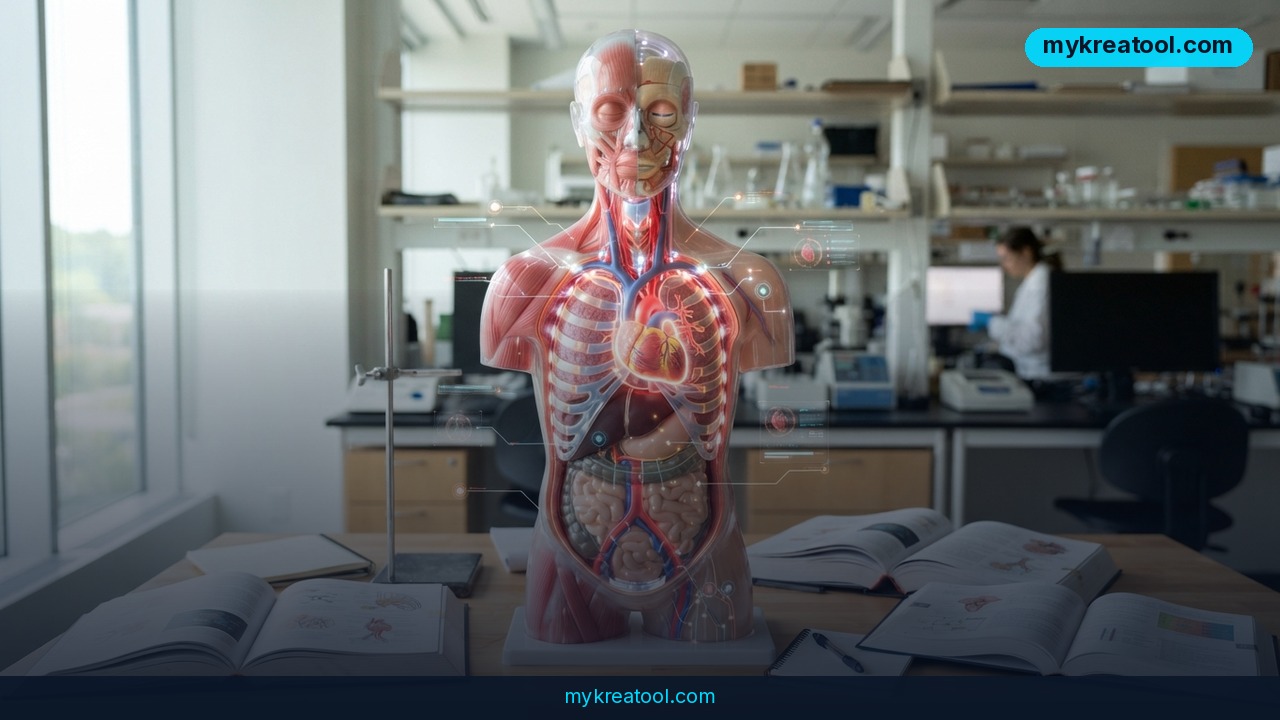
Google DeepMind just showed off an interactive 3D human anatomy atlas that was put together from three open scientific datasets by a single prompt. The model doing the assembling is Gemini 4 Argon, and what came out the other end isn't a slick render or a canned fly-through video — it's a working application. You can rotate organs, strip away tissue layers one at a time, isolate a single muscle, and look inside a beating heart.
Almost one prompt, anyway. DeepMind's own framing carries that little caveat, and it's worth keeping in mind as you read the rest of this.
What happened
Google DeepMind published a demonstration in which Gemini 4 Argon was pointed at three publicly available scientific datasets and asked to build something from them. The result was a full interactive 3D atlas of the human body — the kind of thing that normally takes a studio of 3D artists, developers and anatomists months to ship.
Let's translate the jargon. An open dataset is just a public collection of measurements that anyone can download for free — think of a library where every book is a spreadsheet. Human anatomy data like this has been sitting there for years. What's new is that the model didn't only read the data. It turned it into software: the 3D geometry, the animation, the interface, and the clickable controls that hold it all together.
You can read DeepMind's own write-up on the Gemini 4 Argon announcement if you want the technical version.
What you can actually do inside the atlas
From the demo, the app lets you switch tissue layers on and off one after another, like peeling an onion; pull out individual muscles and study them alone; spin organs around to see them from any angle; look inside a heart while it beats; and watch anatomical structures move.
Why an app beats a video
A pre-rendered animation is a cooking show. You watch someone else sear the steak, and you learn something, but you can't touch the pan. An interactive app hands you the kitchen. You choose where to cut, which layer to remove, how far to zoom in. That difference is the whole ballgame for anyone trying to actually learn something rather than admire it.
What it means for you
The demo is medical. The trick behind it isn't. What DeepMind showed is a repeatable move: take public scientific data, describe the tool you want in ordinary language, and get back an interactive product instead of a static picture. That pattern travels far beyond anatomy.
At home: the diagram that finally makes sense
If you've ever stared at a flat chart of the knee and given up, this is the fix. Instead of a picture in a book, you get an object you can turn over in your hands, peel back and poke at until the shape clicks. That's a different kind of understanding, and for a lot of people it's the only kind that sticks.
At work: dashboards you can spin
Most business data is still trapped in tables that only three people in the company can read. The same approach — feed in the data, describe the view you need — points toward 3D and interactive explainers of your product, your factory layout, your supply chain. No rendering team required.
For students and teachers: textbooks become tools
A teacher could turn a chapter on cell biology into something students click through on a laptop. The curriculum doesn't change; the delivery does. That's usually where learning outcomes actually move.
If you want to warm up on the smaller stuff first — free image generators, transcription, quick text tools — have a look at MyKreaTool before you go near a 3D pipeline.
For creators: 3D content without a 3D artist
Freelancers who sell explainer content have historically needed a modeling specialist on speed dial. If a plain-language description can produce an interactive scene, the bottleneck shifts from hands to ideas. People who can describe things clearly get a lot more leverage.
As income: a new service to sell
There's an obvious small business here: building interactive explainers for clinics, gyms, schools and equipment makers. The scarce skill won't be 3D modeling. It'll be knowing which data is trustworthy and how to phrase a prompt that produces something a real expert won't wince at.
How to try it right now
You won't match DeepMind's atlas on your first attempt, and that's fine. Here's the realistic path.
1. Read the announcement first. Open Gemini 4 Argon and check what access is actually open today. Big demos often land before general availability, so confirm what you can use before you plan around it.
2. Start with the free option. Whatever Google lets you use at no cost — the Gemini app or its developer tools — is plenty for a first test. Don't spend money before you've seen the thing work on your own data.
3. Pick one small public dataset. Something you can eyeball and judge yourself: a single organ, one machine part, one simple structure. Scope is the enemy here.
4. Write the prompt like a brief, not a wish. Name the object, the layers you want to toggle, the interactions you want, and how it should look. Talk to it the way you'd talk to a new hire on day one.
5. Iterate one feature at a time. Ask for the model, then the layer toggle, then the rotation, then the animation. Big all-at-once requests fall apart.
6. Check it against the source data. Spot-check three or four details. If those are wrong, the whole thing is decoration, not a tool.
7. Share a link or a screen recording and get one other person to click through it before you call it done.
Upsides and what changes
The headline win is speed. A pipeline that used to need a modeler, an animator and a developer collapses into a conversation. The second win is access: open scientific data finally has a cheap route to becoming something people can use, not just cite.
The third, and the one worth watching, is the range. DeepMind's own suggestion is that the same approach could stretch from molecular biology to astrophysics. If that holds, the shortage we're about to have isn't data. It's people who can describe what a good tool looks like.
Limitations
Keep your expectations calibrated. The demo is a demo: it was produced by the company that makes the model, it covers one use case, and there's no public evidence yet of how it performs on messy real-world data. The phrase almost one prompt is doing heavy lifting — this took iteration, and it will take iteration for you too. Anatomy is a domain where a confidently wrong model is genuinely dangerous, so anything headed for a classroom, a clinic or a customer needs a human expert signing off on every structure. The three source datasets were open and presumably clean; your data probably isn't. Rendering an interactive 3D scene also costs serious compute, which shows up later as latency or a bill. And open datasets come with licenses — free to download isn't the same as free to sell.
Conclusion
DeepMind didn't just build a nice anatomy toy. It showed that public scientific data can be turned into interactive software by describing what you want, and that's a shift worth paying attention to. The skill that matters now isn't 3D modeling or machine learning. It's being able to look at a pile of data and say, clearly, what a person should be able to do with it.
One action for today: open the announcement, pick a single dataset you already have access to, and write one sentence describing the interactive tool you'd want someone to be able to click through. Save that sentence. It's the prompt you'll use.


Comments 0