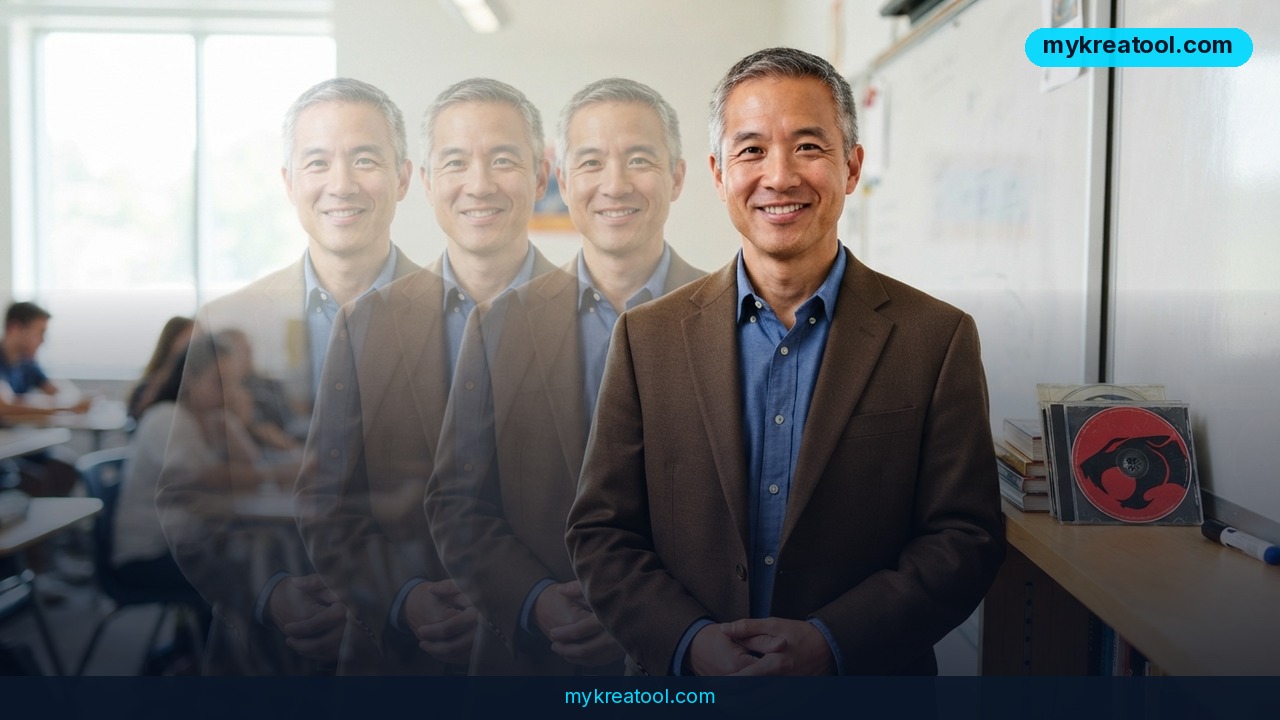
AI teacher clones just became real: Napster, the once-notorious music-sharing service, has signed a partnership with Gems Education in Dubai to build digital twins of real teachers — AI copies trained on a teacher's own lessons that students can talk to any time, day or night.
What happened
Napster — yes, that Napster, the platform that terrified music executives in 1999 — has come back as an AI education company. In September 2026, the rebuilt Napster signed a strategic partnership with Gems Education, a major private-school network in Dubai, United Arab Emirates, to build AI agents and "digital personas" for classrooms. The centerpiece: digital twins of real teachers, trained on that teacher's own material, that students can talk to outside of class.
Here's the backstory in plain numbers. The original Napster shut down its peer-to-peer file-sharing service in 2001 after losing a string of copyright lawsuits. It limped along for two decades as a paid music-streaming app, then in 2025 a Florida tech company called Infinite Reality bought it for $207 million. In January 2026, the new owners pulled the plug on music streaming entirely and turned Napster into an AI platform. Samuel Huber — previously the founder and CEO of a company called Landvault, which Infinite Reality also acquired, in 2024 — is now Napster's CEO for the Middle East and Africa, running the project out of a new Dubai hub.
The first rollout is happening at the Gems School of Research and Innovation, inside the Gems Global Education AI Hub and its "Gems Intelligence 360" platform. The plan: build digital twins of teachers using a system called Napster Learn, plus gamified lessons, AI-generated classroom content, and simulated classroom scenarios. A digital twin is trained on a specific teacher's material — their courses, lesson notes, and papers — so it answers the way that teacher would, not like a generic chatbot. Huber describes it as a "copy of yourself that you can then use to scale your time." Students get to ask the AI version of their teacher questions after school hours, and the teacher gets a dashboard showing what students were actually confused about.
What it means for you
You don't need to work at a Dubai private school for this trend to matter. The same idea — training an AI on someone's own material so it answers questions the way they would — is already spreading into ordinary work, study, and business.
Study. If you're a student, or helping a kid with homework, think of a "digital twin" teacher as a tutor that only knows what your actual teacher taught, instead of the internet at large. That matters because generic AI chatbots sometimes explain a topic differently than your class did, which just adds confusion before a test. A tool trained only on your teacher's own slides and notes stays consistent with what you'll actually be graded on.
Work. The same trick applies to a manager, a support lead, or a consultant. Feed an AI your own training documents, onboarding guides, or FAQ answers, and it can field routine questions from your team or clients while you're offline, without making up answers your company never actually gave.
Business. A small business owner running online courses, coaching, or paid consultations could build a lighter version of this: a chatbot trained on your own course material that answers basic student questions at 2am, so you're not fielding "when's the deadline" messages during dinner.
Creativity. Course creators, YouTubers, and coaches can repurpose existing videos and scripts into a "voice" an AI can answer in — a scaled-down version of what Napster calls a digital persona.
Income. If you already teach, tutor, or coach, this points to a real opportunity: package your own knowledge into a document-trained assistant and sell access to it as an add-on to your existing lessons, instead of giving away more unpaid one-on-one time.
How to try it right now
Napster Learn itself isn't open to the public — it's built specifically for Gems Education's schools in Dubai, so there's no public sign-up today. But you can test the exact same underlying idea — an AI trained on your own material, instead of the open internet — for free, right now.
1. Start with the free option. Go to MyKreaTool, a free collection of AI tools, and use its document and chat tools to feed in your own notes, a course outline, or a set of FAQ answers.
2. Ask it questions the way a student or customer would, and check whether the answers actually stick to your source material instead of drifting into generic filler.
3. Save the file as a reusable reference so you — or anyone you share it with — can keep asking it questions later.
4. Once you've tested the idea for free, decide whether you actually need a paid, more specialized tool. Most people don't, at least not at first.
5. If you're specifically in education and want the full "digital twin teacher" experience Napster is building, that's currently only available through Napster's direct partnership with Gems Education in Dubai — there's no open waitlist yet.
Upsides and what changes
For teachers, the pitch is fewer repeated questions and better visibility: instead of answering "what's due Friday" fifteen times a day, the AI handles it, and the teacher gets a report of what students were actually struggling with. For students, it means help is available outside school hours, not just during class or office hours. Huber says the system leans on voice and video, not just text, aiming to make it feel less like typing into a search box and more like talking to a coworker. He also says student data stays inside the country where it was collected, can in some cases be hosted on a school's own servers instead of Napster's, and that Napster doesn't use that data to train its underlying AI models.
Limitations
None of this has been independently tested yet — it's a freshly announced partnership, not a finished product, so there's no public data on how accurate these teacher clones actually are, how students respond to talking with an AI version of their teacher, or how the privacy promises hold up once real student data starts flowing through the system at scale. It's also worth naming the obvious tension directly: a tool built to "scale a teacher's time" can look, from a school budget's point of view, an awful lot like a tool built to need fewer teachers. Huber insists the goal is to extend teachers, not replace them — that's a claim worth watching over the next year, not one to take on faith today.
Conclusion
Napster's second act has nothing to do with music. It's about turning a teacher's own material into an AI that can answer questions on their behalf, and Dubai's Gems Education is the first real-world test of that idea. One action for today: pick one document you already have — lesson notes, an FAQ, a course outline — and run it through a free AI tool to see for yourself whether a bot trained on your own material actually answers better than a generic chatbot does.
Comments 0