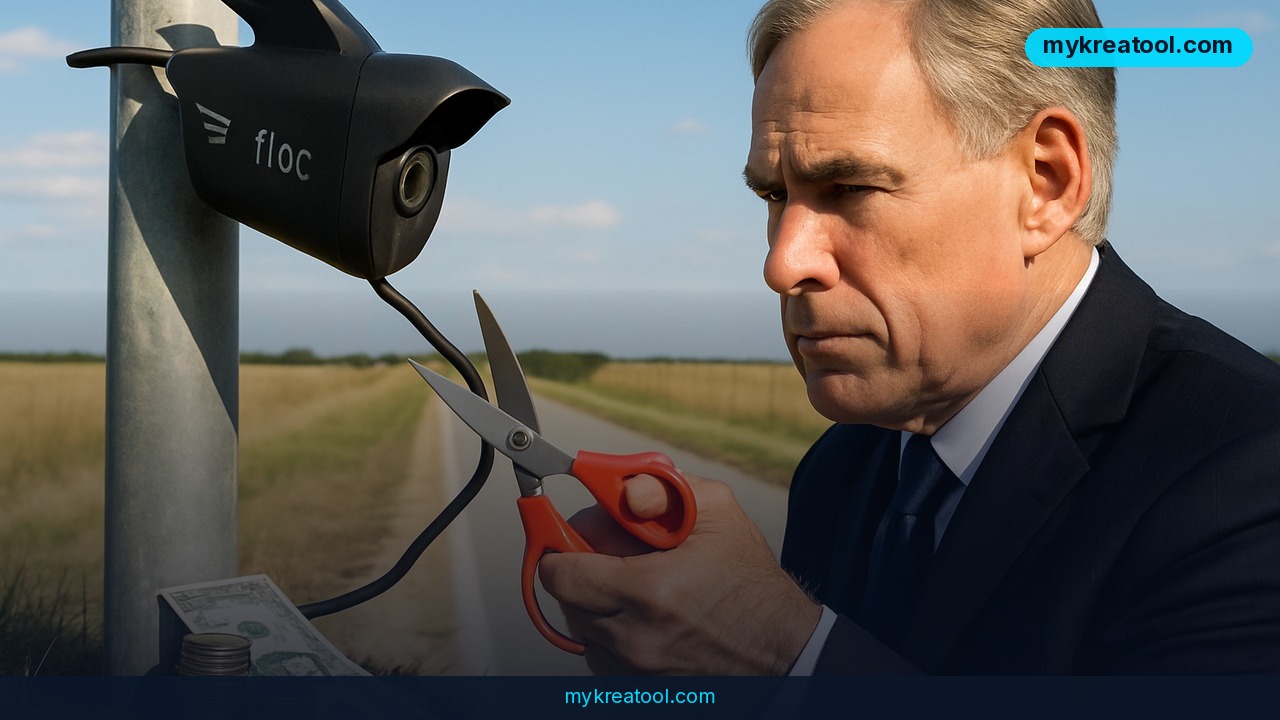
Why Did Texas Halt Flock AI Camera Funding?
Texas Governor Greg Abbott froze Flock Safety AI camera funding after a Texas Tribune investigation revealed that $30 million — drawn from a $1 insurance policy fee — was quietly spent on a statewide license plate tracking network without clear public disclosure.
That $30 million wasn't buried in a general budget line — it was raised through a $1 fee tacked onto insurance policies statewide, originally pitched as a tool to fight catalytic converter theft. Instead, the money funded a much broader AI-powered surveillance buildout, and Texans are only now finding out how their premiums were spent.
The trigger behind the freeze
The timing isn't a coincidence. Abbott's move preceded the Texas Tribune's reporting by only days, suggesting the administration knew the spending story was coming and wanted to get ahead of it. Multiple Texas cities have already canceled their Flock contracts in recent months, part of a nationwide wave of municipalities backing away from the technology.
What Is Flock Safety and How Do Its AI Cameras Work?
Flock's AI cameras use license plate recognition to track vehicle movement across cities, feeding that data into a searchable network used by law enforcement. The technology has expanded fast over the past few years, but Texas's funding freeze marks one of the most significant political pushbacks yet from a Republican-led state government.
Privacy and Fourth Amendment Concerns: Why Backlash Is Bipartisan
Flock cameras have drawn criticism from across the political spectrum — a rare alignment in an otherwise polarized environment. At least six Texas police officers have faced discipline or criminal charges for misusing Flock's surveillance systems, according to reporting cited by The Verge. Nationally, the company has faced scrutiny over its data-sharing practices, camera placement near playgrounds, broad employee access to live video feeds, unsecured feeds discovered by researchers, and what critics describe as evasive responses to transparency requests.
The political fallout is notable because it's not confined to one party. Abbott's Democratic gubernatorial opponent, Gina Hinojosa, has hammered him for expanding camera use across the state. Meanwhile, Republican Representative Keith Self posted publicly that "From Flock cameras to kill switches, we will NOT surrender our Fourth Amendment rights to the growing surveillance state." When a Fourth Amendment argument unites a Democratic challenger and a sitting Republican lawmaker against the same governor's policy, that's a signal the issue has moved past typical partisan lines.
AI Accountability in 2026: What the Flock Case Means for Businesses
This story fits into a larger pattern of 2026: public trust in AI-driven monitoring tools is thinning fast, especially when taxpayer money funds them without clear oversight. It's a reminder that any organization deploying AI systems — surveillance or otherwise — needs a transparent paper trail for what the tool does, who can access its data, and how much it costs.
How to Vet an AI Vendor Before You Are Locked In
For business owners, marketers, and local officials watching this unfold, the practical takeaway isn't about license plates — it's about AI procurement discipline. Before adopting any AI-powered monitoring or automation tool, whether it's a surveillance system or a customer-data platform, ask three questions Flock's critics wish Texas had asked sooner: Who has access to the data? Where does the funding actually come from? And is there a public audit trail?
Entrepreneurs experimenting with AI tools for their own operations — content generation, analytics, customer tracking — can apply the same scrutiny at a smaller scale. Free AI tool directories, like the one at AI tools directory on MyKreaTool, are a good starting point for testing lower-risk, transparent AI utilities before committing budget to a locked-in vendor contract with murky data practices. Vetting a tool before it becomes embedded in your operations is a lot cheaper than unwinding a $30 million contract after the fact.
Practical checklist for AI vendor vetting
• Confirm exactly how the tool is funded and who approved the budget line.
• Ask for a written data-retention and data-sharing policy, not a verbal assurance.
• Check who inside the vendor's company can view raw data or footage.
• Look for existing complaints, lawsuits, or misuse incidents tied to the vendor.
Who Benefits From the Texas Funding Freeze?
Texas taxpayers benefit most directly, since the funding freeze halts further spending pulled from insurance fees that were never clearly earmarked for broad surveillance. Privacy advocates and civil liberties groups gain a concrete win after years of warning about ALPR data-sharing risks. Local governments that already canceled Flock contracts, and those considering it, now have political cover from a Republican governor's own retreat.
Small businesses and marketers also benefit indirectly: the episode is a public case study in why cheap, transparent AI tools often beat expensive, opaque ones — a lesson worth applying whether you're a city government or a two-person startup choosing software.
Risks: What the Freeze Does Not Fix
The freeze doesn't eliminate the cameras already installed, and existing Flock contracts across Texas remain active unless individually canceled. There's also a real risk this becomes a temporary political gesture rather than a permanent policy shift — funding freezes can be reversed as easily as they're imposed, especially once media attention fades.
For Flock Safety, the reputational damage compounds an already long list of scrutiny: data-sharing concerns, unsecured feeds, and camera placement complaints all predate this funding freeze. Any company selling AI-driven monitoring tools to governments should expect this level of scrutiny to become the norm, not the exception, going forward.
The Texas case is a $30 million lesson in why AI procurement discipline matters. Before any AI tool touches your operations or budget, you need clear answers on pricing, data access, and audit trails. Browse transparent AI tools on MyKreaTool — vetted utilities with clear pricing and no locked-in contracts, so you can test before you commit.
Conclusion
Texas's decision to freeze funding for more Flock AI cameras, following revelation of a $30 million spend originally justified by a narrow anti-theft fee, is a concrete example of what happens when AI surveillance spending outruns public oversight. The bipartisan backlash — from a Democratic challenger and a Republican congressman alike — shows that AI accountability isn't a niche issue anymore. Whether you're a city official or a small business owner adopting AI tools, the lesson is the same: transparency about funding, access, and data use has to come before deployment, not after a $30 million bill lands on the public's desk.


Comments 0