What happened
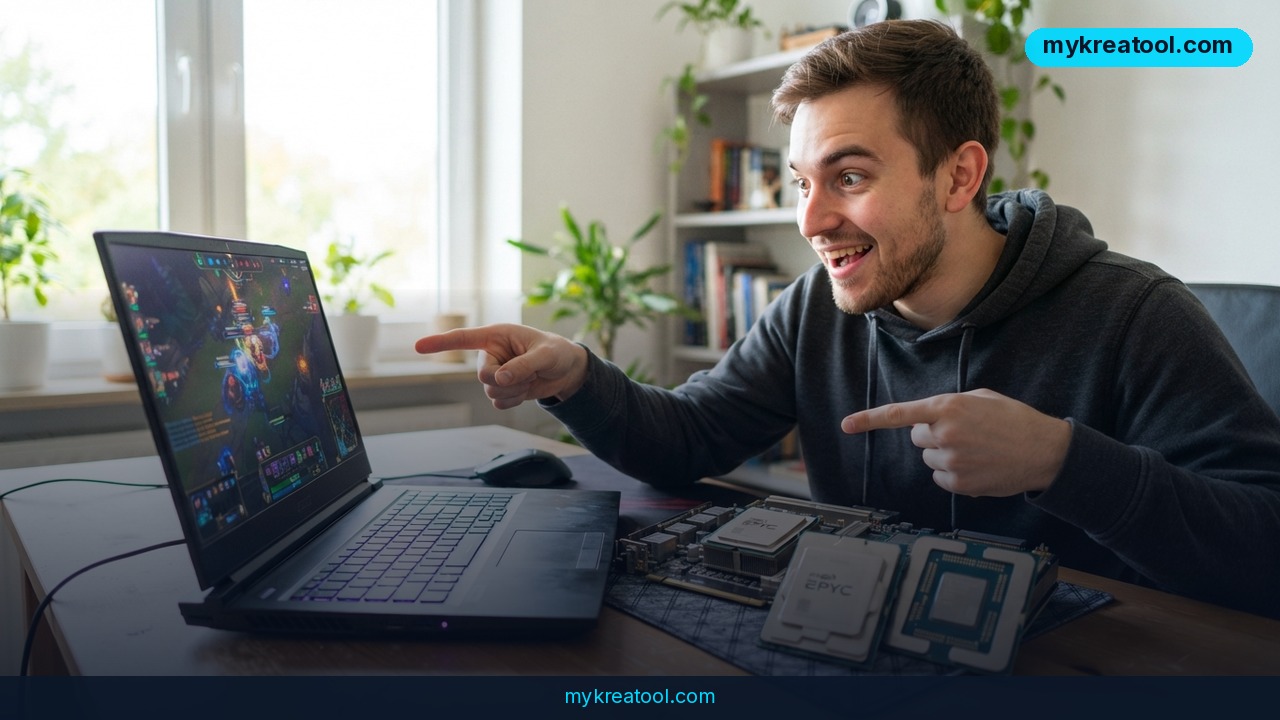
A new local inference engine called FreeToken is making it possible to run large AI models locally on consumer hardware that most people assumed was too weak for the job. Built by engineers who previously worked on vLLM and SGLang, FreeToken targets Mixture-of-Experts (MoE) models specifically, and the early numbers are hard to ignore: a laptop RTX 4060 with just 8GB of VRAM and a PCIe link running at half bandwidth managed 39.3 tokens per second on a 35-billion-parameter model. For context, that's faster than the median decode speed Codex sees in production.
The bigger headline number is 753 billion parameters — the size of MoE model the engine can handle on a single consumer card, because of how MoE architectures separate total parameter count from active compute per token. Instead of benchmarking a single throwaway prompt, the FreeToken team tested realistic, multi-turn agentic workloads: a software engineering task run through OpenCode, the same task through Claude Code's native protocol with parallel subagents and context windows stretching to 56,000–65,000 tokens, and a 13-turn email-and-calendar agent running on OpenClaw.
Why it matters
The real story isn't raw token throughput — it's Time To First Token (TTFT), the delay between sending a request and seeing the first character of a response. In a single chat message, TTFT is a rounding error nobody notices. In an agentic pipeline, it's everything, because context gets reprocessed from scratch on every single tool call, not once per session. Ten tool calls means ten prefill passes over an ever-growing context.
This is where FreeToken's design choice — optimizing for host memory and bus bandwidth utilization rather than just raw compute — pays off. In the worst-case TTFT measured across a full session, FreeToken hit 44 seconds. llama.cpp hit 232 seconds. KTransformers hit 946 seconds. That last number matters because agent harnesses have hard timeouts: OpenClaw's default idle watchdog kills a session after 120 seconds, and Claude Code's default request timeout is roughly 10 minutes. A 946-second stall doesn't just feel slow — it silently kills the agent mid-task, and average tokens-per-second numbers can look perfectly healthy while this is happening, which is exactly why so many people struggle to diagnose why their local agent setups keep failing.
How to use it today
FreeToken is aimed squarely at people already running local or self-hosted AI agents — through OpenCode, Claude Code, or agent frameworks like OpenClaw — who've hit a wall with existing local inference engines like llama.cpp or KTransformers. The core idea to understand before adopting it is the MoE split: in a dense model, every parameter is read from memory to generate every token, so a 30B dense model always costs 30B worth of memory bandwidth per token. In a Mixture-of-Experts model, feed-forward layers are split into many "experts," and a router activates only a small subset per token. A model labeled 30B-A3B has 30 billion total parameters but only 3 billion active per token — meaning memory requirements scale with total size, while generation speed scales with the much smaller active size. That's the mechanism that lets a model far larger than your GPU's VRAM still generate at usable speeds, as long as the engine handles host memory and PCIe transfer efficiently, which is precisely the gap FreeToken was built to close.
If you're experimenting with agent workflows before committing to a specific local inference stack, it's worth testing your prompts and automation logic with lightweight tools first — a resource like mykreatool.com offers free AI tools that let you prototype ideas without any local setup, which is a useful sanity check before you invest time tuning an inference engine for your own hardware.
Once you've confirmed the workflow you want to run, getting started with FreeToken means pairing it with an MoE checkpoint sized for your VRAM-plus-RAM budget, pointing your existing OpenCode, Claude Code, or OpenClaw setup at its endpoint, and watching per-turn TTFT rather than just average tokens-per-second when judging whether it's actually usable for agentic work.
Who benefits
The clearest winners are independent developers and small teams running coding agents or automation pipelines who don't have budget for a rack of enterprise GPUs. A stated 39.3 tok/s on a 35B model from an 8GB laptop GPU with a crippled PCIe link changes the calculus for anyone who assumed local agentic AI required RTX PRO 6000-class hardware. Indie hackers building AI-powered products, marketers running content or research agents locally for privacy or cost reasons, and hobbyists experimenting with SWE-focused agents all stand to gain from an engine that keeps agent sessions alive instead of timing out mid-task. Enterprises with strict data residency requirements also benefit, since running large models on-premises avoids sending sensitive context to third-party APIs.
Risks
FreeToken is still a young project, and MoE inference on consumer hardware comes with real tradeoffs. Running a 753B-class model still requires substantial system RAM even if VRAM demands are lower, so budget hardware with limited memory won't magically run everything. Benchmarks reported by the team building the tool should be treated as a starting point, not a guarantee — real-world performance will vary by model, quantization, and exact hardware configuration. There's also a maturity gap compared to established engines like llama.cpp: fewer community-tested configurations, less documentation, and a smaller ecosystem of prebuilt integrations. Teams considering it for production agent workloads should run their own TTFT stress tests under realistic multi-turn conditions before switching, rather than trusting single-prompt benchmarks.
Conclusion
FreeToken reframes a problem many assumed was purely about GPU budget as one about software efficiency instead. By optimizing for the memory and bus bottlenecks that dominate agentic, multi-turn workloads rather than single-prompt throughput, it lets consumer GPUs — even underpowered laptop cards — run MoE models with hundreds of billions of parameters without agent sessions timing out. For anyone building or running AI agents locally, it's a strong sign that the bottleneck for large-model AI is shifting from hardware ownership to smarter inference engineering.


Comments 0