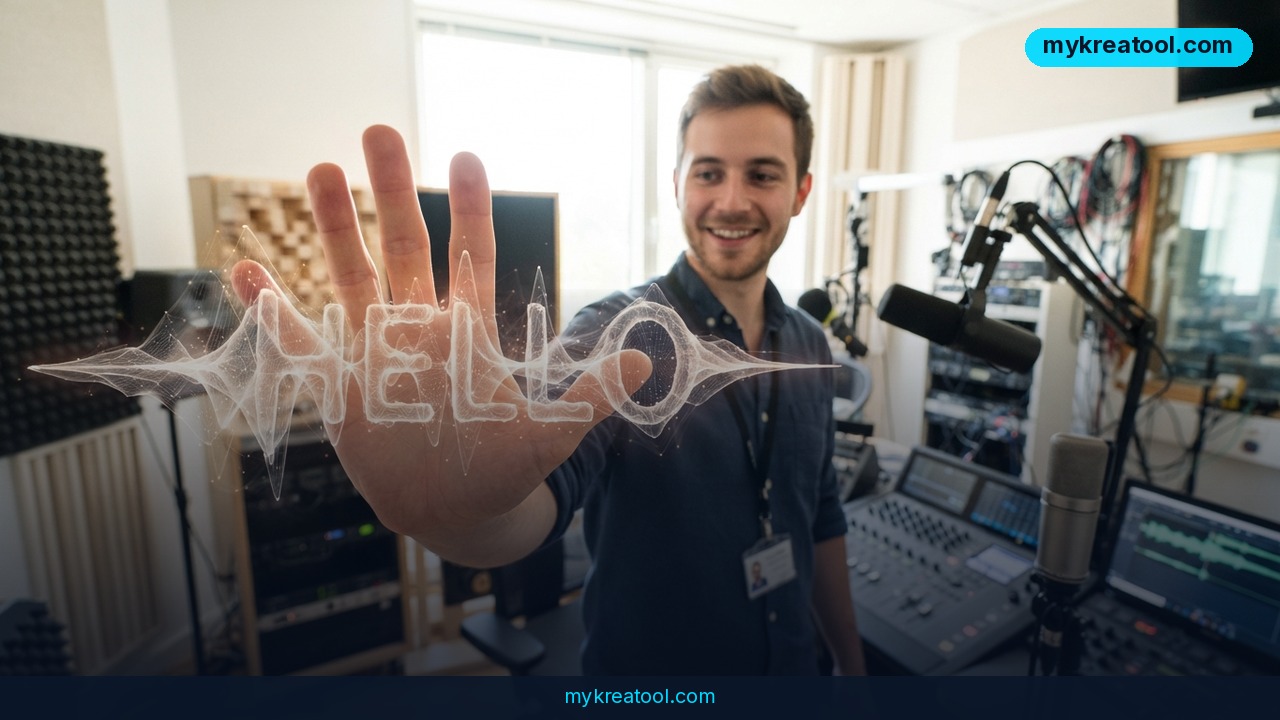
Google just moved text-to-speech from a dropdown menu to a director's chair. On September 23, 2026, the Gemini Audio team launched Gemini 3.8 Flash TTS and Gemini 3.8 Flash-Lite TTS — two models that don't just read your script, they take direction on how to perform it. Describe the voice you want in plain English — a high-energy DJ from Melbourne, a super-tinny monotone robot, a fire-breathing dragon speaking Japanese — and it builds one for you.
What happened
The announcement came from Leland Rechis, Group Product Manager, and Alan Cowen, Director of Research Science, on behalf of the Gemini Audio team. The headline idea: voice generation is no longer a rack of presets. It's a creative studio.
Both models ship across Google AI Studio, the Gemini API, Gemini Enterprise, Gemini Notebook and Google Vids. They join a fast-growing Gemini Audio family that already includes 3.5 Live Translate, 3.5 Transcribe, 3.8 Live and 3.8 Live Extended Thinking.
Two models, two very different jobs
Think of one as a recording studio and the other as a factory.
Gemini 3.8 Flash TTS is the studio. It's built for deep creative direction and character design — bringing characters to life in gaming, immersive audiobooks, podcasts and interactive media. You can direct every single line: acting cues, pacing, dialect shifts, even backchanneling. That last one is the small stuff that makes dialogue feel human — the 'mm-hmm', the laugh, the quick intake of breath.
Gemini 3.8 Flash-Lite TTS is the factory. It's built for high-volume, cost-efficient scale: dubbing, bulk audio content and expressive voice agents, with fine-grained control over tone, pacing and nuance.
From 30 voices to 2,000+ and counting
Here's the number that matters most. The old starting point was 30 original voices. Google now describes an infinite library, and the ready-made shelf alone holds 2,000+ production-ready voices.
Coverage runs across more than 100 languages and dialects, including regional varieties like Mexican Spanish, Quebec French and Scots English. In practice, your Scottish narrator can sound like they're actually from Glasgow instead of like a tourist doing an impression of it.
Voices from a blank page, or from 30 seconds of you
Two features do the heavy lifting.
Generative voice design lets you invent a voice from scratch by prompting for role, accent and vocal characteristics. No sample needed. You're casting, not shopping.
Voice replication goes the other way. Feed it a 30-second audio sample of a voice — your own, or one you have the rights to use — and it rebuilds a consistent vocal profile you can reuse.
Watermarking comes built in
Google says both models include built-in safety tools, watermarking among them, to keep generated audio secure. In plain terms: the audio carries a hidden signature, so it can be identified as AI-generated rather than passed off as a raw recording.
What it means for you
Strip away the product names and this is a fairly simple shift. Twenty minutes ago, a decent voice-over meant booking a human, a studio, or both. Now it means writing a good description and pressing go. Here's what that looks like in ordinary life.
At home
Bedtime stories stop being the same five paperbacks. You can narrate a story in your own voice for a night you're away, or — with her permission — in grandma's voice for the nights she can't call. It's the kind of thing that sounds gimmicky until the first time a kid hears a familiar voice reading their name off the page.
At work
If your team makes training videos, you already know the pain of re-recording a whole module because someone changed slide seven. You rewrite the line and regenerate it. And if your company ships the same onboarding material to offices in five countries, 100+ languages and dialects means you're not hunting for five voice artists on a deadline.
For your business
Flash-Lite is the one to watch here. A phone agent that reads the same refund policy in a flat robot monotone is a customer hanging up. One with control over tone and pacing is a customer staying on the line. High volume, low cost, and a voice that doesn't sound like it wants to be somewhere else.
For studying
Turn your notes into audio and listen on the walk to class. Better yet, build a consistent narrator voice once and reuse it for every subject — a familiar voice is easier to follow for forty minutes than a new one every week.
For creative projects
This is where the directing controls earn their keep. You can build a whole cast, give each character their own accent and energy, and coach a scene line by line — the interruption, the nervous laugh, the pause that lands the joke. If you also need visuals for the same project and don't want to pay for stock, MyKreaTool rounds up free AI tools in one spot.
For income
Dubbing, audiobook production and character work for indie games have all been bottlenecked by the same thing: studio time. That bottleneck just got a lot wider. If you already write, you can now deliver audio too — and if you already deliver audio, the new skill isn't recording, it's direction.
How to try it right now
You don't need to be a developer for the first part. Here's the shortest path, free option first.
1. Open Google AI Studio in a browser. It's the playground Google names first for these models, it runs in a tab, and you don't install anything or write a line of code.
2. Pick Gemini 3.8 Flash TTS from the model list. Use Flash-Lite later, when you're generating volume rather than one hero performance.
3. Paste your script. Start with three or four sentences. Long scripts hide problems.
4. Describe the voice in plain English. Role, accent, age, energy, texture. 'A warm, slightly gravelly narrator in her fifties with a soft Irish accent' works better than 'a nice voice'.
5. Direct it. Regenerate single lines with new instructions — slower here, more sarcasm there, a sigh before the last word.
6. Or upload 30 seconds of audio if you want a consistent vocal profile instead of a new character.
7. Scale it up through the Gemini API once you've got a voice you like, or use it built into Gemini Notebook and Google Vids if you'd rather never leave the app you're already in.
Upsides and what changes
• You can cast, not shop. Going from 30 voices to an infinite library changes the job from picking the least-wrong option to designing the right one.
• Direction beats presets. Line-by-line control over pacing and emotion is the difference between a text reader and a performance.
• Dialogue that breathes. Backchanneling — the 'mm-hmm', the laugh — is what makes two AI voices sound like two people talking.
• Volume gets cheap. Flash-Lite exists specifically for people generating hours of audio, not one trailer.
• Watermarking from day one. Safety isn't bolted on afterwards this time.
• It's everywhere you already work. AI Studio, the API, Gemini Enterprise, Gemini Notebook and Google Vids.
Limitations
The honest caveats. Google labels all of this generative AI, and generative AI is experimental — expect rough edges, and don't ship a voice to a paying client without listening to the whole thing first. Voice replication is the sharp edge here: a 30-second sample is a low bar for copying someone, so the watermark and the consent question do real work, and they're the reason to think twice before cloning a voice you don't clearly own. The announcement also doesn't lay out pricing for high-volume Flash-Lite use, so if you're planning to generate thousands of minutes, treat cost as an open question you need to check before you build a business on it. And expressive range is not the same as acting talent — a model that can shift accent and pacing still needs a human deciding what the scene actually needs.
Conclusion
The story here isn't 'better robot voice'. It's that voice-over just became a creative control panel — describe the character, direct the line, keep the voice consistent, do it in 100+ languages. Gemini 3.8 Flash TTS is for the project where the voice is the product; Flash-Lite is for the project where the voice is the plumbing.
One thing to do today: open Google AI Studio, paste three sentences of your own writing, and prompt Gemini 3.8 Flash TTS for a voice you'd actually want to listen to for an hour. You'll learn more in ten minutes than in any demo video.


Comments 0