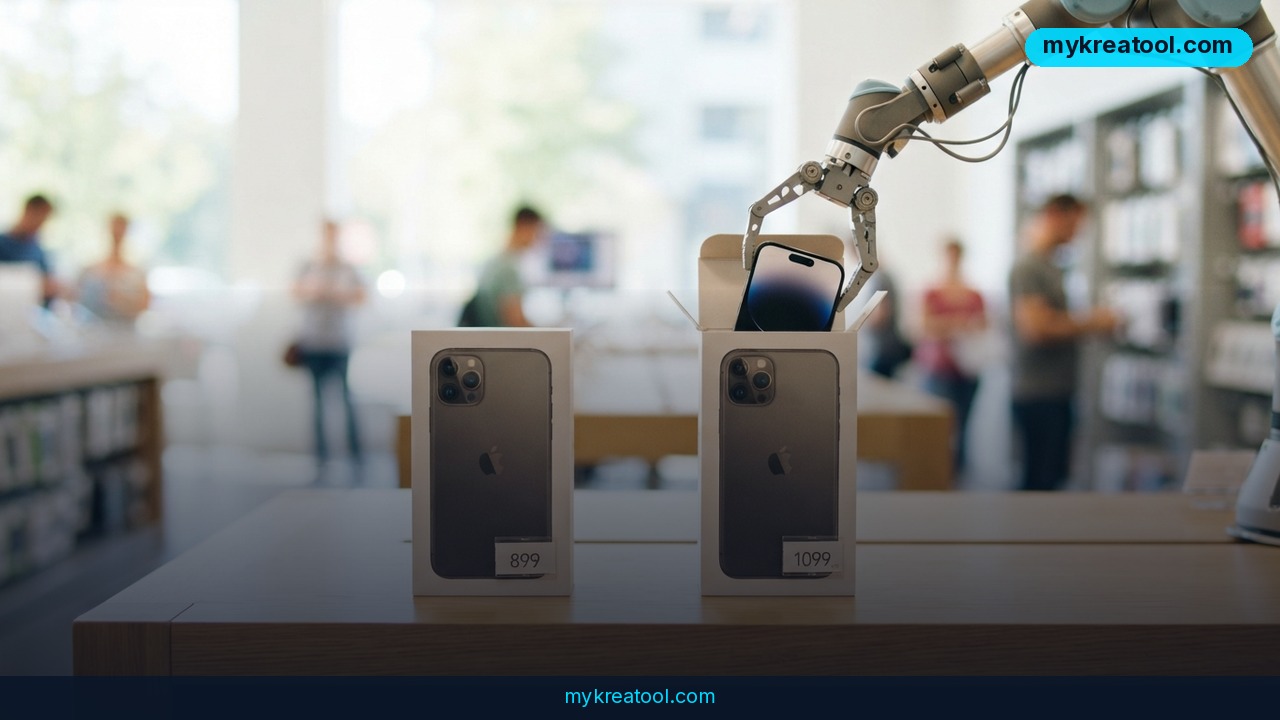
If you've started leaning on AI product search to do your shopping homework, there's a number you should know: 21.6%. That's how much more expensive the identical product was in Google's AI Mode than in ordinary Google search, according to a new data study. Same query, same day, same moment — just a different box on the screen.
The research comes from Productrise, which tracked more than 2 million product listings across more than 100,000 search results pages and AI Mode responses over 23 days, from August 9 to 31, 2026. Roughly a fifth extra, every time you take the AI answer at face value. That's not a rounding error — it's the kind of gap that quietly eats a monthly budget, and it stacks up fast across a year of ordinary purchases.
What happened
The method is easy to describe in one breath. The team ran the same shopping queries through AI Mode — Google's chat-style answer that summarizes recommendations — and through classic search, the familiar list of links and shopping tiles. Then they matched the products that appeared on both sides and compared the lead price each time.
Same product, higher price
Across those matched pairs, AI Mode came out 21.6% more expensive. The screenshots in the study make it vivid: one pair shows the same product ranked #1 in both places, with AI Mode 26% higher. Another shows a completely different seller at 19% above the traditional search price.
The team also compared every priced listing on each side, including products that show up in only one place. On that wider basis, the typical AI Mode listing sits 49% higher than the typical traditional search listing.
Only 1.28% of products overlap
Here's the finding that stuck with me. Just 1.28% of products ranking in traditional search also appeared in AI Mode for the same search on the same day. In plain terms, AI Mode isn't handing you a tidy shortlist of the best options you'd otherwise find. It's showing you a largely different shelf of products.
Which means you can't spot the markup on your own. The cheaper version was never in the answer to begin with — it was sitting one tab over, invisible.
The seller changes nearly half the time
When the same product did land on both sides, the price differed 38.1% of the time — and in those cases AI Mode was the pricier one 68.4% of the time, roughly two out of three. The main seller also differed on 49.6% of matched products. So it isn't simply Google picking a fancier listing of the same item; often it's a different retailer altogether, with different terms, shipping and returns.
Brodie Clark, an independent SEO consultant, offered a fair caveat: the higher price might be shown in the grid result inside AI Mode, which makes a top-level comparison less precise — and in the end, the retailer with the lowest price tends to win the click. Katelyn Geary, senior SEO strategist at Break The Web, framed the consumer side more sharply, describing a curated path to higher-priced stock replacing open market comparison.
What it means for you
If you treat AI Mode as a research assistant rather than a checkout counter, none of this is a disaster. But it does change what the answer is actually good for — and it means the final price check is back on you. If you want free AI helpers to sharpen your product vocabulary or draft comparison notes before you shop, tools like the ones at MyKreaTool can speed that up; just don't let any of them quote you a final price.
At home: the sneaker problem
You ask AI Mode for the best running shoes for flat feet and it names three models. You click through and buy. If the study's average holds, you may have paid around a fifth more than the same model was going for in regular results — and you'd never know, because the cheaper listing never entered the conversation.
At work: sourcing supplies
Ordering office chairs, monitors or printer toner from a summarized answer feels efficient. But when the recommended seller differs on roughly half of matched products, your procurement trail gets murkier: a different vendor, different invoice terms, sometimes a different return policy. A two-minute cross-check before you submit the purchase order is cheap insurance.
In business: your own listings
If you sell online, this cuts both ways. Showing up in AI Mode is valuable real estate. But if AI Mode leans toward pricier inventory, the cheapest listings may be getting filtered out of the answer — and if you compete on price, that's a visibility problem, not a pricing one. Worth understanding before you rebuild your product pages around AI visibility.
For students and researchers
Buying textbooks, lab gear or software licences? Use AI Mode to learn what a category looks like and which specs matter — it's genuinely good at that — then price-check in classic search. The vocabulary AI hands you is useful. The price tag, less so.
For creators
Pricing out a camera, mic or lighting kit from an AI recommendation is fine for brainstorming. On a big-ticket purchase, treat the AI answer as a shortlist of models, not a shortlist of deals.
Income: affiliate and content work
If you earn from affiliate links, that 1.28% overlap deserves a second look. It means the products AI Mode recommends barely intersect with what ranks in normal search — so content built purely to rank in classic results may never surface inside AI answers at all.
How to try it right now
No account, no subscription, no paid tool. Ten minutes and one product you were going to buy anyway.
1. Pick one product and one specific query. A full model name beats a broad category every time — the exact pair of headphones you're eyeing, not just 'headphones.'
2. Run it in traditional Google search first. Free. Note the price and seller in the top shopping results, and screenshot it if you're comparing several.
3. Run the identical query in Google AI Mode. Free as well. Same day, same moment if you can manage it.
4. Compare the seller, not just the number. A different retailer showed up on 49.6% of matched products, so a new name is expected, not alarming.
5. Check the source data. The full write-up behind these numbers is published by Productrise if you want to see how the matching was done.
6. Buy from the cheaper tab. The one you found, not the one you were handed.
The whole exercise takes less time than sitting through a product review video, and it's the difference between absorbing a 21.6% markup and walking away from it.
Upsides and what changes
Let's be fair to AI Mode, because it isn't useless — it's just doing a different job than you assumed. It's excellent at turning a fuzzy need ('something quiet for a shared office') into real product names, specs and trade-offs. That's a genuine time saver, and it's why people reach for it.
What changes is where the comparison happens. Instead of five tabs doing the work for you, you get one confident answer and a hidden penalty if you take it at face value. When the pricier option wins two-thirds of the time, discovery stops being an open market and starts being a curated path. The upside: once you know this, you're suddenly the person in the room who checks. That habit is free, portable, and it works on any AI shopping surface, not just Google's.
Limitations
Honest caveats, because one study isn't the whole map. This is a single vendor's dataset covering 23 days in August 2026, and the published excerpt doesn't break results down by category, country or device. It can't fully separate algorithmic choice from personalization, location, ad placements or plain price volatility — a listing measured on a Tuesday may not cost the same on Friday. Clark's point matters too: the price shown in an AI Mode grid tile may not be what you'd pay after clicking through, so the top-line 21.6% could overstate or understate the real gap depending on where you measure. The matched sample is also small relative to the 2 million listings tracked, since only 1.28% of products overlapped — that's the whole reason the 49% broader figure exists. And the study shows a pattern, not an intent: it doesn't prove Google is steering anyone toward expensive products, only that its answers lean that way right now.
Conclusion
AI Mode is a better librarian than it is a shopping buddy. It's great at telling you what exists and what matters; it's unreliable at telling you what's cheap. The 21.6% gap on identical products, the 1.28% overlap and the seller switcheroo on nearly half of matched items all point to the same takeaway: the final price check is yours to make.
One action for today: take the next thing on your shopping list, run the exact same query in Google AI Mode and in classic search, and compare the seller and the price side by side. If they match, great — you've lost two minutes. If they don't, you've just saved yourself a fifth of the bill.



Comments 0