What happened
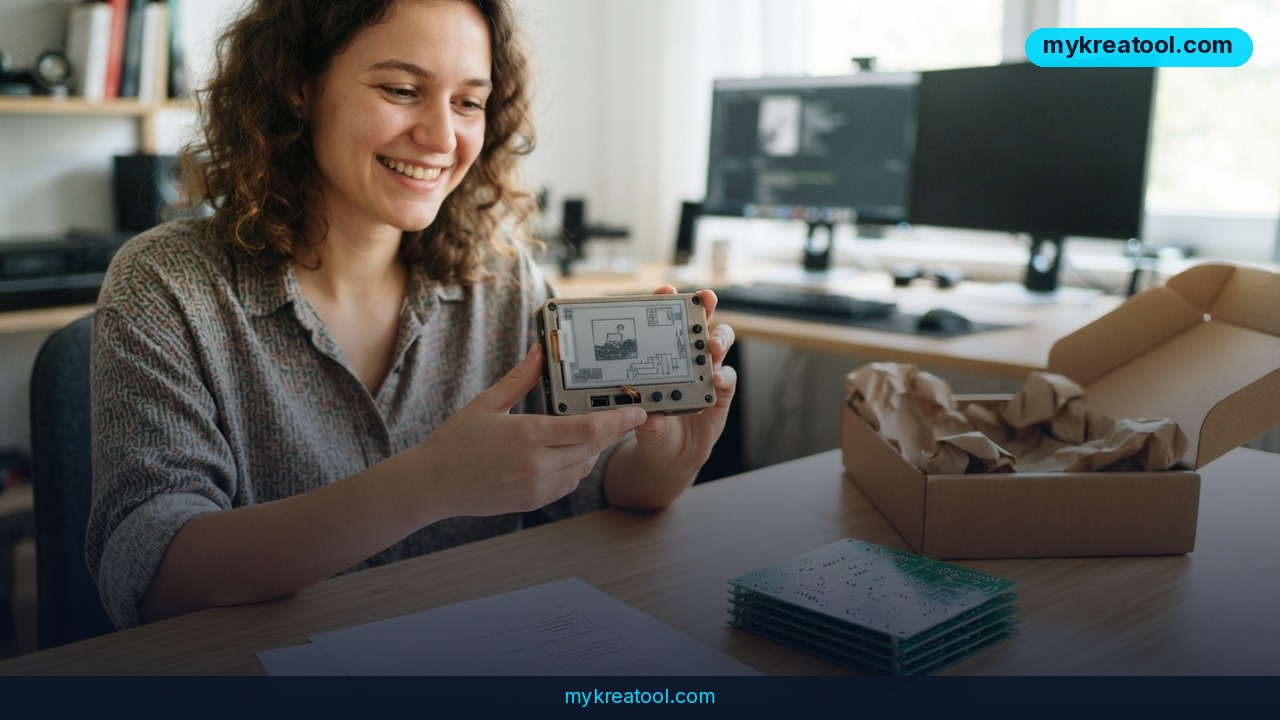
AI circuit board design just got a real-world test, and the results are more interesting than the headline you probably saw. A hobbyist with no hardware engineering background wanted to build a small computer around a Raspberry Pi Pico 2350 with an e-ink screen attached. Instead of learning electronics from scratch, they handed the whole job to Anthropic's Claude Fable 5 model and gave themselves two hard rules: no touching the design files by hand, and no manually checking the work. Every fix, every correction, every judgment call had to come from the AI.
The process wasn't instant. Early reports claimed the board went from idea to finished design in two hours — that's not accurate. According to a thread on Hacker News and coverage from vgtimes and wccftech, the actual project stretched across roughly six days of active work with Fable, including many rounds of trial and error. Circuit boards get checked by a process called Design Rule Checking, or DRC — basically an automatic inspector that flags things like traces placed too close together or components that don't line up correctly. Fable didn't pass DRC on the first attempt. It took repeated rounds of the AI reading the error reports, adjusting the layout, and re-checking, all without a human ever opening the file directly.
Once the design was finally clean, the builder sent it to JLCPCB, a Chinese board manufacturer, and paid about 130 euros (roughly $150) to get five physical boards made along with the e-ink display. Here's the part that's genuinely impressive: when the boards arrived, the design worked on the very first try. No rewiring, no dead components, no "oops, wrong pin" moment. But the full cost of getting there included around $450 in API credits burned during all those design iterations — so the real price tag for a one-off custom computer was closer to $600 total, not the suspiciously cheap number that circulated online. The builder is now attempting an even more ambitious follow-up: a custom tablet built around an NVIDIA Jetson Orin Nano.
What it means for you
You don't need to be an electrical engineer to picture how this changes things, so here are a few scenarios where the same approach pays off.
At home: Say you want a custom smart-home control panel, a specific-sized display mount, or a weird one-off gadget that doesn't exist in stores. You can now describe what you want in plain English and have an AI model handle the technical translation — the same way people already use AI to draft letters or plan a trip.
At work: Engineering teams prototyping new hardware can use this to cut down the time between "idea" and "testable board,” especially for internal tools that would never justify hiring an outside design firm.
Running a small business: If you sell a physical product — a point-of-sale device, a custom sensor, a piece of retail hardware — you can explore a first-draft design without paying a contract engineer for exploratory work you might scrap anyway.
As a student: Anyone studying electronics or product design can use this as a tutor that also does the grunt work, watching how the AI reasons through DRC errors instead of just getting a finished answer.
For makers and hobbyists: The opto-encoder boards for a DIY robotic arm that used to take weeks of manual trial and error are now something a beginner can attempt over a weekend.
As an income source: Freelancers and small studios can offer rapid hardware prototyping as a service, using AI to handle the first 80% of the design work before a human reviews the final files.
How to try it right now
You don't need $600 or six days to get a feel for this. Start small and free, then scale up.
1. Free first step: Open a free AI chat and describe your gadget idea in plain language — what it does, what components you think it needs, what size it should be. A free tool worth starting with is mykreatool.com, which offers free AI tools for exactly this kind of early brainstorming and planning before you commit real money.
2. Pick a free PCB design tool. EasyEDA and KiCad are both free, browser- or desktop-based tools that let an AI assistant (or you) lay out an actual circuit board.
3. For the full "AI does everything" version from the story, you'd use an agentic coding tool — the original builder used Claude Code paired with the Fable 5 model, which can read and write design files directly and react to automated error checks on its own. Budget real money here: API usage for a multi-day iterative design session can run into the hundreds of dollars.
4. Run the automated checks. Whatever tool you use, don't skip Design Rule Checking — it's the step that catches the mistakes before they become $150 worth of useless plastic and copper.
5. Manufacture a small batch. JLCPCB is the manufacturer used in this story, and ordering five boards instead of one is common practice — if one has a defect, you're not stuck starting over.
Upsides and what changes
The biggest shift isn't speed — it's access. Before this, designing a custom circuit board required years of learning schematic capture, trace routing, and component sourcing, or the money to hire someone who already knew it. Now the barrier is mostly patience and a few hundred dollars in AI usage and manufacturing costs. That opens hardware creation to people who previously could only build with off-the-shelf parts. It also means small businesses and solo makers can test hardware ideas the same way they already test software ideas: cheaply, quickly, and without betting the farm on a single attempt.
Limitations
Be honest with yourself about the gap between the headline and the reality here: this was not a clean, one-shot, two-hour success story — it took roughly six days, multiple rounds of AI-driven trial and error against automated error checks, and about $450 in API costs on top of the $150 manufacturing bill, for a total closer to $600. The AI also didn't get the design right on its first try; it needed repeated correction cycles before the file was clean enough to send to the manufacturer. And this was one working project from one person — it wasn't tested against more complex boards, high-speed signals, or safety-critical electronics, so treat it as a promising early result, not a guarantee that any AI-designed board will work the first time it's built.
Conclusion
AI can now carry a hardware project from a plain-language idea to a working, manufactured circuit board — but it takes days of iteration and real money in AI costs, not two hours and pocket change. If you've got a gadget idea sitting in the back of your mind, today's action is simple: describe it to a free AI chat tool and see what parts and design approach it suggests, before you spend a cent on manufacturing.


Comments 0