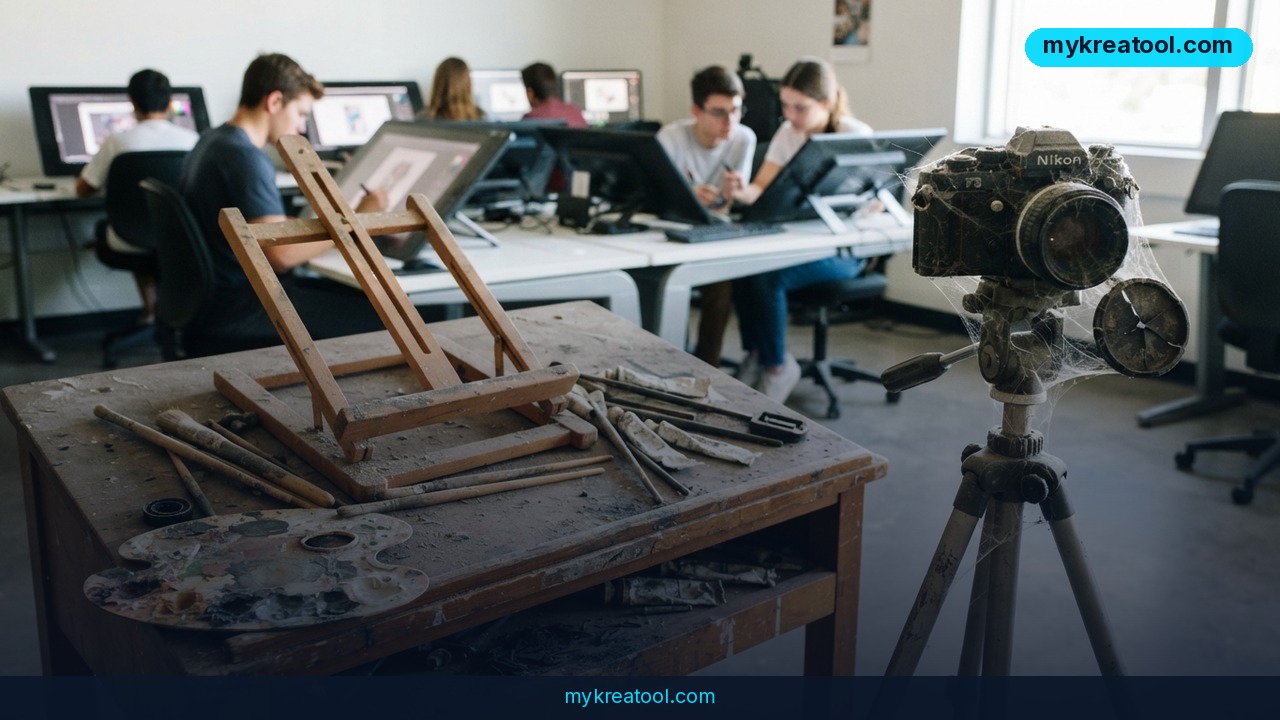
China closing university programs because of AI isn't a future scenario anymore. Between 2021 and 2025, Chinese universities closed or suspended roughly 12,200 study programs, and some of the best-known names in art and media education are on the list. Translation, photography, illustration, visual design and comics have all taken a hit. If you translate, design, write or hire people who do, this is worth five minutes of your time.
What happened
Two flagship schools shut down whole courses
According to reports, two heavyweight institutions, the Central Academy of Fine Arts and the Communication University of China, closed courses in illustration, photography, translation, visual design and comics. The reason they gave was blunt: the programs were "not cost-effective in terms of price and quality." In plain English, the schools decided that teaching these skills the traditional way no longer pays off for students or for the university.
The head of the Communication University of China, Liao Xiangzhong, put it like this: "The traditional specialty of photographer can no longer exist as an independent discipline. Today, anyone can be a content creator." Think of it like the typing pool of the 1980s. Once every desk had a computer, nobody needed a separate department just to type letters.
The numbers behind the headline
The bigger figure is the 12,200. That's the number of programs closed or suspended across Chinese universities from 2021 to 2025. Not all of them were killed by AI alone, since falling enrollment and changing job markets play a part too, but AI is the reason officials and reporters keep pointing to.
What's replacing the old programs? Hybrids. Think audiovisual engineering, or creative design taught together with AI tools. Instead of "photography" as a standalone craft, students learn to shoot, edit and direct AI in one package. Several independent outlets back this up, including ChinaScope, Hightech+, CNews and Habr. The last three are in Russian. They report that many programs were cancelled outright, while others were merged into new AI-focused ones.
What it means for you
You don't have to live in China for this to matter. Universities are usually a few years ahead of the job market, because they're deciding what to teach today's 18-year-olds for jobs that start in 2030. Here's how it plays out in everyday life.
At work: the "first draft" job is shrinking
If your job involves producing a first version of something (a translation, a banner, a product photo), AI now does that in seconds. The human part that's left is judgment: is this right, is this on brand, does this sound like us? Roles are shifting from "maker" to "editor and decider."
In business: you can do more with less
Say you run a small online shop and you've been paying per word for translations of your product pages. Machine translation can now handle the routine 80%, and you pay a human only for the pages that really matter, like your homepage or a legal notice. The same goes for simple graphics and photo touch-ups.
For freelancers and income
If you sell a commodity skill, such as basic translation of emails or generic stock-style illustrations, expect price pressure. If you sell a specialty (medical translation, brand illustration with a distinct style, live interpreting at a business negotiation), you're in a stronger position. The middle is where it gets squeezed.
For students and parents
Before choosing a degree, ask one question: does this program teach the craft plus how to work with AI? A degree that ignores the tools your future employer already uses is like a driving course that never mentions the highway. That's the lesson China's hybrid programs are chasing.
For creativity
When everyone can generate a decent image or a smooth translation, "decent" stops being special. Taste, a personal voice and real-world experience become the things people pay for.
How to try it right now
The best way to judge this isn't to read another opinion. Test it on your own work. It takes about 15 minutes and costs nothing.
Step 1: Start with the free option
Open Google Translate and paste in a paragraph you wrote yourself, such as a customer email or a product description. Translate it into a language you know reasonably well and read the result critically.
Step 2: Do a round trip
Copy the translation and translate it back into your original language. If the meaning survives, the tool handled it well. If it comes back garbled, you've just found where a human still earns their fee.
Step 3: Compare with a second tool
Run the same paragraph through DeepL, which has a free version, and note the differences in tone. Then ask a chatbot such as ChatGPT (the free tier is enough) to translate it "in a friendly, informal tone for a customer." Chatbots let you steer style, and that's something classic translators don't offer.
Step 4: Try visual and writing tasks
If you also work with images or copy, you can experiment with the free AI tools at MyKreaTool to see how far a generated first draft gets you.
Step 5: Write down what you'd still hand to a human
Make two columns: "AI is good enough" and "I'd still pay a person." That list is your personal roadmap. One caution: don't paste confidential contracts or private documents into free online tools.
Upsides and what changes
The upside is real. Small businesses can reach customers in several languages without a big budget. Solo creators can produce work that once took a team. Students who learn a craft together with AI tools graduate with skills employers are actually asking for.
What changes is the shape of the work. Fewer people will be paid to do routine production, and more will be paid to direct, check and take responsibility for the result. Think of a pilot on a modern airliner: the autopilot flies most of the trip, but nobody boards a plane without a human in the cockpit.
Limitations
This story has limits, and it's worth being honest about them. The 12,200 figure covers programs closed or suspended for many reasons, and AI is only one of them, so it isn't a count of "jobs killed by robots." China's education system is also centrally steered, so what happens there doesn't automatically repeat in the US, the UK or Europe. Machine translation still stumbles on idioms, humor, cultural nuance and specialist terms, and it can sound confident while being wrong. Live interpreting, literary translation and legal or medical work still need a accountable human. The real signal is direction, not a done deal: routine tasks are getting cheaper, and expertise is getting more valuable.
Conclusion
China's university closures are a loud signal that the market for routine creative and language work is changing fast, and that schools are betting on hybrids of craft and AI. You don't need to panic, but you do need to know what these tools can and can't do in your own field.
One action for today: take one paragraph of your own work, run it through Google Translate and DeepL, and write down where you'd still trust a human. Ten minutes, and you'll know exactly where you stand.

Comments 0