What happened
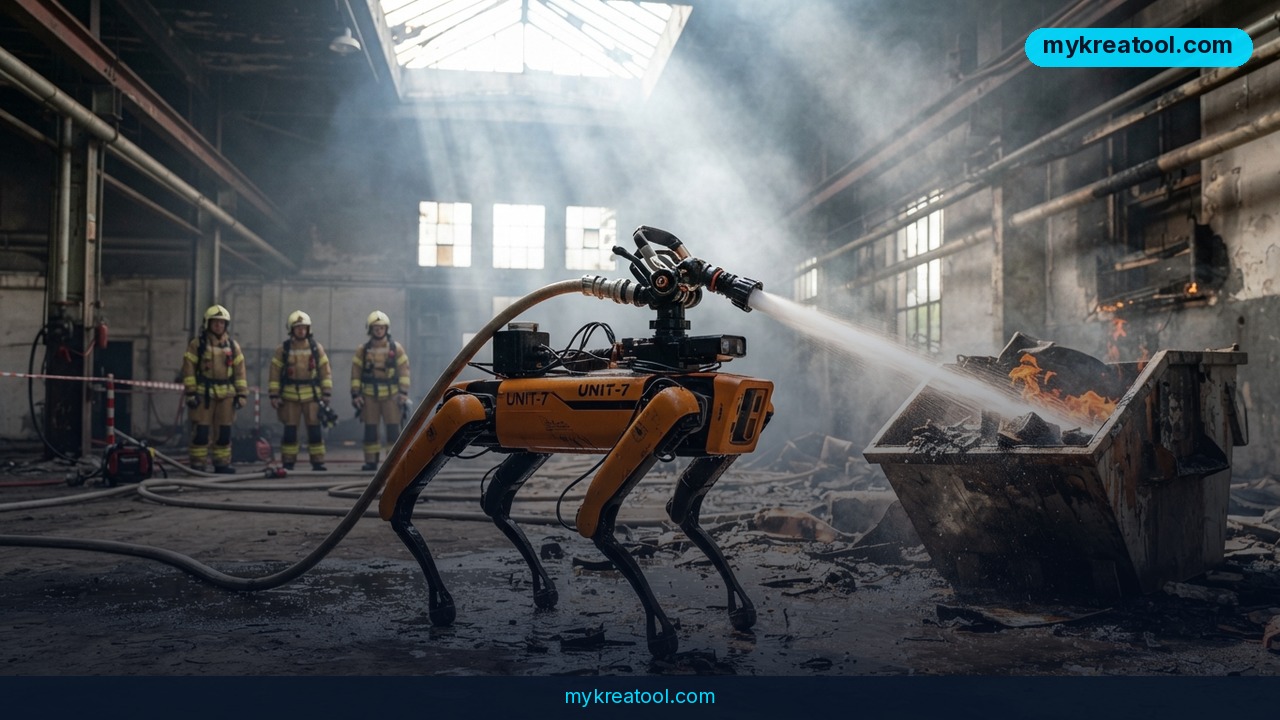
Firefighting robot dogs are moving from research labs into real emergency response in China, where quadruped units are now being deployed to handle fires and toxic chemical leaks that would otherwise put human rescuers at serious risk. The most capable of these machines, the X30, is a rugged four-legged robot built to operate as a mobile firefighting platform rather than just a camera on legs.
According to reporting on the deployment, the X30 can be fitted with a water cannon capable of throwing a stream up to 60 meters at a flow rate of 40 liters per second — enough pressure to knock down flames from a safe standoff distance. When it isn't blasting water, the same chassis can be reconfigured to haul firehoses, portable air tanks, and forcible-entry breaching tools directly into structures, tunnels, or industrial sites where the air itself may be lethal.
Why a robot dog specifically
Wheeled or tracked robots struggle with rubble, stairs, and uneven terrain common in fire and disaster scenes. A legged platform can climb over debris, navigate collapsed structures, and keep its footing on wet or unstable ground — the exact conditions firefighters encounter after an explosion or building collapse. That mobility is why quadruped designs, not wheeled carts, are becoming the platform of choice for hazardous-environment rescue work.
Why it matters
The core value proposition is simple: keep humans out of the first, most dangerous minutes of a fire or chemical incident. Toxic leaks, in particular, create environments where a firefighter's air supply is finite and visibility can be near zero. Sending a robot in first to assess conditions, suppress flames, or deliver equipment buys rescue teams time and information without risking a life on a reconnaissance pass.
This also changes the economics of emergency response. A single robot dog can be repositioned and reused across an entire shift, effectively multiplying the reach of a fire crew without adding headcount. For departments in China facing industrial accidents, chemical plant incidents, or high-rise fires, that combination of range, payload, and reduced human exposure is a meaningful upgrade over hose-and-ladder methods alone.
The bigger robotics trend
This deployment fits a broader pattern: general-purpose legged robots that started as research demos or delivery novelties are being adapted for specific, high-stakes industrial and public-safety jobs. Warehouse inspection, pipeline monitoring, and now firefighting are converging on the same hardware platform, with the payload — water cannon, sensor pack, or cargo rack — determining the use case.
How to use it today
Fire departments and industrial safety teams don't need to build this technology in-house. Several Chinese manufacturers, including Unitree, already sell quadruped platforms compatible with modular attachments like water cannons and gas sensors, and integrators are packaging these into turnkey firefighting kits. For organizations evaluating whether this fits their operations, the practical path is a phased pilot: start with reconnaissance and gas-detection missions, where the robot scouts a hazardous area before any human enters, then expand to active suppression tasks like the X30's water-cannon role once operators are trained.
Beyond hardware, teams planning this kind of rollout often need to model deployment scenarios, draft incident-response protocols, or generate training materials quickly. For creators and small teams doing that kind of planning work without a big budget, a resource like mykreatool.com offers free AI tools that can help draft documentation, summarize technical specs, or brainstorm rollout plans before committing to expensive integration contracts.
Procurement considerations
Buyers should weigh battery runtime under full payload, water-cannon refill logistics, and how the robot communicates with command vehicles over radio-denied or smoke-filled environments — all factors that vary significantly between vendors and aren't always obvious from a spec sheet.
Who benefits
Municipal fire brigades are the most direct beneficiaries, especially units covering industrial zones, chemical storage facilities, and high-density urban cores where toxic leaks and structure fires overlap. Industrial plant operators — refineries, battery manufacturers, chemical processors — also gain a first-response tool that can be stationed on-site and deployed before external emergency services even arrive.
Insurers and safety regulators stand to benefit indirectly: fewer firefighter injuries and faster containment translate into lower claims and better compliance outcomes. Robotics manufacturers and integrators, meanwhile, get a proven, dramatic use case that helps justify continued investment in legged-robot R&D, since fire and hazmat response demonstrates real-world reliability under conditions far harsher than a warehouse floor.
Risks
The technology isn't a full replacement for trained firefighters, and treating it that way would be a mistake. Robots can fail in extreme heat, lose connectivity in smoke-dense environments, or run out of battery mid-operation, and a stalled robot blocking an exit route creates a new hazard rather than solving one. There's also the question of decision-making: a robot spraying 40 liters per second at 60 meters needs precise aim to avoid damaging structural supports or spreading burning debris, which currently requires a skilled human operator rather than full autonomy.
Cost and maintenance are practical concerns too. These are specialized, expensive machines that require trained technicians, spare parts, and regular testing to stay mission-ready — an ongoing budget line that smaller fire departments may struggle to justify compared to conventional apparatus. Finally, over-reliance on robotic response could, in theory, slow human decision-making in the critical first moments of an incident if teams wait for robotic reconnaissance rather than acting on established protocols.
Conclusion
Robot dogs like the X30 mark a real shift in how fire and hazmat teams approach the most dangerous parts of their job, using legged mobility, water-cannon payloads reaching 60 meters at 40 L/s, and toxic-environment tolerance to take on tasks no human should have to. The technology is proven enough to be in active use in China today, but it works best as a force multiplier alongside trained firefighters, not a replacement for them. Organizations exploring similar deployments should start small, pilot reconnaissance missions first, and build operational trust before scaling to full suppression roles.

Comments 0