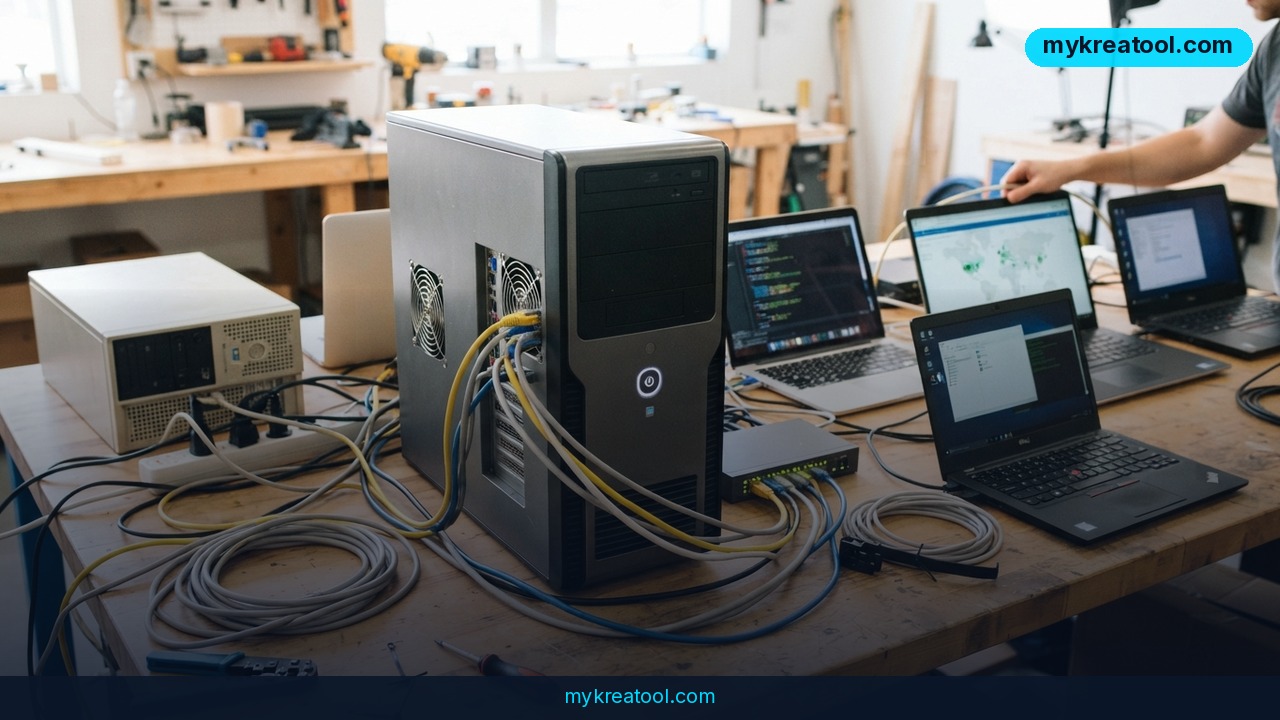
Nvidia PAIR links idle home PCs into one local AI cluster: a free tool that pools spare compute across every device already sitting in a house. Announced September 3, 2026 at IFA 2026, it plugs into Ollama and LM Studio and only taps a machine when it is idle.
What is Nvidia PAIR and how does the Personal AI Router work?
Nvidia launched Personal AI Router (PAIR) on September 3, 2026 during IFA 2026 — a free, open-source tool that turns a house full of idle computers into a personal AI data center. PAIR discovers compatible PCs on the same home network, links them together, and puts their spare processing power to work on local AI inference tasks through tools like Ollama and LM Studio.
Despite the name, PAIR is not a piece of hardware. It's software that runs on each machine and coordinates them as a single distributed system, splitting one job across whichever devices are free at that moment. Nvidia's product manager, Seth Schneider, described it as unlocking "a treasure trove of free tokens just sitting in homes today" — compute that would otherwise sit unused while people sleep, work, or browse.
The beta is available now for Windows, Linux, and macOS, and it's free to download and run.
Supported hardware: RTX 20-series, RTX Pro, DGX Spark and Apple M4
Running large language models locally usually means owning one very powerful GPU, or paying for cloud inference by the token. PAIR changes the math by treating every device in a household as a shared resource pool instead of a single bottleneck.
Supported hardware includes Nvidia GeForce RTX cards from the 20-series onward, RTX Pro GPUs, DGX Spark systems, and Apple M4 chips or newer — meaning a Windows gaming rig and a MacBook Pro can technically contribute to the same job. Older laptops and budget GPUs below those minimums are not on the supported list yet.
How much faster is local inference with Nvidia PAIR across devices?
Nvidia illustrated the potential with a real-world example: a household with a dad running an RTX Spark laptop and a DGX Spark desktop, a mom on an RTX 5090 laptop, a daughter's gaming desktop, and a son's MacBook Pro. Combined, Nvidia estimates that setup holds around 165 teraflops of underutilized compute — enough to meaningfully speed up agentic workflows that break big tasks into smaller parallel jobs.
Does PAIR compete with a game or other work running on the same PC?
Crucially, PAIR only taps a device when it's idle. Start a game on the desktop, and PAIR is designed to back off immediately rather than compete for resources, then redistribute the workload across whatever else is available on the network.
For anyone comparing this to cloud AI spend: PAIR doesn't replace a subscription for occasional questions, but for households or small teams already running local models daily, pooling existing hardware is the only added cost beyond electricity — no per-token cloud bill, no new GPU purchase.
How to set up Nvidia PAIR: six-digit pairing code and mTLS encryption
Setting up PAIR follows a simple pairing model: devices join the network using a six-digit code, and the connection is then secured with mutual TLS (mTLS), creating an encrypted channel trusted in both directions between machines. There's no central server or cloud account required — everything stays on the local network.
Once paired, PAIR works alongside existing local-AI tools rather than replacing them. It's built to plug into Ollama and LM Studio, the two most popular apps for running open-weight models on a personal machine, so anyone already using those tools can add PAIR without changing their workflow.
Nvidia is also rolling out simplified local setup support for three AI agent apps — Perplexity Portable Computer, Hermes Agent, and OpenClaw — specifically tuned for Nvidia GPUs on Windows, so agents can get running locally in minutes instead of requiring manual configuration.
Nvidia PAIR risks: beta status, power draw and network security
What are the main risks of running a home AI cluster with PAIR?
A few caveats are worth flagging before rushing to install PAIR. It's a beta release, so performance, stability, and compatibility with every model and configuration aren't guaranteed yet. The device support list is also relatively narrow: RTX 20-series or newer, RTX Pro, DGX Spark, or Apple M4 or newer — older laptops and budget GPUs are excluded entirely.
Security is another consideration. While mTLS encryption and six-digit pairing codes are reasonable safeguards, running a distributed compute network across home devices still expands the attack surface compared to keeping each machine isolated. Anyone running sensitive workloads should treat the pairing code the same way they'd treat a Wi-Fi password.
Finally, Nvidia's own estimate accounts for electricity cost, but running multiple idle machines at higher utilization for extended periods will still increase power draw, particularly for desktop GPUs kept awake purely to serve inference requests.
Who benefits most from running a home AI cluster?
According to Schneider, Nvidia doesn't expect most users to have a four-device household like the one in its demo. The realistic target user is someone with one laptop (Windows or Mac) and one gaming PC — a far more common setup than a house full of DGX Spark machines.
That makes PAIR most relevant to:
• Developers and hobbyists who already run local models and want faster inference without buying a new GPU.
• Small households with multiple devices — a gaming PC plus a laptop is enough to see a real speed benefit on agentic tasks.
• Privacy-focused users who want to keep AI workloads off the cloud entirely, since PAIR routes everything over an encrypted local network rather than external servers.
• Creators and entrepreneurs experimenting with local agent workflows who want to cut recurring API costs by using hardware they already own.
For businesses or teams evaluating on-device AI, PAIR is a low-cost way to test whether local inference can replace some cloud API spend, since the only investment is existing consumer hardware.
Before you build a cluster, try it without hardware
Building a home AI cluster around Nvidia PAIR still means owning the right GPUs, keeping machines awake, securing a local network and tuning models yourself — and it only pays off for regular, heavy workloads. Most people just need an answer, an image, a transcript or a headline right now, without hardware and without configuration.
MyKreaTool gives you ChatGPT, Claude and Gemini in one AI chat, browser-based AI tools for quick tasks, and a way to transcribe audio and video files — all in the browser, on plans and pricing you choose. See more of the AI news coverage on MyKreaTool, or open the AI chat and creative workspace in the studio. Start with a quick task, then decide whether a local setup like PAIR is worth building out. Open AI chat on MyKreaTool →
Conclusion
Nvidia PAIR is a practical answer to a real waste problem: most households already own enough combined GPU and NPU power to run meaningful local AI workloads, they just have no way to combine it. By turning idle laptops and desktops into a coordinated, encrypted local cluster, PAIR gives anyone with a couple of modern devices a free path to faster local inference — no cloud subscription required. The beta is live now for Windows, Linux, and macOS, and the barrier to trying it is low: a compatible GPU or Apple M4 chip, and a six-digit pairing code.

Comments 0