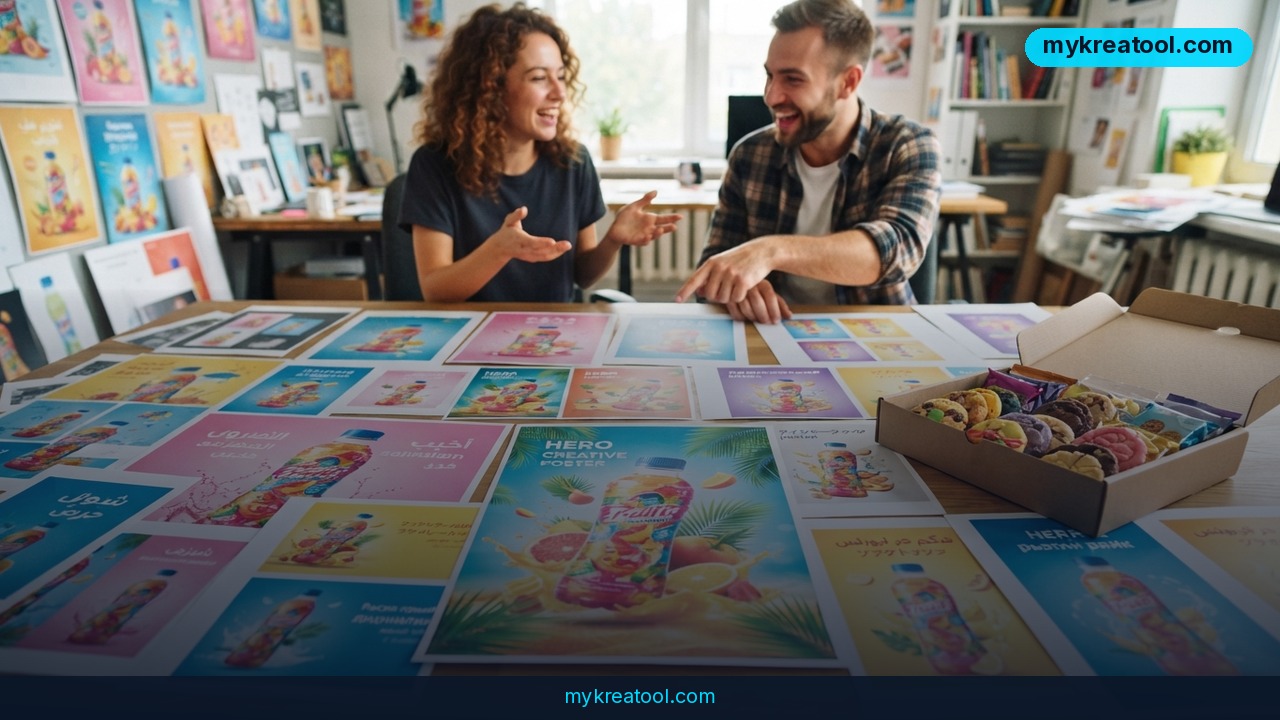
Luma AI ad creatives address the 4 p.m. scramble when the hero image just got signed off but by morning you need fifty versions of it: six hooks for Meta, four aspect ratios for TikTok, localized text for three markets, and a dozen copy angles to test against each other. That's the everyday reality of AI for advertising — the bottleneck isn't the idea anymore, it's the production line standing behind it.
Luma AI's answer is a feature called Layers, powered by its Uni-1 model. Instead of treating your approved image as a finished file, it treats it as a working file you can still take apart. One approved asset goes in; dozens of platform-ready variants come out.
What happened
The old math: every variant was a new project
Traditional creative production treats every change as a fresh job. Swapping the product means a new photoshoot. Changing a headline kicks off a full design cycle. Localizing for a new market means rebuilding the whole asset with a different team. The timeline alone costs you 3–4 weeks — by the time your variants reach the media buyer, the campaign window they were built for has already closed.
That hurts more than it used to. Meta now rewards creative diversification over creative perfectionism, and the algorithm actively penalizes creative similarity. Which means a few tweaked words on an identical layout don't count as distinct variants at all.
Why volume wins now
The numbers explain the urgency. Campaigns running 15+ variants a month deliver 23% higher return on ad spend than single-creative approaches. Only 6–7% of variants ever become scaling winners — so you can't find the winners without producing a lot of near-misses first. And the combinations get big fast: six hooks times six copy angles times four proof elements is 144 potential messages before you've even adapted a single format.
Speed shows up in conversion data too. Paid social ads in the automotive industry convert at 2.9%, so every faster test cycle puts you in front of real buyers sooner. Every week spent rebuilding images instead of buying media is a week with no performance data.
Layers: editing instead of regenerating
Here's the practical part. An approved hero image is really hundreds of decisions stacked together: lighting, composition, product placement, typography, color relationships. Rebuilding from scratch means remaking every one of those calls and hoping you land back on the version that got approved.
Layers keeps them. Objects, text, and backgrounds become independent layers — whether the image came out of Luma or was uploaded from an existing campaign. Swap the product bottle and the beach stays. Change the headline and the bottle holds its position, the brand typography keeps its exact kerning, the shadow relationships don't shift.
A beverage brand is the clean example. It approves a summer hero: a bottle against a beach backdrop, "Summer Refresh" as the headline. The campaign then needs three product colorways (original, berry, citrus), four seasonal headlines for different market timing, regional variants with localized text, and an Instagram Stories crop with adjusted composition. With traditional tools, each change means regenerating the entire image — the beach lighting drifts, the shadow falls differently, the type spacing wanders. Hours disappear into chasing the approved original. Layers changes one element and leaves the rest alone.
What it means for you
At home: the side hustle that needs more than one photo
Say you sell candles on weekends. You've got one photo you love. With layered editing you can swap the candle, redo the headline for Mother's Day versus Christmas, and crop a vertical version for Stories — without booking a photographer or paying for a second shoot.
At work: the marketing team of one
A solo marketer usually ships one or two creatives a month because that's all the hours allow. That's below the 15+ threshold where the 23% ROAS lift shows up. Layered editing is how one person clears that bar: 3.5–5 hours for a full variation set instead of 15–20.
In business: three markets, one asset
If you're launching in three regions, localized text used to mean three rebuilds and three rounds of approval. Keep the approved layout, swap the text layer, and you're shipping market variants from a single source of truth.
For study: seeing how an image is built
Students learning design or marketing get something rare here — a picture that comes apart into its decisions. Watching a headline change while kerning holds still teaches composition faster than any lecture slide.
For creativity: variations instead of a blank canvas
The blank page is the enemy. Starting from an approved image and changing one variable at a time is a far easier way to explore — and it keeps you from throwing out what already worked. If you want free AI tools to draft those copy angles before you touch the visuals, MyKreatool is a good place to warm up.
For income: selling direction, not production hours
Freelance designers who bill by the hour get punished for getting faster. Teams reporting 4–6x production increases aren't just working quicker — they're re-pricing around strategy and art direction while the repetition gets automated.
How to try it right now
1. Start free with your own archive. Pick one approved asset you already own the rights to. No new shoot, no new spend — that's your test case.
2. Open Luma AI's Layers. Go to Luma AI and load the asset into Layers, which runs on the Uni-1 model. Uploaded campaign images work, not just ones generated inside Luma.
3. Split it into three layers. Separate the object, the text, and the background. This is the step that stops future rebuilds.
4. Change exactly one thing. Swap the product colorway. Confirm the lighting, shadow, and composition didn't move.
5. Change the headline next. Type a new one and check that the bottle position and kerning hold.
6. Crop for each platform. Build the four TikTok aspect ratios and the Stories crop with composition adjusted by hand.
7. Run the matrix. Six hooks, six copy angles, four proof elements — 144 combinations to pick from.
8. Log the winners. Expect roughly 6–7% to become scaling winners. That's normal, not failure.
Upsides and what changes
The headline gain is time: 3.5–5 hours for a complete variation set against 15–20 hours manually. That's the difference between testing this week and testing next month. The second gain is accuracy — no more "close enough" versions of an approved asset, because the approved layout is literally preserved underneath your edit. And the third is scale: 15+ variants a month puts you in the bracket with 23% higher ROAS, and 4–6x production increases become realistic for small teams.
Limitations
Be clear-eyed about what this doesn't do. Layers preserves what you approved — it doesn't tell you what's worth approving, and it can't rescue a weak concept. Only 6–7% of variants become winners, so most of your output will still lose, and that's baked into the process rather than fixed by it. Localization is another soft spot: swapping a text layer gives you translated words, not culturally tuned messaging, and someone still has to check idiom, claim rules, and legal wording per market. Format adaptation isn't fully automatic either — the Stories crop needed deliberately adjusted composition. And none of it removes the need for a human at the quality checkpoint, or for rights to every asset you upload.
Conclusion
One approved asset can become a full campaign if your work compounds instead of restarting. Luma's Layers is a genuinely different way to think about creative production: the hero image stops being a finished artifact and becomes an editable file that keeps every decision you fought for.
The numbers point the same direction — 23% higher ROAS at 15+ variants a month, 3.5–5 hours instead of 15–20, and only 6–7% of variants ever winning, which makes volume non-negotiable.
One action for today: dig out the single best-performing creative you've already got approval on, upload it to Layers, and change exactly one element. That's the whole test. If the lighting and layout hold, you've just found your production line.

Comments 0