What happened
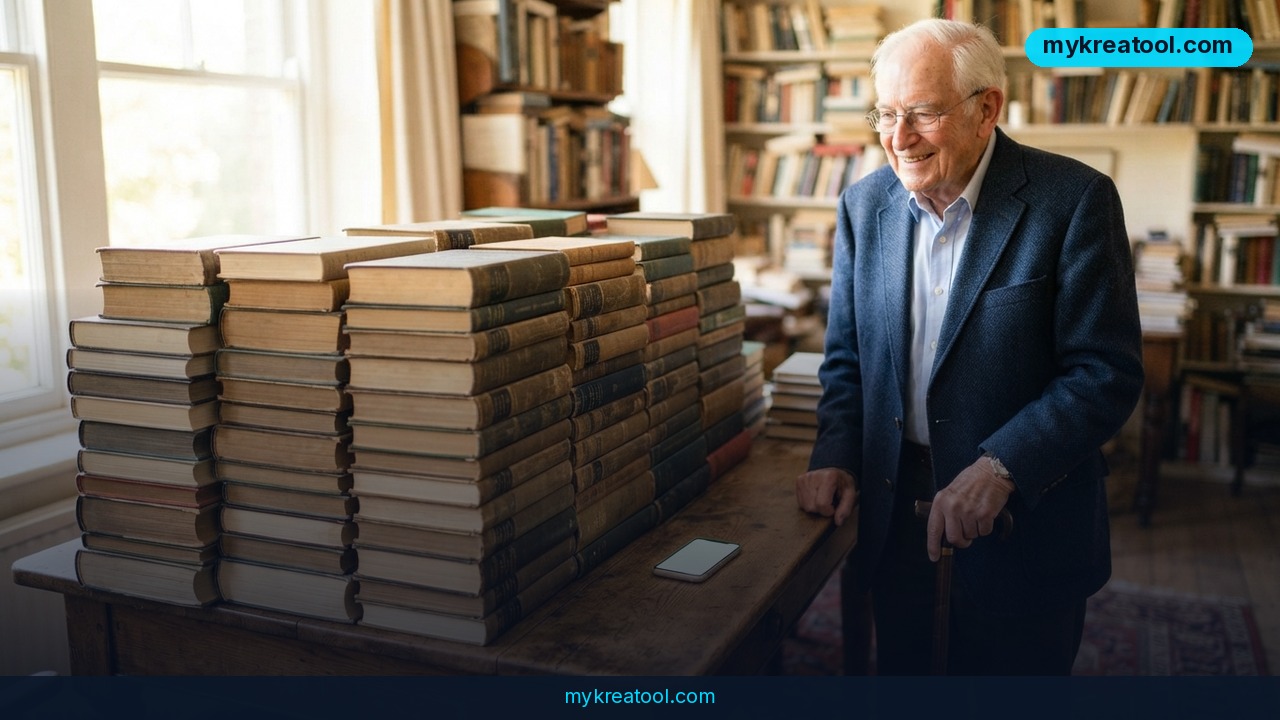
Bill Jones retired two years ago at 70 with a lifelong itch to write. Instead of spending a year on one book, he opened ChatGPT and started drafting nonfiction titles on whatever he was curious about that week — jazz history, World War II, obscure sports trivia, eccentric geniuses. His first book, 651 pages, took about two weeks to put together. It sold only a handful of copies. He kept going anyway.
Today Jones has 445 titles live on Amazon. He isn't slowing down — he aims for ten new books a week, which he says is the maximum Amazon lets a single author publish in that stretch of time. Over one summer alone he added 70 new books to his catalog. During the last holiday shopping season he sold 821 copies and pulled in about $6,000.
He isn't doing this in a spare hour after dinner. Jones puts in 8 to 12 hours a day, six or seven days a week: picking topics, prompting ChatGPT, editing the output, generating a cover image, and uploading the finished file to Amazon's Kindle Direct Publishing and other marketplaces. His books run around 300 pages with 10 to 15 chapters — and he's learned to keep each ChatGPT writing session short, because the longer a single generation runs, the more likely the model is to drift off-topic or simply invent facts that aren't true.
What it means for you
You don't have to want to be an author for this story to matter. What Jones actually shows is a shift in the economics of making things — any things — when AI drafts the first version. A few places that shows up in ordinary life:
• Home: Writing a family cookbook, a photo-and-story memoir for a parent's 80th birthday, or a neighborhood newsletter used to mean weeks of typing. Now a rough draft takes an afternoon, leaving your time for the parts only you can do — the stories, the captions, the personal touches.
• Work: If your job involves reports, training manuals, or internal documentation, you can draft ten versions of an explainer and pick the one that lands, instead of agonizing over getting one version perfect on the first try.
• Business: Jones's real insight isn't "AI writes books" — it's "AI makes testing cheap." A small business can test ten product descriptions, ten ad headlines, or ten email subject lines in the time it used to take to write one, then double down on whichever actually gets a response.
• Study: Students can use the same approach to generate practice questions, summarize dense chapters, or draft study guides — then check and correct the output themselves, which is also how you actually learn the material.
• Creativity: Hobbyist writers and amateur illustrators can throw out a hundred rough ideas instead of laboring over one, because the cost of a bad attempt has dropped to almost nothing.
• Income: Jones's payout is modest — by his own math, roughly $300 to $940 a month from his full catalog, assuming 10-30% of his 445 books actually sell and each sale earns him about $7. That's beer money, not a retirement windfall, and it came after two years of 60-hour weeks. Treat it as a floor, not a fantasy.
How to try it right now
You don't need Jones's stamina to test the same idea on something smaller — a short guide, a batch of blog posts, a set of product descriptions.
1. Start free. Before paying for anything, try myKreaTool, a set of free AI writing and image tools, to draft an outline, a short piece of text, or a cover-style image without spending a cent. It's a fast way to see whether AI-assisted drafting fits how you work before you commit to a paid subscription.
2. Pick one narrow topic you actually know something about. Jones succeeds partly because he picks subjects he's genuinely curious about — that's what lets him catch the AI's mistakes during editing.
3. Ask for a short section at a time, not a whole book or report in one go. Jones's own rule: the longer the AI writes in one stretch, the more it makes up. Ask for one chapter, one page, or one paragraph, then read it before asking for the next.
4. Fact-check everything before you publish or send it. Treat the AI's first draft the way you'd treat a smart but occasionally careless intern's work — useful, but not to be trusted blind.
5. Go further with ChatGPT (chat.openai.com) for the actual drafting, paired with any AI image generator for a cover, and a marketplace — Amazon KDP, Etsy, your own website — to put the finished piece in front of people.
6. Ship it, then move to the next one. The whole model depends on volume: one weak piece doesn't matter if you're not betting your entire year on it.
Upsides and what changes
The core change here isn't that AI can write — it's that AI collapses the cost of trying. Before large language models, writing a book nobody wanted meant losing a year if you guessed wrong. Jones tests a new topic in a couple of days instead. That's the same logic venture capital firms use: fund twenty companies knowing most will fail, because the one or two that work pay for all the rest. Jones runs that playbook solo, with book topics instead of startups. For ordinary people, it means you can prototype an idea — a course, a guide, a small side project — cheaply enough that being wrong doesn't cost you much anymore.
Limitations
This isn't a shortcut to easy money or effortless quality. Writers who work this way describe it as genuinely exhausting — hours of prompting, reading, and correcting the AI's output, because these models still lose the thread in long conversations and confidently state things that are false. Jones's own income, after two years of near-full-time work, works out to a few hundred dollars a month, not a windfall. Flooding a marketplace with low-effort AI content also has real downsides for readers, who increasingly wade through more noise to find something worth their time — and Amazon and other platforms are actively tightening disclosure rules for AI-generated books, so what works today may face new restrictions tomorrow.
Conclusion
Jones's 445 books aren't really a story about writing — they're a story about what happens when trying something new stops being expensive. Your action for today: pick one small piece of writing you've been putting off — an email sequence, a how-to guide, a short story — and draft it with a free AI tool in one sitting. You'll learn more about whether this actually works for you than another week of thinking about it ever could.


Comments 0