What happened
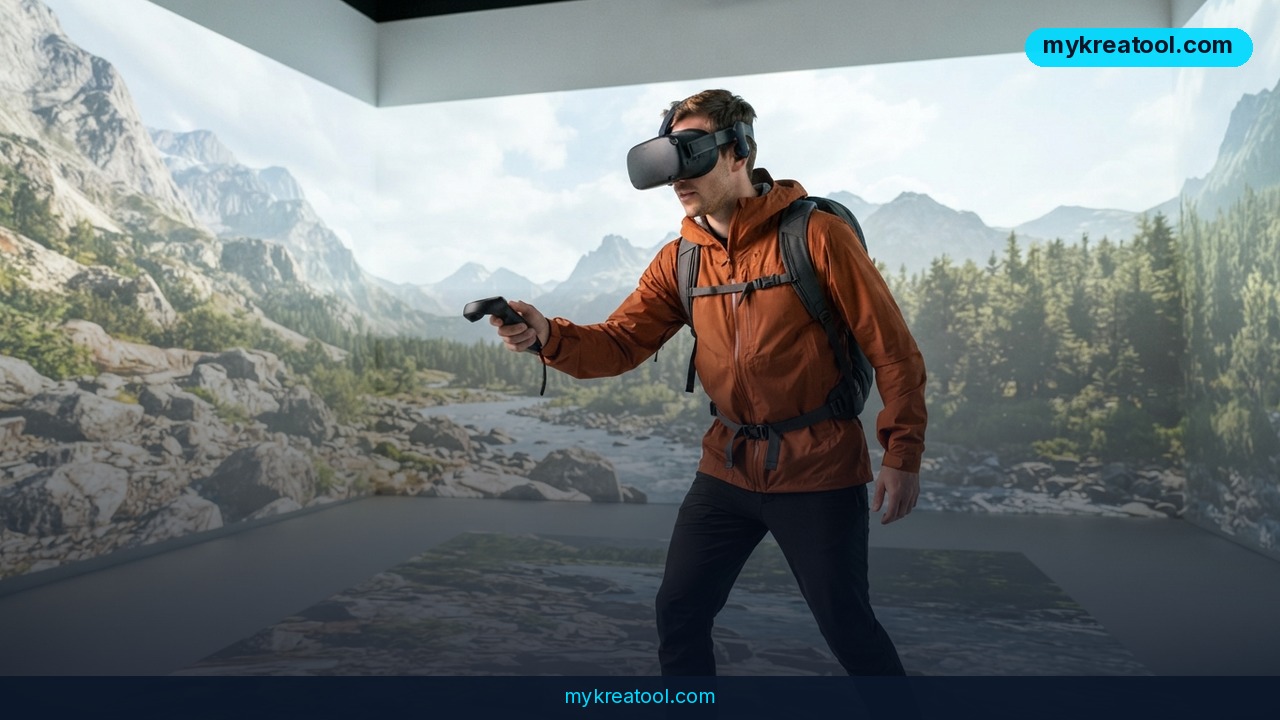
There's a new AI world model out, and it doesn't just describe imaginary places — it builds them while you're standing inside them. Odyssey-3, from Odyssey Systems, turns a text prompt into a playable 3D environment and keeps regenerating that environment in real time as you move through it. Walk from one end of a canyon to the other and the canyon gets drawn as you go, rather than loaded off a hard drive.
A world model, in plain English, is an AI that learns how physical scenes unfold and then predicts what happens next. It's the same instinct as a video generator guessing the next frame, except this one has geometry, movement and cause-and-effect baked in. Odyssey-3 is the company's third attempt at this, and it's the first release you can actually poke at yourself in a browser.
A prompt goes in, a world comes out
The loop is dead simple. You type something like a rocky coast at dusk or a neon city street after rain, and the model assembles the scene around you. From there you can walk in first person, flip to third person, swing the camera wherever you like, or drop new events into the world while the generation is still running. No pause button, no reload screen.
You can also skip typing and upload an image instead — the model will grow a world out of it. The demo clips shipped with the launch lean into the weird stuff: you can scoot around as a sea lion, stroll as a cat, or paddle a kayak, all while the scenery keeps shifting around you. Regular human walking is still on the menu, obviously. It plays less like a game and more like a sandbox for what-if-I-try-this moments.
The number worth remembering: 66.1
Odyssey's Pro version scored 66.1 on Physics-IQ Verified in video-continuation mode. Here's how that benchmark works: researchers take footage of real physics experiments, feed the model only the first part, and ask it to generate the rest. Then they compare the AI's ending with what actually happened on camera. Did the liquid spill the way it should? Did the object fall at the right speed? Did the stack topple correctly?
In everyday terms, it's a gut check on whether a model has genuinely absorbed how the physical world behaves, or is just painting pixels that look convincing. A 66.1 in continuation mode is the kind of result that makes robotics teams sit up straight.
The part that isn't about games at all
For all the fun of being a sea lion, the launch material is upfront about the real target: robots and self-driving cars. A separate control module translates the model's internal representations into actual actions, and for vehicles it predicts points along a future trajectory — essentially guessing where the car will be in a moment so the system can react before anything goes wrong.
Think of it as the difference between watching a weather forecast and steering a boat by it. The same machinery that predicts what a room will look like when you turn your head could help a machine predict where it's heading next, and what it'll hit if it doesn't adjust.
What it means for you
You don't need a robotics lab to get something out of this. Real-time world generation starts showing up in pretty ordinary places.
At home
Imagine redecorating without moving a single chair. You describe the living room you want, generate it, and walk around inside it before you spend a dime on paint or furniture. Same idea for planning a garden, testing where a sofa actually fits, or showing your partner why the wall color you love would look terrible under evening light.
At work
Teams that build anything spatial — floor plans, factory layouts, event staging, safety drills — can walk through a version of a plan instead of squinting at a diagram. Training scenarios get much cheaper too: instead of booking a facility, you generate one and put people inside it.
For business
Product demos, virtual showrooms, and immersive ads stop being six-week video projects. You write the scene, generate it, and change it the same afternoon when the client says they'd rather see it at sunset. Small teams suddenly get the kind of environment work that used to require a studio.
For studying
History, biology and physics lessons get a walkaround mode. Instead of reading about a Roman street, you stand in one and nudge the camera. Physics students can watch an experiment get continued by the model and then compare it against reality — which is, quite literally, what Physics-IQ does.
For creativity
Writers and artists get a fast way to test whether a scene actually works before committing to it. If your moodboard has been sitting untouched for months, a free AI tools hub like mykreatool is a handy warm-up for prompt writing before you jump into a world model.
For a side income
There's a growing market for custom generated environments: virtual sets for small video creators, walkthroughs for real-estate listings, prototype levels for indie game jams. The tool is free to try, so the barrier to a paid gig is mostly your taste and your turnaround time.
How to try it right now
Start with the free option — that's the smaller model, Flash, which runs in a browser.
1. Open the Odyssey-3 launch page and look for the Flash demo.
2. Expect a queue. Reports from early users put the wait at roughly five minutes, followed by a similar stretch of playtime before you're sent back to the end of the line. Traffic will decide how true that stays.
3. Type a prompt. Specific beats poetic: name the place, the weather and the time of day. Or skip it entirely and upload an image as your starting point.
4. Move around. Try first person, then third, and drag the camera to see how the world fills itself in behind you.
5. Push it. Throw in a new event mid-generation and watch the scene react. That's the whole point of a world model.
6. Want the details first? Read the technical introduction, the benchmark writeup on daily.dev, and the independent overview at Art Realm AI.
Upsides and what changes
Interactive generation flips the usual workflow. Traditional 3D work is front-loaded: build the asset, then explore it. Here, exploring is the build. That collapse of steps is what makes it feel less like software and more like a place.
It also drags environment work out of the specialist's hands. You no longer need a game engine and three months to test whether an idea has legs. Describe it, walk through it, throw it away, try again — all before lunch.
And the robotics angle is the tell. When a company bothers to publish a physics benchmark score, it's auditioning for industries where being wrong is expensive. A model that can guess how a room behaves is a model that can help a machine move through one.
Limitations
Be honest about the gaps before you get excited. Interactive generation is heavy computing, which is exactly why the free Flash tier puts you in a queue and hands you a short session instead of an all-day sandbox. The public demo is a preview, not a product, and the specifics of waiting times and session lengths aren't officially documented — they can shift with demand. The 66.1 score is a benchmark result, not proof that the model will handle the messy, unpredictable real world every single time. And the robotics work is stated intent, not shipped hardware: a control module that converts internal representations into actions is a research direction, not a robot you can buy. Treat Odyssey-3 as an early look at a genuinely new category, not a finished tool you can build a business on tomorrow.
Conclusion
Odyssey-3 is the clearest sign yet that world models are moving from research papers into something you can open in a browser tab. A prompt becomes a place, the place reacts to you, and it scored 66.1 on Physics-IQ Verified doing it — with robotics and autonomous driving named as the real destination. Here's your one action for today: open the Odyssey-3 launch page, join the Flash queue, and spend your five minutes generating a world you've always wanted to stand in. You'll learn more about where this is heading in five minutes of walking around than in an hour of reading about it.


Comments 0