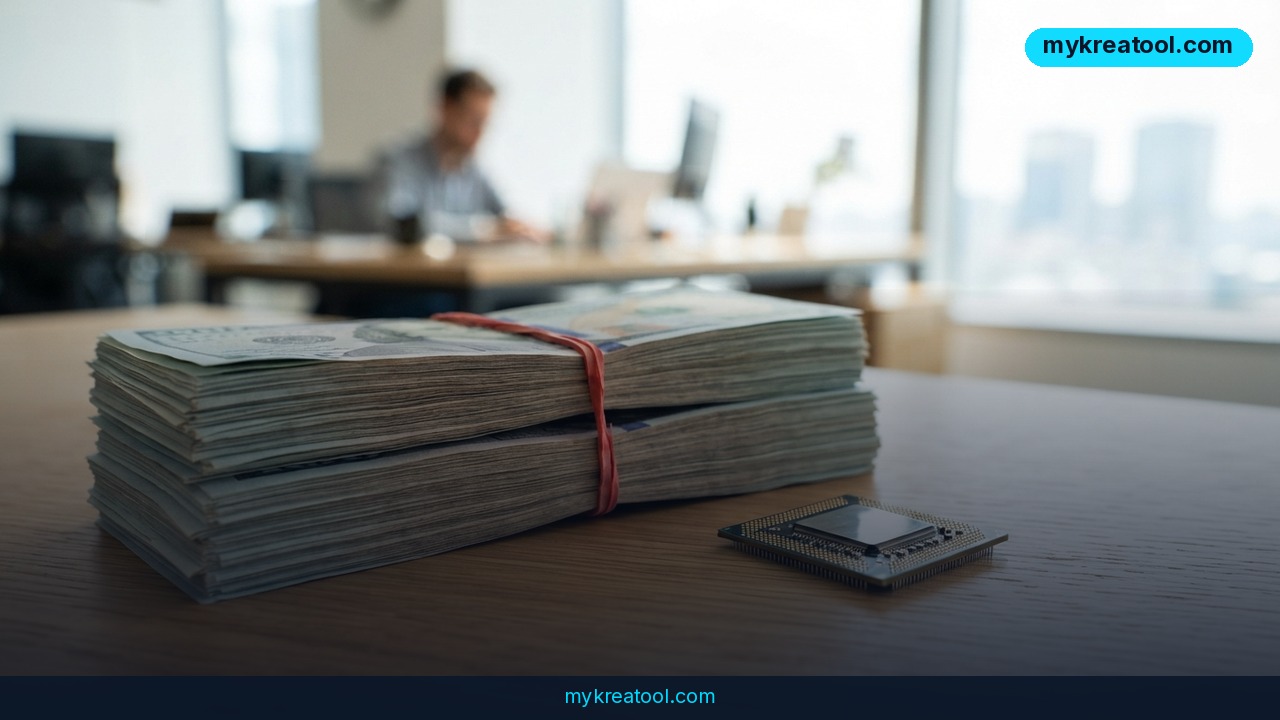
AI for business just got a lot cheaper — and not in the vague "prices may vary" way. On October 26, 2026, OpenAI released GPT-6.1 Terra, a mid-range model that sells through the API at half the price of the model it replaces: $1 per million input tokens and $5 per million output tokens, against $2 and $12 for GPT-5.6 Terra. If you've ever glanced at an AI invoice and quietly closed the tab, that's the line worth reading twice.
A token, by the way, is just a chunk of text — roughly three-quarters of a word. A million of them is a stack of novels' worth of reading, and paying a dollar for that is pocket change for most teams. That's the reason this release matters more than another benchmark bragging right.
What happened
A mid-range model that undercuts the competition
Terra sits in the middle of OpenAI's line-up: cheaper and faster than the flagship models (GPT-6.1 Sol, GPT-6 Astra), smarter than the light ones (GPT-6 Luna). It's the company's closest answer to Anthropic's mid-tier Sonnet series, and it beats it on price. Claude Sonnet 5.5 charges $2 per million input tokens and $10 per million output tokens. Terra charges half that on input and half on output.
Cached inputs — text the model has already read once and doesn't need to re-process from scratch — drop to $0.05 per million tokens, a quarter of the previous rate. Think of it as a loyalty discount for repeating yourself, which, let's be honest, is most of what business software does.
What OpenAI says it's actually for
This isn't a coding-first launch. OpenAI built Terra for office work: drafting proposals, reading technical drawings, filling in forms. The pitch is fast visual reasoning plus precise computer control plus a more natural writing style. It's available right now to Plus, Pro, Enterprise and Edu users inside ChatGPT Work and Codex, and through the API for anyone building their own thing.
What the benchmark numbers say
Analytics firm Artificial Analysis calls Terra a new benchmark for intelligence per dollar. On its Intelligence Index the model scores 48 — between GPT-6.1 Sol on 52 and GPT-5.6 Terra on 42. At maximum reasoning effort it gains 6 points over its predecessor while costing $0.40 per task instead of $1.40. At lower effort levels the gains stretch to 7–13 points, which puts it on the "Pareto frontier": jargon for the sweet spot where you can't get cheaper and smarter at the same time.
On the new Coding Agent Index v2.0 it scores 48 — six points behind GPT-6.1 Sol (54) and 17 ahead of GPT-6 Luna (31). The hallucination drop is bigger still. On the private AA-Omniscience benchmark, Terra only guesses when it doesn't know the answer 38 percent of the time, down from 88 percent for GPT-5.6 Terra. Accuracy rose by two points.
Computer control is where the gap is widest
"Computer control" means the model can drive software: click, type, scroll, fill things in. On the Agents' Last Exam benchmark, Terra matches GPT-6 Astra at one-tenth the token price. Against Claude Opus 5.5 at maximum effort, it's more than three times as token-efficient at a quarter of the token price — roughly nine times lower cost per task — and it finishes more than three times faster than both GPT-6 Astra and GPT-6.1 Sol.
Elsewhere: it beats GPT-5.6 Terra at every reasoning level on MMMU-Pro (visual reasoning) and nearly matches Astra and Sol. On the desktop agent test OSWorld 2.1, it tops its predecessor's best result at medium effort for a fraction of the cost. On Terminal-Bench 4.0 it solves 50.3 percent of tasks at maximum effort, up from 21.5 percent — a 20-point jump that Artificial Analysis puts in the same tier as Sol. On Terminal-Bench-Science 0.1 it beats Sol at lower cost and lands within five points of Claude Opus 5.5 at less than a fifth of the estimated cost. For the hardest coding work, though, OpenAI still points people to Sol and Astra.
What it means for you
At home: fewer evenings lost to forms
Most of us don't have "AI strategy" problems. We have a PDF that needs filling in, a lease we don't fully understand, and a pile of paperwork with small print. A model that reads images well (MMMU-Pro) and costs pennies per request is exactly the tool for that. You snap a photo, ask what the awkward clause means, and move on. Add the drop in made-up answers — 38 percent guessing instead of 88 percent — and you're spending less time double-checking what it tells you.
At work: the spreadsheet-monkey era ends
Computer control is the quiet headline. An agent that can click through a dashboard, pull numbers into a report and submit a form is the difference between "AI that writes a nice paragraph" and "AI that saves you an hour on Tuesday." Terra finishing more than three times faster than GPT-6 Astra and GPT-6.1 Sol on agent tasks matters more than raw scores here: slow agents feel like waiting on a slow intern, and nobody keeps those around.
For your business: the math finally works
Here's the part owners care about. At $1 and $5 per million tokens, and $0.05 cached, you can put a mid-tier model behind customer emails, quote drafting, document checks and internal search without a finance conversation. On agents' tasks the gap versus Claude Opus 5.5 at max effort is roughly nine times the cost per task, according to the published numbers. And the $0.40-per-task figure versus $1.40 means you can run three extra pilots for the price of one old one.
If you'd rather test the cheap side of the market first, mykreatool.com rounds up free AI tools you can try before you commit a single dollar to an API bill.
For studying: diagrams stop being a dead end
Reading a technical drawing, a circuit diagram or a page of biology figures used to be the moment chatbots waved the white flag. Terra outperforms its predecessor at every reasoning level on visual tests and nearly matches the top models — at a price a student can afford. It's also a decent study partner for the boring part: turn a lecture handout into practice questions, then check the answers rather than trusting them blindly.
For creators and side income
A more natural writing style at half the price is a straightforward win for anyone producing content, product descriptions or newsletters. The speed gain helps too — three times faster on agent-style jobs means batch work doesn't stall. And because cached inputs are a quarter of the old rate, reusing the same brand brief across twenty posts no longer quietly eats your margin.
How to try it right now
Step 1: Find out what you already pay for. There's no free tier for Terra in this announcement, and I'm not going to pretend there is. The zero-extra-cost route is your existing plan: Plus, Pro, Enterprise and Edu all include it, so if you're already a subscriber, you've got it today.
Step 2: Open ChatGPT Work and pick GPT-6.1 Terra from the model selector. Don't start with something clever. Start with the dullest task on your list — a form, a supplier PDF, a report you rewrite every month.
Step 3: Turn the reasoning effort down for routine jobs. The intelligence-per-dollar story is strongest at lower effort levels, where Terra gained 7–13 index points over its predecessor. Save maximum effort for genuinely hard questions.
Step 4: If you code, try Codex. That's where the Terminal-Bench jump shows up: 50.3 percent of tasks solved at maximum effort versus 21.5 percent before. Keep GPT-6.1 Sol or GPT-6 Astra in reserve for the nastiest problems, as OpenAI itself recommends.
Step 5: If you're building something, get an API key and budget with real numbers: $1 per million input tokens, $5 per million output, $0.05 cached. Set a hard spend cap before you ship anything, and send repeatable context through the cache.
Step 6: Compare it to what you use now. If you're on Claude Sonnet 5.5 at $2 and $10, or GPT-5.6 Terra at $2 and $12, run the same ten tasks through both and count corrections. That's the only benchmark that describes your business.
Upsides and what changes
The obvious upside is the price floor moving down. A mid-tier model that costs half of last year's mid-tier model, and roughly a ninth per agent task compared with a top model at max effort, changes what's worth automating. Things that were "not worth the tokens" — summarizing every support ticket, checking every invoice line, tagging every product photo — become cheap enough to just do.
The second change is trust. Cutting guessing from 88 percent to 38 percent won't make anyone stop checking, but it moves AI from "fun toy, verify everything" toward "decent first draft, spot-check it." That's the shift that turns a demo into a daily habit.
The third is competitive pressure. Terra undercuts Claude Sonnet 5.5 on both input and output, and it's three times faster than OpenAI's own bigger models on agent work. When the middle of the market gets this aggressive on price-to-performance, everyone's roadmap gets cheaper.
Limitations
Be careful with all of this. Almost every number above comes from OpenAI or from Artificial Analysis running its own tests — not from your documents, your customers or your messy internal processes, and cost per task depends entirely on how many tokens a task actually burns. Terra still trails GPT-6.1 Sol on the Intelligence Index (48 versus 52) and on the Coding Agent Index (48 versus 54), and OpenAI explicitly steers demanding coding work to Sol and Astra. Solving 50.3 percent of Terminal-Bench tasks sounds great until you remember it fails the other half. Guessing 38 percent of the time is a big improvement and still means one answer in three might be invented when the model is out of its depth. "Nearly matches" on visual reasoning isn't "matches." And there's no free tier here — you're either on a paid plan or paying per token. Treat the launch figures as a strong reason to test, not as proof that your workflow will get nine times cheaper.
Conclusion
GPT-6.1 Terra is the least glamorous release OpenAI has put out in a while, and probably the most useful for ordinary work: same family, half the API price, far fewer confident guesses, and computer control that's three times faster than the big models. If you run anything — a team, a shop, a newsletter, a household with paperwork — the cost of handing repetitive clicking and reading to a model just dropped below the point where you need to justify it.
One action for today: open ChatGPT Work, pick GPT-6.1 Terra, and run your single most repeated copy-paste chore through it once. Time it, count the corrections, and decide with your own numbers instead of a leaderboard.
Comments 0