What happened
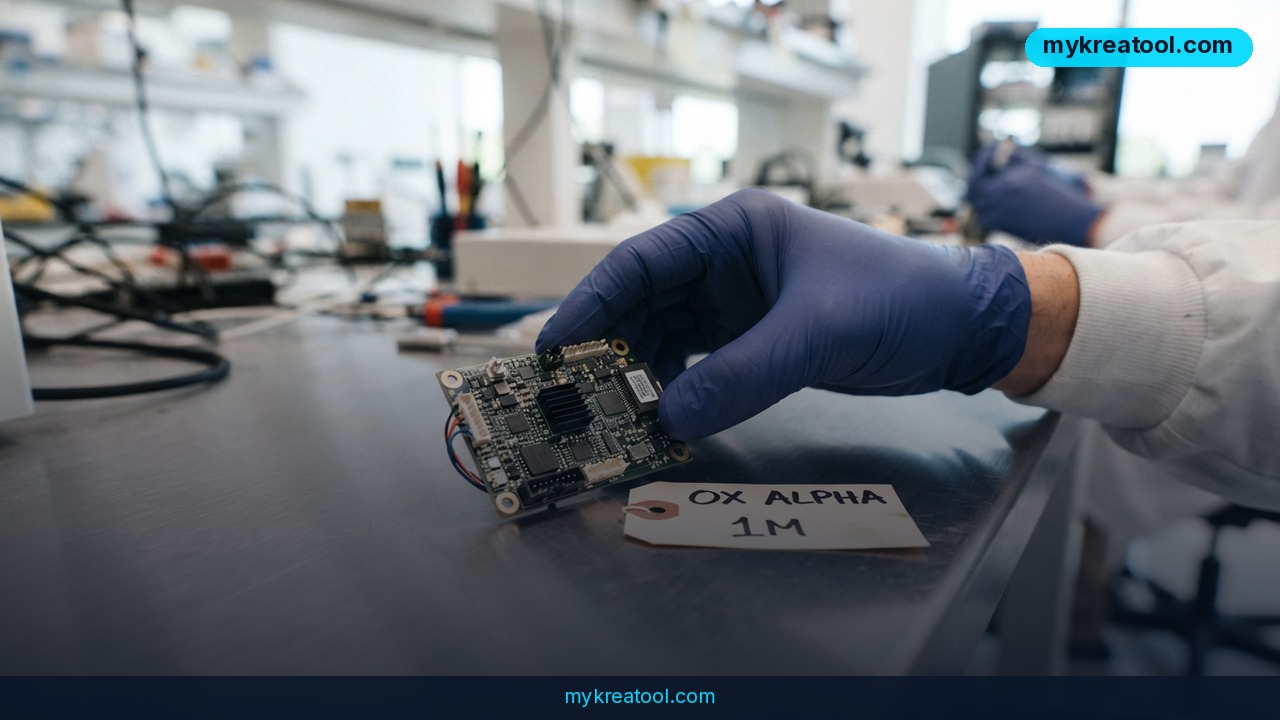
A mystery AI model called Ox Alpha appeared on OpenRouter this week with no name behind it, no research paper, and no launch announcement. It simply showed up in the model list: free to use, a 1,048,576-token context window, and multimodal input support for text, images, and video. Nobody has stepped forward to claim it, and OpenRouter's listing offers no clues about the lab that built it.
Curiosity got the better of one team, who plugged Ox Alpha in as the reasoning engine for an autonomous build-and-verify agent nicknamed Row-Bot and gave it a single instruction: research yourself, build a Three.js website about what you find, then open it in a browser and check your own work. No hand-holding, no retries — just a live test of how a completely unverified model handles an open-ended task from start to finish.
The results were published as a self-contained case study, and the specs it surfaced were striking. Ox Alpha's own runtime reported a 131K max output limit, native tool-calling with roughly a 4.45% error rate, generation speeds around 50 tokens per second, and 99.99% reported uptime. The model swept X and news sites, pulled in 15 posts, cross-checked two primary articles, and cross-referenced everything against its live configuration — separating confirmed numbers from identity speculation instead of repeating unverified hype. Tokenizer fingerprints hinted at a connection to GLM-5.3, but that remains unconfirmed.
Why it matters
A free model with a 1 million token context window is not a small thing. Most production-grade models with context windows that large sit behind paid tiers, rate limits, or enterprise contracts. Ox Alpha showing up free, multimodal, and with native tool calling puts serious capability within reach of anyone with an OpenRouter account — no vetting, no waitlist, no pricing page.
What makes this case study more than a curiosity is what it demonstrated in practice. The model didn't just answer questions about itself; it ran a three-phase autonomous loop: research, build, and self-QA. In the build phase, it wrote a single-file HTML page from scratch, no frameworks or templates, including a CRT-style boot terminal, a 14,000-particle Three.js hero animation, a live benchmark chart, and verdict cards that honestly flagged claims that didn't hold up. In the QA phase, it launched a headless Chromium browser, took section-by-section screenshots, and vision-checked its own output like a critical reviewer would.
That combination — long context, multimodal reasoning, tool use, and the ability to self-correct without human intervention — is exactly the profile of model that reshapes how solo builders and small teams approach automation. It's also a reminder that capability is now shipping faster than transparency: a model can be genuinely competitive on real benchmarks while its origin, training data, and safety testing remain entirely undisclosed.
How to use it today
Ox Alpha is currently accessible through OpenRouter like any other listed model, which means it can be dropped into existing pipelines with minimal setup. A few practical starting points:
Test it on a real task first
Before routing production traffic through an unverified model, run it against a task you already know the correct answer to. Compare its tool-calling reliability, output length, and factual accuracy against a model you trust.
Use the long context deliberately
A 1M-token window is large enough to hold entire codebases, long transcripts, or full document sets in a single prompt. That's useful for research synthesis, contract review, or codebase audits — but only if the model actually reasons well over that much text, not just accepts it.
Pair it with lightweight tooling
For teams experimenting with autonomous or semi-autonomous workflows similar to the Row-Bot case study, it helps to have a stack of no-cost utilities on hand for the surrounding tasks — image handling, quick conversions, or content prep. A free toolkit like mykreatool.com can cover that supporting layer without adding another subscription while you evaluate whether a new model like this is worth building around.
Who benefits
Indie developers and solo founders stand to gain the most in the short term. A free model with this feature set lowers the barrier to prototyping agentic workflows — research bots, content generators, code reviewers — without a metered API bill hanging over every test run.
Marketers and content teams can use the long context window for tasks like summarizing large campaign histories, auditing brand messaging across dozens of documents, or drafting long-form content with full source material in the prompt at once, rather than chunking it manually.
Developers building agentic tools benefit specifically from the native tool-calling support, since that's the feature that let Ox Alpha browse, build, and self-verify without a custom orchestration layer bolted on top. The ~4.45% tool-calling error rate is a reasonable benchmark to test against when comparing it to named alternatives.
Risks
An anonymous model carries real trade-offs that are easy to overlook when the price tag reads zero. There's no published safety documentation, no stated data-retention policy, and no accountable entity if the model is quietly changed, degraded, or shut down. Free access through a router also typically means no SLA — the reported 99.99% uptime is self-attested, not independently audited.
There's also the open question of provenance. Tokenizer fingerprints suggesting a link to GLM-5.3 are circumstantial at best, and running an unidentified model on sensitive business data — proprietary code, customer records, internal strategy documents — is a real exposure risk until the source is confirmed. Treat Ox Alpha the way you'd treat any unverified open-source dependency: fine for experimentation and low-stakes prototyping, risky for anything involving confidential input or production reliability guarantees.
Conclusion
Ox Alpha is a genuine anomaly: a free, multimodal, 1M-context model with working tool-calling that showed up on OpenRouter without a name attached to it. The self-build, self-QA case study is a compelling demonstration of what it can do, but the lack of a disclosed origin, safety review, or accountable owner means it belongs in the experimentation lane for now, not the production one. Watch for confirmation of its origin before trusting it with anything sensitive — and in the meantime, it's a low-risk way to stress-test what a long-context, tool-using model can actually deliver for free.



Comments 0