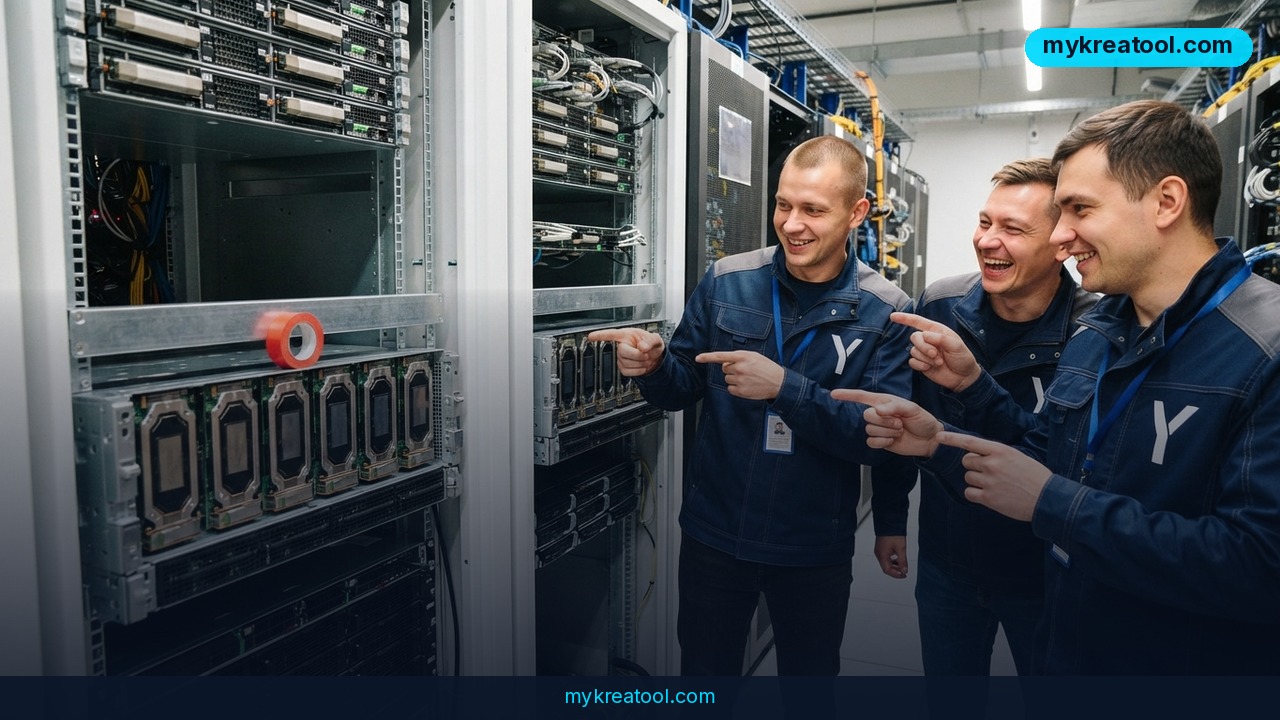
Yandex's new Alice AI Foundation LLM is a from-scratch large language model — software trained on huge amounts of text to predict and generate language — that the company says beats an NVIDIA model at writing code. It's also open enough to fine-tune under Apache 2.0. That matters because most 'open' models start life with someone else's weights; this one didn't.
What happened
Yandex released the pretrain of Alice AI Foundation LLM. The company trained it from scratch on Yandex data, without initializing it on another lab's open weights. In plain English: it didn't borrow a finished brain and slap a new label on it. The pretrain is distributed under Apache 2.0, so you can use it commercially or for research and fine-tune it for your own job.
Yandex calls the model an experimental stepping stone to a single reasoning model, or ERM. The team is using it to test architecture decisions; the ERM will later power agent features in Alice AI.
The 80B-parameter trick
At 80 billion parameters, Alice AI Foundation LLM sounds enormous. Parameters are the dials a model tunes during training; more dials usually mean more knowledge, but also more compute. The clever part is that it's a mixture-of-experts (MoE) model: out of 80 billion parameters, only 3 billion are active at any moment.
Think of a company with a huge pool of specialists. Each ticket goes to a small squad, not the whole floor. That's how the model can carry broad knowledge without firing up every parameter for every word. It has already passed its main training stage, so you can use it as a base for your own projects.
Benchmarks that speak to Russian users
On Yandex's tests, the model beats a solution from NVIDIA in code writing. It ties an Alibaba model on olympiad math problems, and it outperforms DeepSeek on tasks that need broad factual knowledge — despite being smaller. Against Yandex's previous Alice AI LLM 235B, the new version wins 75% of factual questions, even though the older model has three times the parameters and seven times the active parameters. It handles long texts up to 128K tokens — roughly a short book — at the level of market leaders, sharing first place with DeepSeek.
Yandex also published two benchmarks aimed at Russian-language knowledge: WikiWebFacts, built on Wikipedia, and HardMultiQA, built from real Alice AI user queries. The reference answers and evaluation protocol are out too.
What it means for you
Here's where an open code-and-facts model stops being a lab curiosity and starts touching real life.
At home and in study
At home, the practical win is a smarter helper for homework, planning, and plain-language explanations. A student can use a model with strong math and factual knowledge to check reasoning, not just get answers. A parent can fine-tune a small assistant on household docs or a kid's study notes if they have the technical help — or use a hosted tool instead. The model's 128K-token context means you can feed it a long article, a manual, or a semester's worth of notes without chopping it into tiny pieces.
At work and in business
At work, the code result is the headline. A small team can take an Apache 2.0 base model and tune it on its own code style, internal APIs, and review comments. That's the difference between a generic coding chatbot and a junior developer who knows your repo. In business, the same pattern applies to support replies, product descriptions, and policy summaries: fine-tune on your own examples, then test against a baseline before you roll it out. Because only 3 billion parameters are active at a time, the compute bill can be far lower than the raw 80B headline suggests.
For creators and side income
For creators, the long-context strength is handy for turning transcripts, interviews, and research notes into drafts. For side income, the code angle is more direct: if you build websites, automations, or small apps, a model that beats NVIDIA's solution in Yandex's tests is worth benchmarking on your own tasks. Don't switch your whole workflow on a press release; run a bake-off with real prompts from your paid work. Then you'll know whether it saves you hours or just looks good on a chart.
How to try it right now
The free route is the open pretrain itself. The exact name to search for is Alice AI Foundation LLM.
1. Find the official release. Go to Yandex's official AI pages or the model hub Yandex uses and search for 'Alice AI Foundation LLM'. Stick to the official source; don't grab a random mirror.
2. Check the license. Confirm the Apache 2.0 label. That's your permission slip for commercial and research use, including fine-tuning.
3. Match it to your hardware. This is a base model, not a phone app. You'll need a GPU setup and an ML framework, or a cloud notebook with enough memory.
4. Fine-tune on your own examples. Start with a focused set of examples of your code style, support replies, or niche facts. Keep a held-out set for testing.
5. Run a bake-off. Use the same set of prompts on your current tool and the new model. Measure time saved, mistakes caught, and edits needed.
If you don't want to touch a GPU, use the no-code shortcut first: test your code and writing prompts with the free AI tools at mykreatool.com. It's a zero-setup way to see whether a model's style fits your task before you spend engineering time on the Yandex pretrain.
Upsides and what changes
The biggest upside is the license. Apache 2.0 means you can use the pretrain for commercial and research work, then fine-tune it without begging for a special deal. That's a big deal for startups, agencies, and internal IT teams that want to keep their data and prompts under their own control.
The second upside is efficiency. An 80B model with 3B active parameters is like a warehouse with a huge inventory but only a small crew working at once. You get the storage, not the full power bill. Yandex also says it kept GPUs from sitting idle waiting for data, making one training stage about twice as fast, and cut GPU memory use for intermediate data by three times. Those are engineering wins that make future models cheaper to build.
The third is competition. A from-scratch model that beats NVIDIA's solution in code, ties Alibaba in olympiad math, and beats DeepSeek on broad factual knowledge — by Yandex's own tests — gives buyers another credible option. It also raises the bar for Russian-language benchmarks, since Yandex published WikiWebFacts and HardMultiQA with reference answers and an evaluation protocol.
Limitations
This is an experimental step toward Yandex's unified reasoning model, not the finished ERM, and the impressive code and factual numbers come from Yandex's published tests, including its own Russian-language benchmark sets — so treat them as a strong signal, not an independent verdict. The pretrain is a base model: ordinary users won't get a polished chat box, and you'll need GPU resources and machine-learning skills unless someone hosts it for you. The source doesn't list a public demo URL or pricing. And be precise about the 75% figure: it's a win rate against Yandex's older 235B model on factual questions, not a claim that the model writes code 75% more efficiently.
Conclusion and one action for today
Yandex's Alice AI Foundation LLM is a serious open-model release: 80 billion parameters, 3 billion active, Apache 2.0, strong code and factual results in Yandex's tests, and a 128K-token context. For entrepreneurs and creators, the useful move isn't to worship a benchmark table. It's to test the model on your own work and see whether it earns a place in your stack.
Your one action today: write down one repetitive code or text task you'd fine-tune a model for, then search for 'Alice AI Foundation LLM' and check the official release for the Apache 2.0 license and weights. If you'd rather skip the setup, run the same task through a free AI tool and compare the output.


Comments 0