Say a sentence out loud, then type that exact sentence into an AI voice tool and press play. The difference used to jump out at you — flat delivery, odd pauses, and a chirpy tone in places where no human would ever sound chirpy. That gap just got narrower again: ElevenLabs has shipped Eleven v4 and Eleven v4 Turbo. The company's own label for the new model is a single word: emotive. If you make videos, ads, courses, audiobooks, or anything else that needs a voice that sounds like a person, the ElevenLabs Eleven v4 emotive AI voice update is worth ten minutes of your time.
What happened
ElevenLabs released two models on the same day. Eleven v4 is the flagship text-to-speech engine — TTS, in plain terms, is software that reads written words out loud in a human-sounding voice. Eleven v4 Turbo is a lighter version tuned for low latency, which means it starts talking almost immediately instead of making you wait. That matters for anything interactive: a voice assistant, a game character, a phone menu, a robot.
The launch numbers are unusually specific. Eleven v4 went straight to No. 1 on the Artificial Analysis leaderboard, an independent ranking that pits AI models against each other. In blind listening tests, 75% of listeners preferred v4 to the alternatives — three out of four people picking it without knowing which model they were hearing. VKTR's launch write-up and Unite.AI's coverage both land on the same takeaway: this is the current state of the art.
Why 'emotive' beats 'expressive'
For a couple of years, 'expressive' was the word every voice company leaned on. Expressive means the voice can do range: it rises and falls, pauses for effect, lands a punchline. Emotive means something narrower and harder — the voice sounds like it means it.
Think of karaoke. An expressive singer hits every note perfectly. An emotive one sings the same song at 2 a.m. and the room goes quiet. Same lyrics, same melody, completely different experience. That's the jump ElevenLabs is claiming, and the blind-test result is the evidence: listeners weren't just hearing a cleaner voice, they preferred it.
The robot demo that made the point
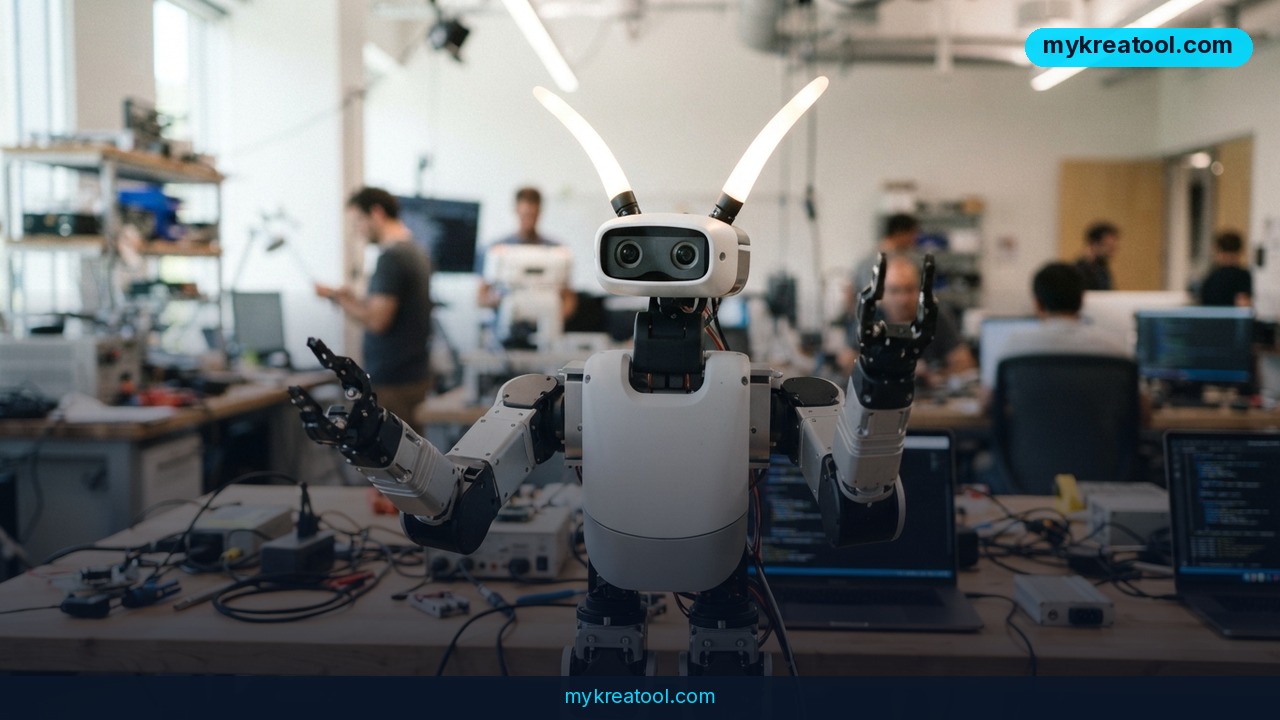
The clearest demonstration didn't come from ElevenLabs. A creator wired the new voice into a Reachy Mini, a small desktop robot with two movable antennas, and asked it to act out the same emotions with those antennas that the voice was carrying. Happy voice, antennas perk up. Sad voice, they droop.
The part that raised eyebrows: everything in that video — the robot programming and the editing — was handled by Opus 5.5, an AI model. The human involvement amounted to finding a camera and picking the shot. The demo pulled 2,098 views, 99 reposts and 54 reactions on Telegram, which for a niche robotics clip is a lot of quiet nodding. As the creator put it, in a world where agents do the building, ideas are about the only thing that still costs something.
What it means for you
You don't need a robot. The practical question is simpler: what does a voice that sounds like it means what it says unlock for an ordinary person with a laptop?
At home
Smart speakers and screen readers are the obvious win — a reminder that sounds like a person instead of a vending machine. Families can narrate slideshows and home videos without anyone's awkward voice memo making the final cut. And for anyone with low vision or dyslexia, an emotive voice is far easier to listen to for long stretches than a flat one. Listening fatigue is real, and monotone is what causes it.
At work
Training videos, onboarding decks, internal explainers, sales demos — most companies still record these on a laptop mic with all the energy of a Monday morning. Pasting the script into Eleven v4 and getting a clean, emotionally matched read takes minutes. If you'd rather test a few free AI tools before committing to any of them, MyKreaTool keeps a handy library of them in one place.
For your business
This is where the money is. Product videos, paid ads, explainer reels, phone menus and e-learning modules all need voice, and voice is usually the first thing a small budget skimps on. The bigger shift is localization. A 30-second ad used to require a fresh voice actor for every market. Now you can keep the same emotional performance and just change the language.
For studying
Turn your notes, lecture slides or a PDF chapter into audio and listen on the commute. Emotion matters here more than people expect: a bored-sounding narrator makes dull material duller, and duller material is harder to remember. Language learners get the same break — hearing a sentence delivered with real frustration, excitement or hesitation teaches more than a textbook recording ever will.
For creative projects
Audiobooks, indie games, comics, podcasts, short films. A solo creator used to be limited by their own voice or by the budget for someone else's. A character can now sound scared in one line and sarcastic in the next without hiring two actors. For game developers, v4 Turbo's low latency means a character can answer a player without an awkward pause in the middle of the conversation.
For income
Voice work is a service, and services are billable. Freelancers are selling narration for faceless YouTube channels, explainer videos, audiobook chapters and ad reads. Agencies are bundling voice into their video packages. Course creators are re-releasing the same course in three languages for the price of a rewrite. The catch: everyone has access to the same tool, so your differentiator is the script and the direction, not the model. Write better and you'll win the job.
How to try it right now
You can hear the difference today, and you can do it for free.
1. Start with the free option. Open the ElevenLabs Eleven v4 documentation and create an account. A free account is enough for your first test — you don't need to pay anything to hear what v4 sounds like.
2. Write a script with feeling in it. This is the step people skip. A neutral paragraph ('The quarterly report covers three regions...') hides every improvement, because there's nothing there to emote. Write a line with a question, a laugh or a warning in it.
3. Pick the right model. Choose Eleven v4 for normal narration and voiceover. Choose Eleven v4 Turbo when the voice has to respond instantly — an assistant, a game, a robot, a live conversation.
4. Generate and listen on headphones. Phone speakers flatten everything. Headphones are where you'll hear the breaths, the micro-pauses and the emotional turns.
5. Run an A/B test. Take the same script and generate it with an older model, then with v4. Play them back to back for someone who doesn't know which is which. That blind test is the whole point.
6. Scale it up. Once you've decided, the same text can be reused for ads, courses and social clips. Keep your scripts in one folder so nothing gets lost.
If you want a second look at the model before you build a whole workflow around it, Venice.ai has a page for the ElevenLabs TTS v4 model that's worth a browse.
Upsides and what changes
The headline upside is cost. Professional voiceover used to be the bottleneck in every video project — the booking, the retakes, the revisions, the invoice. Most of that is gone. You can re-record a line at 11 p.m. because you changed one word.
Accessibility gets a real upgrade too. Screen readers, audio articles and reading tools for kids all sound less robotic, and when they sound less robotic, people actually keep using them.
Speed is the other quiet win. A 30-second voiceover now takes about as long as the video render. For a small team, that turns a two-day bottleneck into a coffee break.
And the qualitative change is the one that matters most: emotion is what makes a listener trust a voice. When the delivery matches the message — a calm voice for a safety warning, a warm one for a welcome — people stop thinking 'that's a robot' and start thinking about what you actually said.
Limitations
It's emotive, not mind-reading. That 75% blind-test figure sounds decisive, but it also means roughly one in four listeners preferred something else, and taste in voices is genuinely subjective — some people will still pick a different brand for a particular accent or character. Pronunciations remain a weak spot: names, brands, acronyms and regional accents can come out wrong, so check them before anything goes public. Long-form narration can drift in tone over several minutes, which means a chapter that starts wistful can end merely polite unless you break it into chunks and direct each one. The Turbo latency advantage is per-model, so if you're building something interactive, test it on your own connection and hardware rather than trusting a benchmark. And the ethics are unchanged: get consent, label synthetic audio, and never use someone's voice to say something they never said. ElevenLabs has safeguards around voice cloning, but no safeguard replaces your own judgment.
Conclusion
Eleven v4 is the top-ranked model on the Artificial Analysis leaderboard, preferred by 75% of listeners in blind tests, with a faster Turbo variant for anything that has to respond in real time. The move from 'expressive' to 'emotive' isn't marketing wordplay — it's the difference between a voice that can act and a voice that sounds like it feels something. For anyone who makes videos, courses, ads or audio, that's a meaningful upgrade to a part of the job that used to be slow and expensive.
Here's your one action for today: open ElevenLabs, create a free account, and paste in one paragraph of your own writing — the opening of a sales page, the intro to a lesson, the first line of a story. Pick Eleven v4, hit generate, and listen on headphones. That single test will tell you more about where AI voice is right now than any review, including this one.

Comments 0