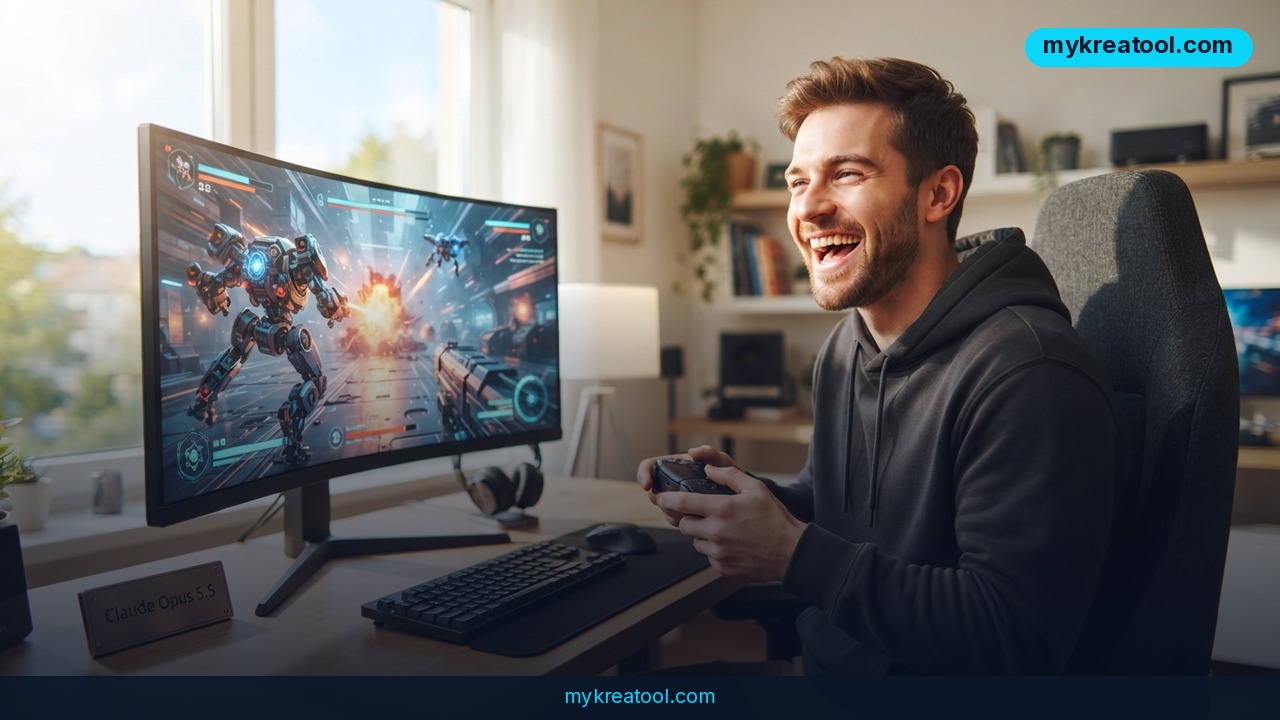
If you've ever asked an AI to build a game, you know the letdown. It hands you something that looks like a game — sprites, a score counter, a menu — but plays like a spreadsheet with sound effects. According to programmer Simon Willison, that changed in October, when Claude Opus 5.5 turned AI game creation into something you'd actually choose to play.
He should know. Over a few weeks he built four browser games without reading a single line of the code, and none of them took more than four hours of his own time. Here's what changed, and how you can use it today.
What happened
Willison, a well-known programmer who writes about AI tools, calls October a turning point. In his telling, Claude Opus 5.5 now builds games that are fun to play, while older models produced things that only looked like games. The difference sounds small. It isn't. Fun is the hard part — a game that isn't fun is just a program with rules.
He calls his method "vibe coding": you describe what you want in plain English, the AI writes the code, and you keep talking about what feels wrong until it feels right. No syntax, no debugging, no reading somebody else's code. Just conversation.
Three games, three completely different genres
• Tree Appreciator is a spot-the-difference game built around two generated trees. It came out of a single prompt in the regular Claude chat — no plugins, no special setup.
• Emberwick is a fantasy RPG (a role-playing game: you play a character in a story and live with your choices) with a 15-minute story. Its ending left him, in his own words, "emotionally affected."
• Battle Drones is a real-time strategy game in the mold of Command & Conquer — the classic build-a-base, crush-your-opponent genre — and it now supports 2–4 player multiplayer.
Three genres, three different sets of code, one assistant, and no more than four hours of human time on any of them.
The prompt that does most of the work
His starter prompt is short enough to memorize: "Build a mobile-friendly three.js game where..." Three.js, if you're wondering, is a free tool that draws 3D graphics inside a web browser, so nobody has to install anything. He says the prompt works in both ChatGPT and Claude.
And when the first draft comes back dull? He types one more line: "Make it a LOT more fun." That's it. That's the trick.
Competitors aren't standing still. Willison says GPT-6 Astra can build games too, but that its "sense of fun doesn't match that of Opus 5.5." If that sounds like hype, remember who's saying it: someone who has spent years testing tools and publishing the results. You can dig into the launch coverage yourself in the write-ups from Evolink and AlphaCorp, or the shorter breakdowns at Emergent and Shattered.
What it means for you
You don't have to be a game developer to care about this. You just need a reason to make something interactive — and most of us have one.
At home: game night that isn't Monopoly again
Ask for a spot-the-difference game using photos from your last vacation, or a quick quiz game about your family's inside jokes. It's the kind of thing you'd never hire anyone to build, and now it's a five-minute conversation.
At work: training people actually finish
Compliance modules and onboarding decks get clicked through on autopilot. A tiny browser game where people score points for spotting the right procedure? They'll play it twice. That's a real difference in whether anything sticks.
For business: a lead magnet people play
Instead of a PDF nobody opens, a small branded game gives people a reason to spend ninety seconds with your name. It's also a genuinely good conversation starter at events: "Try this, I made it this morning."
For study: flashcards that fight back
A history student can ask for a timeline game where wrong answers cost lives. A language learner can ask for a vocabulary game with a timer. Same content as a textbook, completely different amount of attention.
For creators: a prototype instead of a pitch
Writers and artists usually describe ideas. Now you can hand someone something they can click. If you've ever tried to explain a mechanic in a doc, you know how much faster this lands.
For income: small games as paid work
Freelancers are already getting asked for "something interactive" by clients who don't have a game budget. A four-hour build is a realistic line item. If you want to keep your tool costs near zero while you experiment, the free AI tools at mykreatool are a sensible place to start.
How to try it right now
Start in a plain chat window — the regular Claude chat is exactly what Willison used for Tree Appreciator, and the same prompt works in ChatGPT. No paid tiers, no coding environment, no installs.
1. Open Claude or ChatGPT in a browser tab.
2. Paste the template: "Build a mobile-friendly three.js game where..." and finish the sentence with something tiny and specific. "...you tap falling leaves before they hit the ground" beats "...it's a fun adventure."
3. Play the first draft immediately. Don't read the code — judge the feel. Too slow? Too easy? Boring by round three?
4. Type: "Make it a LOT more fun." Then let it rewrite. Repeat as often as you like; it's the single highest-value line in the whole process.
5. Add one feature at a time. Emberwick got a 15-minute story and Battle Drones got 2–4 player multiplayer, both through plain-English requests.
6. Ask for a single file you can open in your browser so you can share it with a link or attach it to an email.
7. Keep a complaint list. Give three specific gripes at once ("too slow, not enough feedback, ending is flat") and you'll get a better revision than five vague ones.
Upsides and what changes
The obvious win is speed. Work that used to mean weeks of learning a framework now fits into a single afternoon, and four hours is the ceiling Willison hit on his projects, not the floor.
• The blank page is gone. You can have a playable draft before you've finished your coffee.
• Iteration is cheap. "Make it more fun" costs one sentence, so taste becomes the bottleneck instead of skill.
• Genres are within reach. Spot-the-difference, story-driven RPG, multiplayer strategy — those are wildly different builds, and one person made all three.
• Non-coders are in the game. Teachers, marketers, and small business owners can ship something interactive without hiring anyone.
The bigger shift is that "fun" is now a thing you can ask for. Before, AI could produce the shape of a game. Now, at least according to one very credible tester, it can produce the feeling too.
Limitations
Keep your expectations honest. This is still vibe coding: you're not reading the code, so you don't fully control what's inside it, and fixing something weird can be harder than asking for it in the first place. Four hours is still four hours of your attention, and a hobby-sized browser game isn't a commercial release — balancing, saving progress, and polishing multiplayer take real work. Fun is also subjective, and this is one experienced tester's verdict, not a controlled study. GPT-6 Astra is close behind, so today's gap may not last, and models get updated under your feet. Treat the first build as a sketch, not a product.
Conclusion and one action for today
A month ago, asking an AI for a game got you something that looked like a game. Now, by one respected programmer's account, you can get something that plays like one — in under four hours, without reading code.
Your action for today: open Claude or ChatGPT and paste "Build a mobile-friendly three.js game where..." with one small idea from your own life. Play it once, then type "Make it a LOT more fun" and watch what happens.

Comments 0