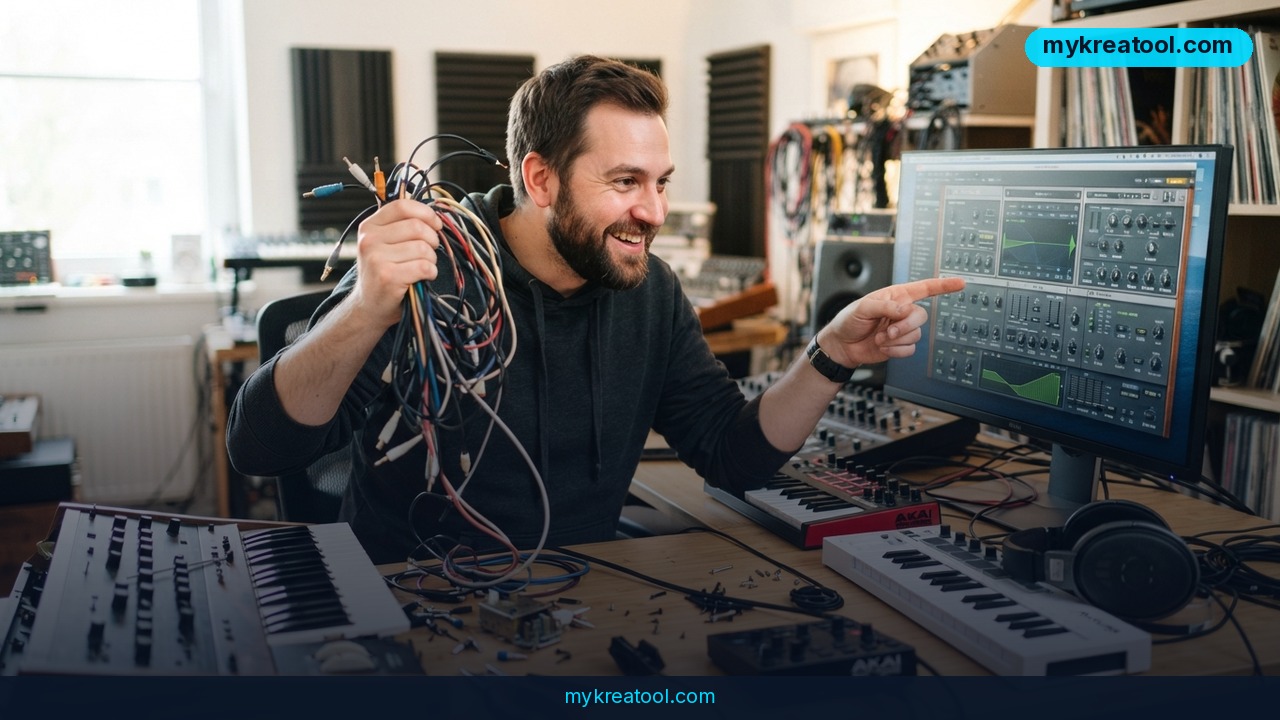
Most people assume that building your own VST plugin takes years of C++ and a deep feel for digital signal processing. A working musician with no coding background just proved that's not the whole story: he built a drone synthesizer with 16 oscillators, a tape delay, and a modular synth engine — by talking to AI in plain language. The strangest part isn't the plugins, though. It's what came next: he wired the system so that a single sentence, like "cold rusty drone at dawn," assembles a working synth patch on its own.
What happened
He's a product guy, not an engineer
He opens his write-up by describing himself as someone who "somehow ended up in IT" — but not as a programmer, and not as an engineer. His experience sits around projects and products: years at a software vendor, watching teams run projects well and, more usefully, watching them run projects badly across very different businesses. He's also a musician who plays his own material live.
Until January 2026, he gigged in the Dawless format — music made on hardware synths with no computer on stage. His set-up was already built, calibrated and learned by heart. Then he had to sell all of it. He doesn't dwell on why; he just says it happened. So he went looking for comfort in Ableton, the music software he's used since he was 17, bought an AKAI APC 40 MK1 controller and started trying to play live again.
That's where the wall appeared. Almost every VST plugin he tried was built for mouse work in a studio: sculpt one perfect sound, automate every detail, hit record. Great for production, useless when you're improvising in front of a room. (VST plugins, if you've never touched one, are virtual instruments and effects that live inside your music software — a whole rack of gear that only exists on your hard drive.)
The magic wand week: 16 oscillators in a day
He installed Claude Code — Anthropic's AI tool that writes and edits code for you — and describes the first few days as being handed a magic wand: pronounce the spell correctly and you get the result. Everything he'd wanted to build but couldn't, because he lacked the skills, was suddenly reachable.
So his first project went straight to the deep end: a drone synthesizer with 16 oscillators, several kinds of mutual modulation, modulation driven by incoming audio, and a full effects block. An oscillator is just a tone generator — picture a guitar string that never stops vibrating. Modulation is one control nudging another. A drone is a sound that holds and evolves instead of playing a melody. Sixteen of those stacked and cross-talking is a lot of noise to wrangle.
It came together in about a day. He tested it, found a few bugs, and wasn't hooked. Then came a tape delay, then a handful of other ideas he can't even place in order anymore.
The big idea: describe a sound, get a synth
Then he aimed much higher: one synthesizer that could generate any sound from a text prompt in an LLM — and not just spit out audio, but actually assemble the patch that matches the description.
That required building blocks: oscillators, LFOs (low-frequency oscillators, the invisible hands that turn knobs for you), envelopes (the shape of a note as it starts, holds and fades), filters, effects. His first module list ran to roughly 40 items.
His workflow is the interesting part. He used DeepSeek to argue about the module list and shape a plan, treating it like a well-read honors student — gets a lot right, can be spectacularly wrong about the big picture. Then Claude tears that work to shreds ("some amateur clearly wrote this") and insists on doing everything differently. Whatever survives the argument becomes the spec.
The architecture flip: sound as a wiring diagram
Here's the real shift. Before, every plugin was a standalone object with a hard-wired sound path. Modules repeated across plugins, but building something new meant starting a new plugin from zero.
He turned that inside out. The sound is no longer described by code — it's described by a patch: which blocks you pick (oscillators, filters, saturation, delays, reverb), how they're wired, and what modulates what. The patch is saved as plain text, a JSON patch. And text is exactly what a language model is good at. So the model can "build a synthesizer" from a phrase like "cold rusty drone at dawn" — all that's missing is an engine that reads the wiring and plays it.
What it means for you
At home
You don't need a wall of hardware to get sounds nobody else has. If you've got a laptop and a music app, the missing piece was always the software — and software is exactly what AI can now write for you. Start with one small idea, like a reverb you actually like, and see how far a weekend takes you.
At work
Prototypes stop waiting in the dev queue. Product people, marketers and solo founders can now build a rough, working version of an audio feature — a demo, an internal tool, a quick answer to "would anyone even want this?" — before a single engineer is booked. That's a very different conversation to walk into a team meeting with.
In business
Niche tools that were never worth a developer's time suddenly pencil out: a small plugin for your own podcast, your course, your clients' video work. If you'd rather test the waters first, there are curated stacks of free AI tools you can play with before committing to anything.
For study
Learning flips direction. Instead of grinding through tutorials for a tool you may never use, you build the thing you actually want and keep asking the model why it made each choice. The DeepSeek-versus-Claude trick is basically a tutor who argues with another tutor — sharp, cheap and awake at 2 a.m.
For creativity and income
Your weird idea gets a shot in a way it never did before. Custom tools for narrow audiences — church sound teams, lo-fi producers, podcast editors — are gaps a big plugin company will never bother filling. One person with taste and a chat window can now cover them.
How to try it right now
Step 1: Draft the idea in a free chat
Open DeepSeek in your browser — the web version is free, and it's the exact tool the author used for planning. Describe what you want in plain English: "a synth that makes cold, metallic drones for ambient sets." Ask it to list the modules you'd need, in order.
Step 2: Make the models fight
Paste that list into Claude and tell it to attack the plan: what's wrong, what's missing, what will fall apart. You'll come out with a sharper spec and fewer blind spots.
Step 3: Start writing code with Claude Code
Install Claude Code and build the smallest possible plugin — one oscillator, one volume control, sound coming out. Getting any audio at all is the first milestone, and don't skip it.
Step 4: Then go big, but only pick one thing
The author's first build was a 16-oscillator drone synth. Yours can be a delay, a filter, or a strange little noise box. Finish one, test it, keep a bug list.
Step 5: Switch to patches
Once you have modules, store sounds as text patches in JSON instead of hard-coding them, and write a small engine that reads a patch and builds the chain. That's the step that lets a sentence turn into a synth.
Step 6: Make it playable live
Map the controls you actually touch to your hardware. The author runs an AKAI APC 40 MK1 with Ableton, and everything he builds faces one test: can he improvise with it on stage?
Upsides and what changes
• Coding stops being the gate. If you can describe a sound and judge it when you hear it, you can build the tool.
• Speed is absurd. A 16-oscillator drone synth with cross-modulation took about a day.
• You get tools shaped around your workflow, instead of bending your performance around plugins designed for studio mouse work.
• Text becomes the interface for sound design. A patch is something you can write, save, share and generate.
• Product thinking becomes the bottleneck, not technical skill — which is very good news if you're the product person.
Limitations
The models can't hear anything, and that's the whole problem. They'll hand you code that runs perfectly and sounds terrible, and they'll do it confidently; architectural mistakes from an LLM can cost you days, which is exactly why the author runs one model against another before writing a line. You still have to learn enough about sound — aliasing, gain staging, why a filter goes squeaky — to know when you're being sold something bad. Each plugin needs testing and bug-fixing, and none of this replaces taste. It just removes the wall that used to sit in front of it.
Conclusion: One Action for Today
The headline here isn't "AI builds synths." It's that the skill gap between wanting a tool and having one just collapsed, and the people who move fastest will be the ones who can describe what they want and tell good sound from bad. So do the smallest version of that today. Open DeepSeek, write one paragraph about the plugin you wish existed, and ask for the five building blocks it would need. One prompt. No code. Then pick the smallest block and build it this weekend.


Comments 0